
[Paper Review] Alternating Gradient Descent and Mixture-of-Experts for Integrated Multimodal Perception
This paper introduces Integrated Multimodal Perception (IMP), a scalable, modality-agnostic training framework that combines Alternating Gradient Descent (AGD) and Mixture-of-Experts (MoE) to unify image, video, text, and audio modeling in a single Transformer encoder. By alternating between diverse tasks, modalities, and resolutions, and using sparse MoE experts, IMP achieves state-of-the-art zero-shot video classification (77.0% on Kinetics-400) with only 15% of the compute of prior models.
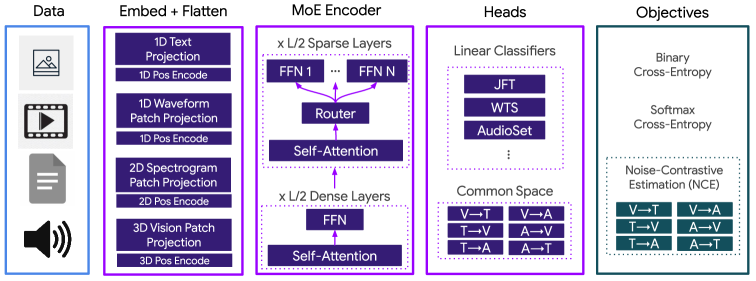
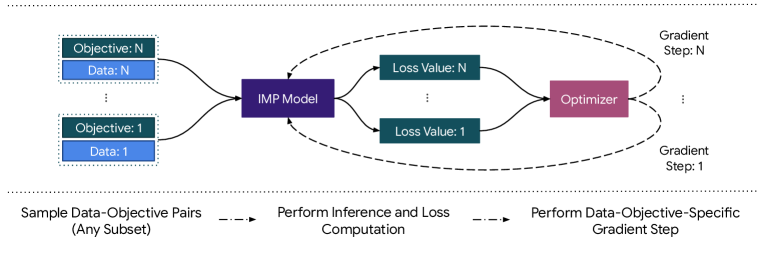
We present Integrated Multimodal Perception (IMP), a simple and scalable multimodal multi-task training and modeling approach. IMP integrates multimodal inputs including image, video, text, and audio into a single Transformer encoder with minimal modality-specific components. IMP makes use of a novel design that combines Alternating Gradient Descent (AGD) and Mixture-of-Experts (MoE) for efficient model and task scaling. We conduct extensive empirical studies and reveal the following key insights: 1) Performing gradient descent updates by alternating on diverse modalities, loss functions, and tasks, with varying input resolutions, efficiently improves the model. 2) Sparsification with MoE on a single modality-agnostic encoder substantially improves the performance, outperforming dense models that use modality-specific encoders or additional fusion layers and greatly mitigates the conflicts between modalities. IMP achieves competitive performance on a wide range of downstream tasks including video classification, image classification, image-text, and video-text retrieval. Most notably, we train a sparse IMP-MoE-L variant focusing on video tasks that achieves new state-of-the-art in zero-shot video classification: 77.0% on Kinetics-400, 76.8% on Kinetics-600, and 68.3% on Kinetics-700, improving the previous state-of-the-art by +5%, +6.7%, and +5.8%, respectively, while using only 15% of their total training computational cost.
Motivation & Objective
- To design a scalable, unified multimodal learning framework that integrates diverse inputs—image, video, text, audio—without modality-specific architectures.
- To address the challenge of training large-scale multimodal models efficiently, avoiding performance degradation and high computational costs.
- To enable seamless integration of new tasks, datasets, and loss functions without retraining or architectural redesign.
- To improve model generalization and parameter efficiency by combining AGD for task alternation and MoE for sparse expert routing.
- To achieve state-of-the-art performance in multimodal understanding, especially in zero-shot video action recognition.
Proposed method
- The model uses a single, shared Transformer encoder with no modality-specific encoders, enabling modality-agnostic learning.
- Alternating Gradient Descent (AGD) is applied by cycling through different modalities, tasks, and loss functions during training to improve convergence and generalization.
- The training dynamically alternates between varying input resolutions, sequence lengths, and batch sizes to maintain efficiency and stability.
- Mixture-of-Experts (MoE) is applied to the unified encoder, allowing sparse activation of experts per token to scale model capacity without proportional compute cost.
- JAX primitives are used to implement efficient MoE and AGD training, enabling high throughput and low memory overhead.
- The model is trained using a combination of contrastive losses (image-text, video-text, video-audio) and classification heads across modalities.
Experimental results
Research questions
- RQ1Can alternating gradient descent across diverse modalities and tasks improve convergence and generalization in multimodal learning?
- RQ2Does a unified, modality-agnostic encoder with Mixture-of-Experts outperform multi-tower or modality-specific architectures in performance and efficiency?
- RQ3Can sparse MoE routing effectively resolve parameter bottlenecks in unified multimodal encoders while maintaining accuracy across modalities?
- RQ4To what extent does AGD enable incremental scaling of tasks and datasets without compromising training efficiency?
- RQ5Can a single sparse model achieve state-of-the-art performance in zero-shot video understanding with significantly reduced compute?
Key findings
- The IMP-MoE-L model achieves 77.0% zero-shot accuracy on Kinetics-400, a +5.0% improvement over the previous SOTA, using only 15% of the training compute.
- On Kinetics-600, IMP-MoE-L achieves 76.8% accuracy, a +6.7% improvement over prior methods, with the same low compute cost.
- On Kinetics-700, the model reaches 68.3% zero-shot accuracy, a +5.8% improvement, demonstrating strong generalization to larger action sets.
- MoE with just 4 experts improves zero-shot image classification accuracy significantly, and scaling to 16 experts yields consistent gains across all downstream tasks.
- The single-tower MoE model is both more parameter-efficient and compute-efficient than multi-tower dense models, outperforming them in accuracy while using fewer parameters.
- MoE effectively mitigates modality interference, reducing the negative impact of adding audio on image and video performance compared to dense baselines.
Read this paper
Open the full text in the Nubint reader and ask about any passage as you read.
Read this paper on NubintThis review was generated by AI from the original paper. Please check the paper before citing it.