
[Paper Review] Amazing Things Come From Having Many Good Models
The paper argues that real-world tabular datasets often admit many equally good models (the Rashomon Effect), enabling simple, interpretable models to match black-box performance and enabling interactive, multi-objective model selection.
The Rashomon Effect, coined by Leo Breiman, describes the phenomenon that there exist many equally good predictive models for the same dataset. This phenomenon happens for many real datasets and when it does, it sparks both magic and consternation, but mostly magic. In light of the Rashomon Effect, this perspective piece proposes reshaping the way we think about machine learning, particularly for tabular data problems in the nondeterministic (noisy) setting. We address how the Rashomon Effect impacts (1) the existence of simple-yet-accurate models, (2) flexibility to address user preferences, such as fairness and monotonicity, without losing performance, (3) uncertainty in predictions, fairness, and explanations, (4) reliable variable importance, (5) algorithm choice, specifically, providing advanced knowledge of which algorithms might be suitable for a given problem, and (6) public policy. We also discuss a theory of when the Rashomon Effect occurs and why. Our goal is to illustrate how the Rashomon Effect can have a massive impact on the use of machine learning for complex problems in society.
Motivation & Objective
- Motivate the Rashomon Effect as a common phenomenon in real-world datasets, especially noisy tabular data.
- Show that many good models exist and can be simpler yet accurate.
- Argue that embracing multiple good models enables flexibility for fairness, monotonicity, and other constraints.
- Propose computing and interacting with the Rashomon set to address uncertainty, variable importance, and policy implications.
Proposed method
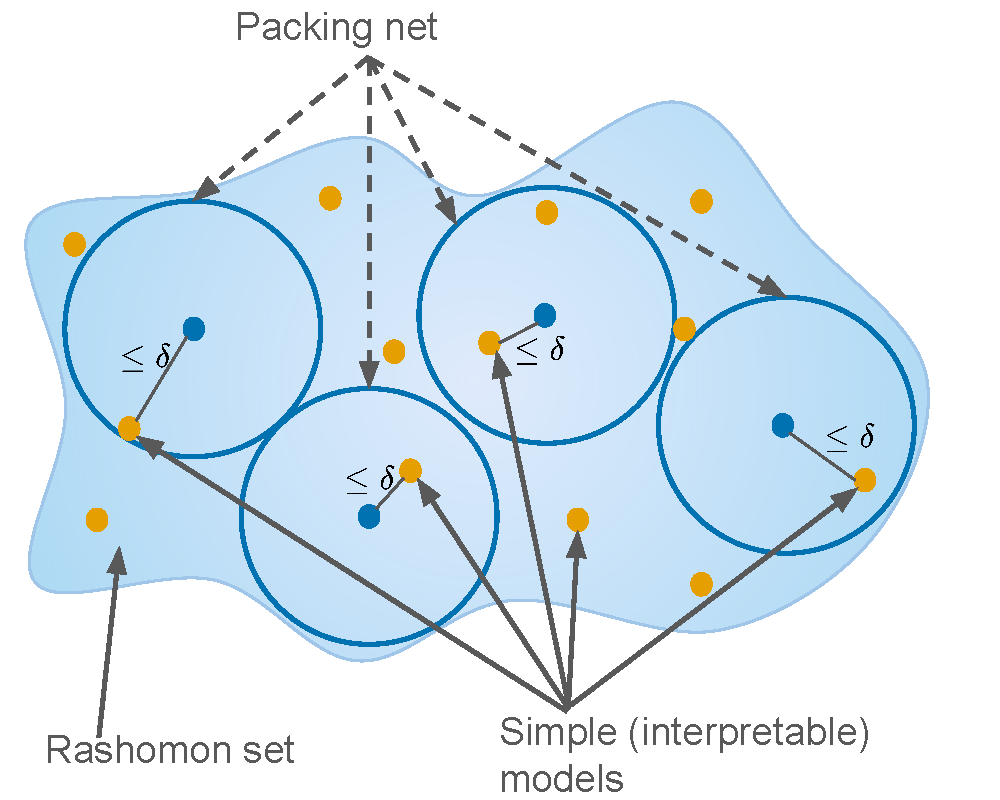
- Define and motivate the Rashomon set as the collection of models with approximately optimal performance within a function class.
- Empirically illustrate Rashomon sets on the FICO dataset across diverse model classes.
- Discuss theoretical results showing that large Rashomon sets imply existence of simpler models with comparable accuracy.
- Describe algorithms (TreeFARMS, GAM Rashomon set, FasterRisk) to enumerate or sample Rashomon sets for interpretable models.
- Demonstrate interactive tools (TimberTrek, GAMChanger) to explore Rashomon sets and satisfy user constraints.
Experimental results
Research questions
- RQ1Do real-world tabular datasets admit many equally good models across different functional forms?
- RQ2Can simpler models within the Rashomon set achieve performance comparable to complex models on noisy data?
- RQ3How can the Rashomon set support fairness, monotonicity, and other domain-specific constraints without sacrificing accuracy?
- RQ4How can stable variable importance be computed across all good models?
- RQ5What is the policy and practical impact of adopting Rashomon-set guided modeling for high-stakes decisions?
Key findings
- Multiple model classes (trees, SVMs, logistic regression, GAMs, neural nets) achieve comparable test performance on the same dataset, illustrating the Rashomon Effect.
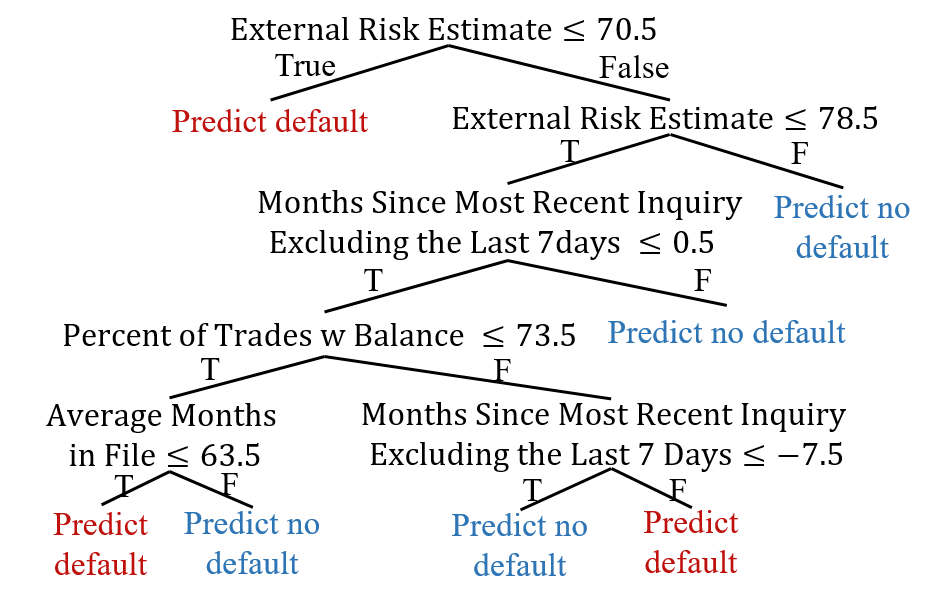
- There exist simpler models within the Rashomon set that match the accuracy of complex models (e.g., a 7-leaf sparse decision tree and a sparse GAM achieve near-peak performance on FICO).
- Variable importance varies across good models, indicating no single variable dominates all good models.
- Interactive Rashomon-set tools enable alignment with domain knowledge and constraints in real time, addressing the interaction bottleneck.
- Stable variable importance can be improved by the Rashomon Importance Distribution, accounting for bootstrapping and model multiplicity.
- The choice of algorithm should consider outcome noise; simpler, interpretable models often perform as well as black-box models on noisy tabular data.
Read this paper
Open the full text in the Nubint reader and ask about any passage as you read.
Read this paper on NubintThis review was generated by AI from the original paper. Please check the paper before citing it.