
[Paper Review] Ambient Diffusion: Learning Clean Distributions from Corrupted Data
A diffusion-based framework learns the distribution of clean data using only highly corrupted samples by injecting extra measurement distortion during diffusion, enabling sampling from the true distribution without clean data.
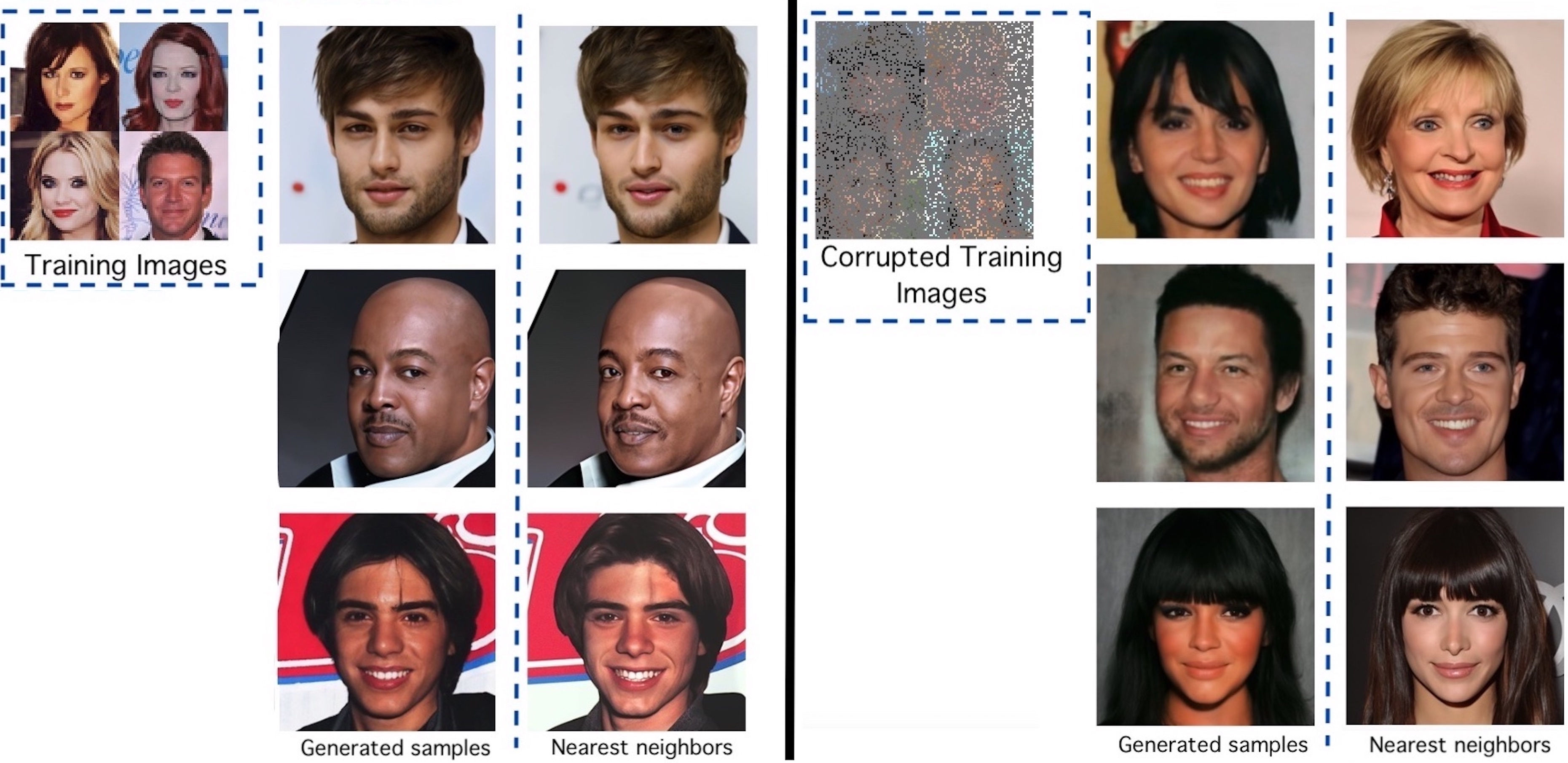
We present the first diffusion-based framework that can learn an unknown distribution using only highly-corrupted samples. This problem arises in scientific applications where access to uncorrupted samples is impossible or expensive to acquire. Another benefit of our approach is the ability to train generative models that are less likely to memorize individual training samples since they never observe clean training data. Our main idea is to introduce additional measurement distortion during the diffusion process and require the model to predict the original corrupted image from the further corrupted image. We prove that our method leads to models that learn the conditional expectation of the full uncorrupted image given this additional measurement corruption. This holds for any corruption process that satisfies some technical conditions (and in particular includes inpainting and compressed sensing). We train models on standard benchmarks (CelebA, CIFAR-10 and AFHQ) and show that we can learn the distribution even when all the training samples have $90\%$ of their pixels missing. We also show that we can finetune foundation models on small corrupted datasets (e.g. MRI scans with block corruptions) and learn the clean distribution without memorizing the training set.
Motivation & Objective
- Motivate learning a data distribution when uncorrupted samples are unavailable or expensive.
- Develop a diffusion framework that uses corrupted data to learn the conditional expectation of the clean data.
- Provide theoretical guarantees for learning from corrupted measurements under general corruption processes.
- Demonstrate practical effectiveness on standard benchmarks and real-world corrupted datasets.
- Show finetuning of foundation diffusion models on small corrupted datasets while mitigating memorization.
Proposed method
- Introduce additional measurement distortion during diffusion and train to predict the original corrupted image from the further corrupted image.
- Train a score-network h_theta that, given a further corrupted input and A, estimates E[x0 | Ãx_t, Ã].
- Use a training objective J_corr(theta) that minimizes ||A(h_theta(Ã, Ãx_t, t) - x0)||^2 across (x0, x_t, A, Ã).
- Apply the theory showing the optimal model recovers E[x0 | Ãx_t, Ã] under broad corruption settings with full-rank A^T A conditional on Ã.
- Perform sampling by approximating E[x0 | x_t] with E[x0 | Ãx_t, Ã] for chosen A and Ã, enabling practical generation.
- Enhance sampling with Reconstruction Guidance to enforce consistency across masks during diffusion.
Experimental results
Research questions
- RQ1Can we learn the conditional expectation E[x0 | y_t, A] when only corrupted measurements y0 = Ax0 are available?
- RQ2If so, can we use the learned restoration to approximate E[x0 | x_t] and sample from the true distribution without clean data?
- RQ3How does introducing a small amount of additional corruption à during training affect the learned distribution and memorization in finetuned models?
- RQ4What is the performance trade-off between corruption level and generator quality across standard benchmarks?
- RQ5Can the method finetune foundation diffusion models on small corrupted datasets (e.g., medical images) while avoiding memorization?
Key findings
- The method learns the conditional expectation E[x0 | Ãx_t, Ã] under general corruption A and Ã, with minimal additional distortion (delta can be small but positive).
- Diffusion models trained on corrupted data can produce samples close to the clean distribution, outperforming AmbientGAN and baselines in many settings.
- In experiments on CelebA-HQ, AFHQ, and CIFAR-10, the approach yields reasonable generation quality even with up to 90% missing pixels (as measured by FID and Inception Scores).
- The learned restoration enables competitive or superior performance on inverse problems with far fewer sampling steps compared to baselines requiring hundreds of steps.
- Finetuning pre-trained diffusion models on highly corrupted data reduces memorization, demonstrated by lower similarity of generated samples to training images, while enabling domain transfer (e.g., brain MRI).
- Code and models are open-sourced (GitHub link provided in the paper).

Read this paper
Open the full text in the Nubint reader and ask about any passage as you read.
Read this paper on NubintThis review was generated by AI from the original paper. Please check the paper before citing it.