
[Paper Review] Amortized Planning with Large-Scale Transformers: A Case Study on Chess
The paper trains a 270M-parameter transformer on 10M chess games with Stockfish-annotated action-values to produce a strong, search-free chess policy that reaches grandmaster-level play and outperforms several baselines. Model and data scaling are key for strong performance.
This paper uses chess, a landmark planning problem in AI, to assess transformers' performance on a planning task where memorization is futile $\unicode{x2013}$ even at a large scale. To this end, we release ChessBench, a large-scale benchmark dataset of 10 million chess games with legal move and value annotations (15 billion data points) provided by Stockfish 16, the state-of-the-art chess engine. We train transformers with up to 270 million parameters on ChessBench via supervised learning and perform extensive ablations to assess the impact of dataset size, model size, architecture type, and different prediction targets (state-values, action-values, and behavioral cloning). Our largest models learn to predict action-values for novel boards quite accurately, implying highly non-trivial generalization. Despite performing no explicit search, our resulting chess policy solves challenging chess puzzles and achieves a surprisingly strong Lichess blitz Elo of 2895 against humans (grandmaster level). We also compare to Leela Chess Zero and AlphaZero (trained without supervision via self-play) with and without search. We show that, although a remarkably good approximation of Stockfish's search-based algorithm can be distilled into large-scale transformers via supervised learning, perfect distillation is still beyond reach, thus making ChessBench well-suited for future research.
Motivation & Objective
- Investigate whether supervised learning at scale can yield a high-quality chess policy without explicit search.
- Quantify how model size and dataset size affect chess performance.
- Compare transformer-based policies to strong baselines (Stockfish, AlphaZero variants, GPT-3.5) across multiple metrics.
Proposed method
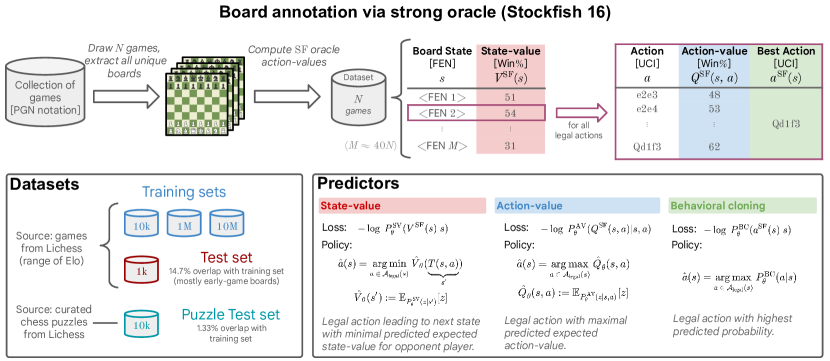
- Train decoder-only transformers of 9M, 136M, and 270M parameters on 10 million annotated chess games.
- Annotate boards with Stockfish 16 state- and action-values using 50ms per board; create large action-value datasets (~15.32B).
- Predict discrete bins of win-probability for state-action pairs (action-value prediction) or state-values, or directly imitate oracle actions (behavioral cloning).
- Tokenize boards via FEN to 77-character strings; tokenized actions via 1968 possible legal moves; train with cross-entropy loss using Adam for 10 million steps.
- Construct policies by selecting actions that maximize predicted value (AV), minimize predicted opponent value (SV), or maximize predicted action probability (BC).
- Evaluate with action accuracy, Kendall’s tau ranking, puzzle accuracy on 10k puzzles, and Elo-based play against humans and bots.
Experimental results
Research questions
- RQ1Can a large-scale, supervised transformer learn a competitive chess policy without explicit search?
- RQ2How do model size and training data scale affect generalization to unseen positions and puzzle-solving ability?
- RQ3How does a Stockfish-annotated, data-driven policy compare to established baselines like AlphaZero and GPT-3.5 in play and puzzle-solving?
- RQ4What ablations reveal about the importance of targets, data sampling, value binning, and loss choice in this setup.
Key findings
- A 270M-parameter transformer achieves a Lichess blitz Elo of 2895 against humans.
- Larger models consistently improve performance across metrics (9M, 136M, 270M).
- The model outperforms AlphaZero’s policy and value networks (without MCTS) and GPT-3.5-turbo-instruct on several benchmarks.
- Puzzle solving is strongest for the 270M model, approaching Stockfish performance on curated puzzles, with Stockfish leading but our model competitive.
- Action-value prediction yields the best overall ranking and puzzle accuracy among predictor targets; scale and data diversity are crucial.
- Robust generalization emerges only at sufficient scale of both model size and dataset size.

Read this paper
Open the full text in the Nubint reader and ask about any passage as you read.
Read this paper on NubintThis review was generated by AI from the original paper. Please check the paper before citing it.