
[Paper Review] An Alternative to WSSS? An Empirical Study of the Segment Anything Model (SAM) on Weakly-Supervised Semantic Segmentation Problems
The paper investigates using the Segment Anything Model (SAM) as a pseudo-label generator for weakly-supervised semantic segmentation, comparing it to traditional WSSS methods on PASCAL VOC and MS-COCO. It analyzes performance, limitations, and practical implications.
The Segment Anything Model (SAM) has demonstrated exceptional performance and versatility, making it a promising tool for various related tasks. In this report, we explore the application of SAM in Weakly-Supervised Semantic Segmentation (WSSS). Particularly, we adapt SAM as the pseudo-label generation pipeline given only the image-level class labels. While we observed impressive results in most cases, we also identify certain limitations. Our study includes performance evaluations on PASCAL VOC and MS-COCO, where we achieved remarkable improvements over the latest state-of-the-art methods on both datasets. We anticipate that this report encourages further explorations of adopting SAM in WSSS, as well as wider real-world applications.
Motivation & Objective
- Explore whether SAM can serve as a pseudo-label generator for image-level WSSS using only class labels.
- Assess SAM-based pseudo-label quality against state-of-the-art WSSS methods on standard datasets.
- Identify limitations of SAM in WSSS, including semantic obscurity and practical deployment considerations.
- Provide guidance on when a SAM-driven WSSS pipeline is advantageous in real-world settings.
Proposed method
- Use Grounded-DINO to convert image-level class labels into grounded bounding boxes via text prompts.
- Feed the grounded boxes into SAM (ViT-H) to obtain instance segmentation masks.
- Combine SAM masks to produce semantic segmentation pseudo-labels for training.
- Evaluate pseudo-label quality and downstream segmentation with DeepLab-v2 (ResNet-101) on PASCAL VOC and MS-COCO.
- Compare SAM-based pseudo-labels and final segmentation against a range of previous WSSS methods and full supervision.
- Discuss practical considerations including computational costs and data-ground-truth alignment.
Experimental results
Research questions
- RQ1Can SAM, guided by text-grounded prompts, generate high-quality pseudo-labels for WSSS without fine-tuning?
- RQ2How does SAM-based pseudo-labeling compare to state-of-the-art WSSS methods on PASCAL VOC and MS-COCO?
- RQ3What are the practical limitations (e.g., semantic obscurity, resource requirements) of using SAM in WSSS?
- RQ4Can SAM approach approach fully-supervised segmentation performance on standard benchmarks?
Key findings
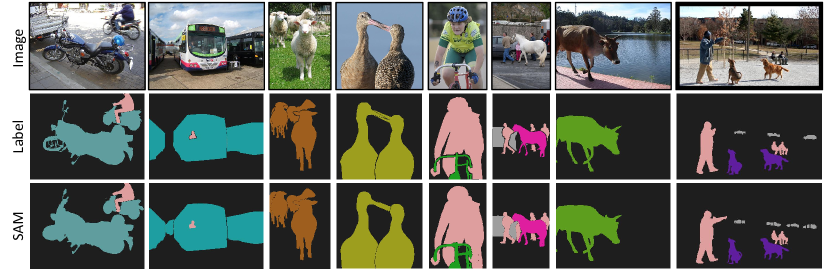
- SAM pseudo-labels achieve 88.3 mIoU on PASCAL VOC train, outperforming prior WSSS methods by 13.3 mIoU.
- SAM-based final segmentation reaches 77.2 mIoU (val) and 77.1 mIoU (test) on PASCAL VOC, surpassing prior SOTA methods.
- On MS-COCO, SAM achieves a pseudo-label mIoU of 66.8 and final segmentation 55.6 mIoU, significantly outperforming existing WSSS methods.
- SAM demonstrates competitive performance without fine-tuning, highlighting its potential as a foundation-model-based WSSS alternative.
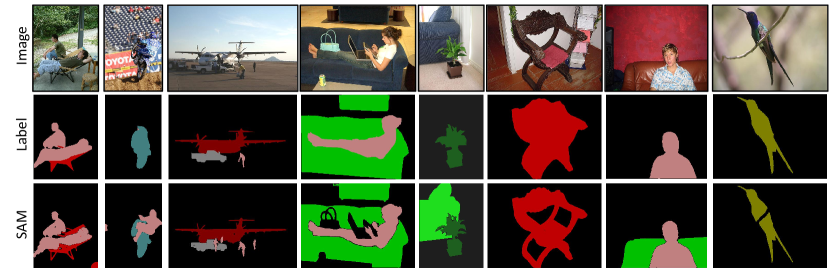
- The study notes semantic obscurity as a limitation, where SAM’s granularity may differ from human annotations, suggesting hierarchical prompts as future work.
- SAM is not a strict fair comparison to WSSS (since it is trained on large-scale, potentially fully-labeled data), but offers a practical, streamlined WSSS alternative.
Read this paper
Open the full text in the Nubint reader and ask about any passage as you read.
Read this paper on NubintThis review was generated by AI from the original paper. Please check the paper before citing it.