
[Paper Review] An Edge-Computing based Industrial Gateway for Industry 4.0 using ARM TrustZone Technology
This paper proposes an edge-computing based Industrial Gateway (EC-IG) architecture leveraging ARM TrustZone to secure vertical and horizontal integration in Industry 4.0, and demonstrates a prototype for remote production-line maintenance.
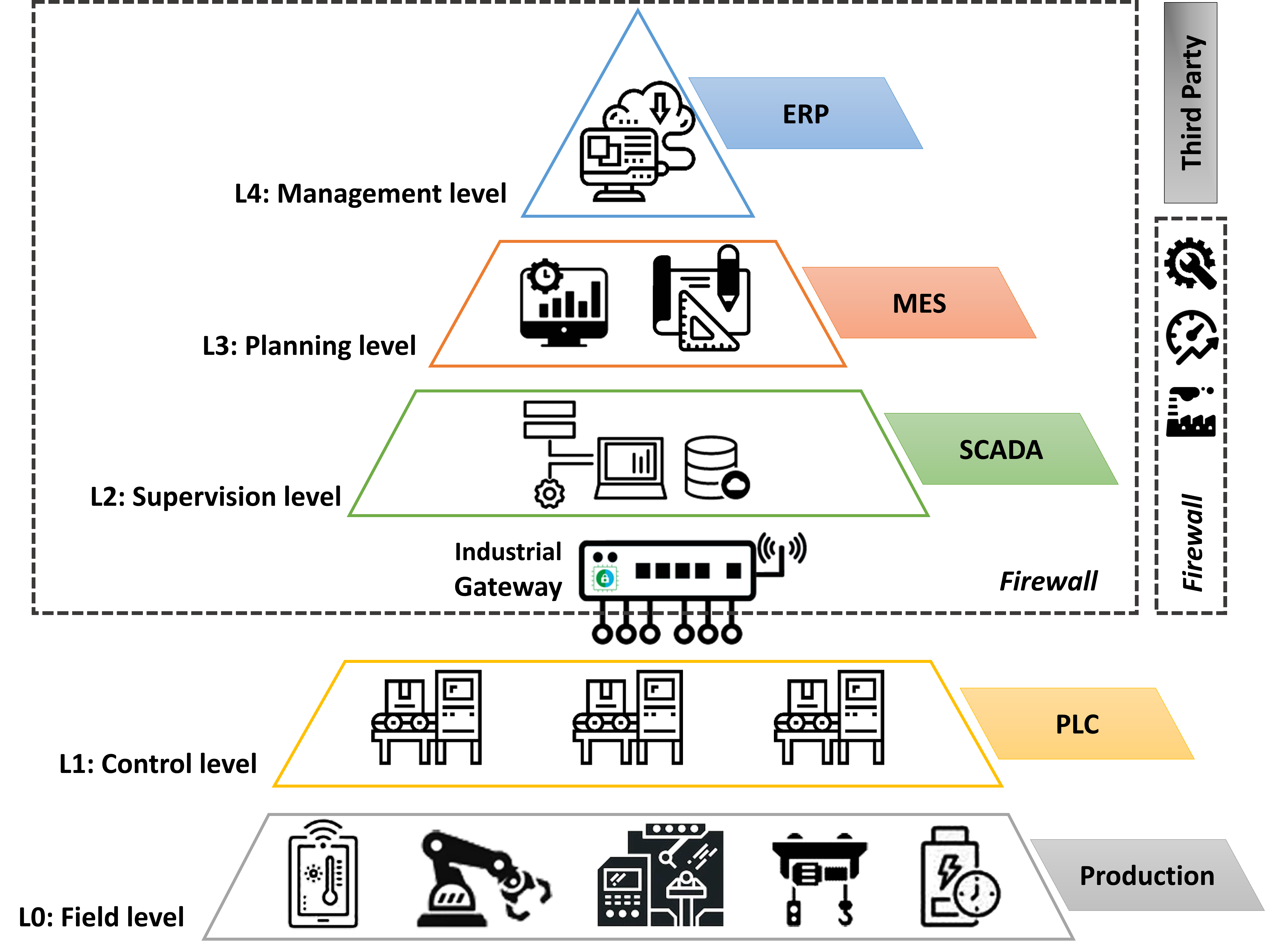
Secure and efficient communication to establish a seamless nexus between the five levels of a typical automation pyramid is paramount to Industry 4.0. Specifically, vertical and horizontal integration of these levels is an overarching requirement to accelerate productivity and improve operational activities. Vertical integration can improve visibility, flexibility, and productivity by connecting systems and applications. Horizontal integration can provide better collaboration and adaptability by connecting internal production facilities, multi-site operations, and third-party partners in a supply chain. In this paper, we propose an Edge-computing-based Industrial Gateway for interfacing information technology and operational technology that can enable Industry 4.0 vertical and horizontal integration. Subsequently, we design and develop a working prototype to demonstrate a remote production-line maintenance use case with a strong focus on security aspects and the edge paradigm to bring computational resources and data storage closer to data sources.
Motivation & Objective
- Motivate secure, scalable vertical and horizontal integration across the Industry 4.0 automation pyramid.
- Propose an edge-centric Industrial Gateway (EC-IG) architecture to bring computation and storage close to data sources.
- Evaluate security-focused design principles, including TrustZone-based isolation and threat profiling, in a working prototype.
Proposed method
- Design an EC-IG architecture that interfaces Level 0/1 with Levels 2–4 and third parties.
- Implement a prototype on OP-TEE enabled QEMU targeting Armv8-A to demonstrate secure edge processing.
- Utilize ARM TrustZone to provide a Secure World for security-sensitive tasks and a Normal World for regular operations.
- Apply threat modeling (STRIDE) and boundary protection concepts to define security requirements and risk mitigation.
- Describe an intelligent threat profiling mechanism to aid auditing and intrusion detection.
Experimental results
Research questions
- RQ1How can ARM TrustZone-based isolation be used to secure edge gateways interfacing IT and OT in Industry 4.0?
- RQ2What design principles and architectural components are needed to achieve secure vertical and horizontal integration via an edge gateway?
- RQ3Can a working EC-IG prototype effectively support remote production-line maintenance with secure data handling and access control?
- RQ4What threat model and audit mechanisms are suitable for EC-IG in IIoT contexts?
Key findings
- A secure edge gateway architecture is feasible for Industry 4.0 by combining a Secure World (TEE) with a Normal World (REE).
- Threat modeling and boundary protection can guide the design of secure IT/OT interconnections for remote maintenance.
- An OP-TEE based prototype demonstrates the practical feasibility of EC-IG for remote diagnostics, firmware management, and threat profiling.
- Audit trails and threat profiles are integrated to support monitoring and forensics in edge environments.
- The architecture supports data filtration, secure communication, and bidirectional channels with PLCs, SCADA/MES, and cloud services.
- TrustZone-based isolation helps protect confidentiality, integrity, and availability of security-sensitive operations in the gateway.
Read this paper
Open the full text in the Nubint reader and ask about any passage as you read.
Read this paper on NubintThis review was generated by AI from the original paper. Please check the paper before citing it.