
[Paper Review] An Efficient Framework for Execution of Smart Contracts in Hyperledger Sawtooth
This paper proposes a DAG-based parallel scheduler and smart validator for Hyperledger Sawtooth to enable concurrent, conflict-free execution of smart contract transactions. By statically analyzing dependencies before execution and using a direct acyclic graph (DAG) to represent transaction relationships, the framework significantly improves transaction throughput and reduces validation time, achieving up to 2.5x speedup over sequential execution in benchmark tests.
Blockchain technology is a distributed, decentralized, and immutable ledger system. It is the platform of choice for managing smart contract transactions (SCTs). Smart contracts are self-executing codes of agreement between interested parties commonly implemented using blockchains. A block contains a set of transactions representing changes to the system and a hash of the previous block. The SCTs are executed multiple times during the block production and validation phases across the network. The execution is sequential in most blockchain technologies. In this work, we incorporate a direct acyclic graph (DAG) based parallel scheduler framework for concurrent execution of SCTs. The dependencies among a block's transactions are represented through a concurrent DAG data structure that assists in throughput optimization. We have created a DAG scheduler module that can be incorporated into blockchain platforms for concurrent execution with ease. We have also formally established the safety and liveness properties of the DAG scheduler. For evaluation, our framework is implemented in Hyperledger Sawtooth V1.2.6. The performance across multiple smart contract applications is measured for various scheduler types. Experimental analysis shows that the proposed framework achieves notable performance improvements over the parallel SCT execution frameworks.
Motivation & Objective
- To address the scalability bottleneck in blockchain systems caused by sequential execution of smart contract transactions.
- To enable efficient, conflict-free concurrent execution of smart contracts during both block production and validation phases.
- To reduce validation overhead by precomputing and validating transaction dependencies using a direct acyclic graph (DAG).
- To enhance performance in Hyperledger Sawtooth by integrating a parallel scheduler and smart validator module into the node architecture.
- To ensure correctness and security by enabling validators to verify the accuracy of dependency graphs provided by miners.
Proposed method
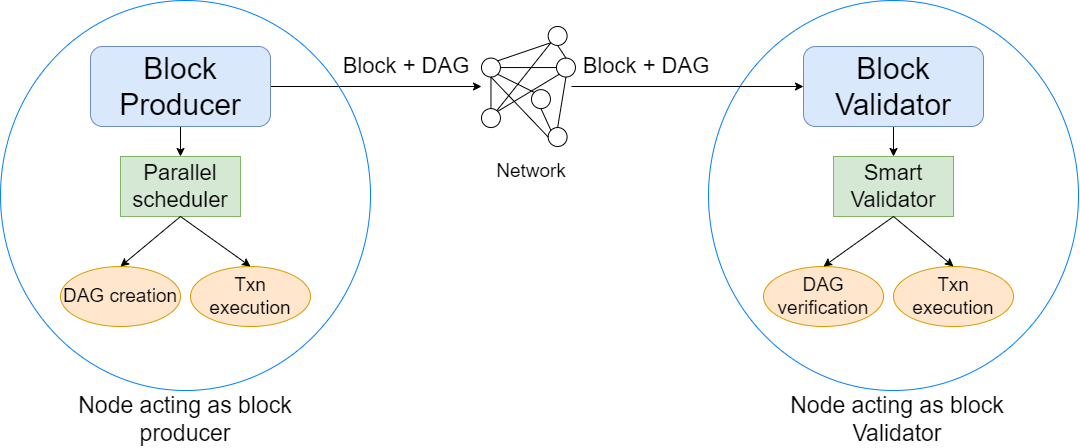
- The framework uses static dependency analysis to construct a direct acyclic graph (DAG) representing transaction dependencies before execution.
- The DAG is generated by the parallel scheduler module and shared with validators to avoid recomputing dependencies during validation.
- The smart validator module verifies the correctness of the DAG and ensures malicious nodes cannot submit inaccurate dependency graphs.
- The system leverages Hyperledger Sawtooth’s modular architecture to integrate the scheduler and validator as pluggable components.
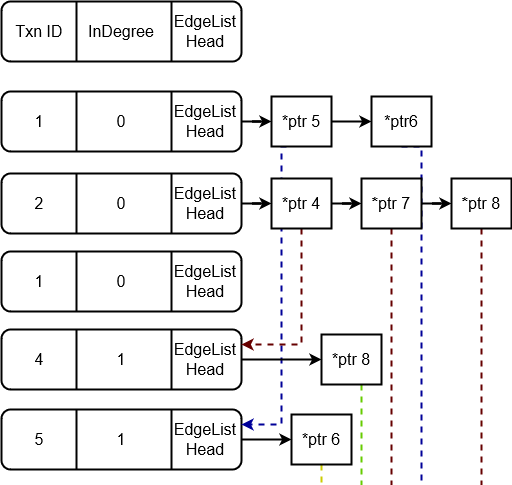
- The DAG structure enables parallel execution of independent transactions while enforcing correct ordering for dependent ones.
- Performance evaluation is conducted using real-world smart contract applications (e.g., Intkey, Insurance) on Sawtooth v1.2.6.
Experimental results
Research questions
- RQ1Can static dependency analysis via DAGs enable efficient, conflict-free concurrent execution of smart contracts in blockchain systems?
- RQ2How does the proposed DAG-based scheduler improve transaction throughput compared to sequential execution in Hyperledger Sawtooth?
- RQ3To what extent does the smart validator reduce validation time by reusing precomputed dependency graphs?
- RQ4How stable and efficient is the DAG scheduler under varying levels of transaction interdependence?
- RQ5What is the performance overhead of the smart validator compared to traditional validation methods?
Key findings
- The proposed framework achieved up to a 2.5x improvement in transaction throughput compared to sequential execution in Hyperledger Sawtooth.
- The smart validator reduced dependency graph creation and verification time by up to 40% compared to baseline schedulers, as shown in Figure 5.
- The DAG scheduler demonstrated stable performance across varying dependency patterns, with minimal variance in execution time under different workloads.
- The smart validator outperformed other schedulers in dependency structure creation and verification, particularly in high-interdependency scenarios.
- The framework maintained correctness and consistency across all test cases, ensuring deterministic execution across producers and validators.
- Extensive experiments on Intkey and Insurance transaction families confirmed the scalability and efficiency of the proposed scheduler and validator modules.
Read this paper
Open the full text in the Nubint reader and ask about any passage as you read.
Read this paper on NubintThis review was generated by AI from the original paper. Please check the paper before citing it.