
[Paper Review] An Empirical Study of Catastrophic Forgetting in Large Language Models During Continual Fine-tuning
The paper empirically analyzes catastrophic forgetting (CF) in LLMs during continual instruction tuning, finding CF across domain knowledge, reasoning, and reading comprehension, mitigated somewhat by model architecture and general instruction tuning.
Catastrophic forgetting (CF) is a phenomenon that occurs in machine learning when a model forgets previously learned information while acquiring new knowledge for achieving a satisfactory performance in downstream tasks. As large language models (LLMs) have demonstrated remarkable performance, it is intriguing to investigate whether CF exists during the continual instruction tuning of LLMs. This study empirically evaluates the forgetting phenomenon in LLMs' knowledge during continual instruction tuning from the perspectives of domain knowledge, reasoning, and reading comprehension. The experiments reveal that catastrophic forgetting is generally observed in LLMs ranging from 1b to 7b parameters. Surprisingly, as the model scale increases, the severity of forgetting intensifies in such a model sale range which may result from the much significant initial performance in the larger LLM. Comparing the decoder-only model BLOOMZ with the encoder-decoder model mT0, BLOOMZ exhibits less forgetting and retains more knowledge. Interestingly, we also observe that LLMs can mitigate language biases, such as gender bias, during continual fine-tuning. Furthermore, our findings indicate that general instruction tuning can help alleviate the forgetting phenomenon in LLMs during subsequent fine-tuning.
Motivation & Objective
- Investigate whether general knowledge stored in LLMs is forgotten during continual instruction tuning.
- Identify which knowledge types (domain knowledge, reasoning, reading comprehension) forget more or less.
- Examine how model scale and architecture affect forgetting.
- Assess whether general instruction tuning mitigates forgetting.
- Evaluate biases during continual fine-tuning to see if they are mitigated or amplified.
Proposed method
- Define a sequence of generation tasks (Simp, Emdg, InqQG, Exp, HGen) to simulate continual instruction tuning.
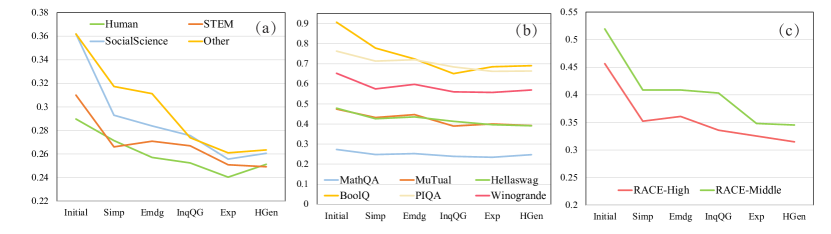
- Use FLOSS evaluation across multiple knowledge tasks: domain knowledge (MMLU), reasoning (BoolQ, PIQA, Hellaswag, etc.), reading comprehension (RACE), and bias (CrowSPairs).
- Measure forgetting with FG = average over evaluation sets of (R_o - R_m)/R_o, where R_o is initial performance and R_m is performance after m tasks.
- Compare decoder-only BLOOMZ with encoder-decoder mT0 to assess architectural effects on forgetting.
- Incorporate LLAMA and ALPACA to study effects of general instruction tuning on forgetting.
- Train BLOOMZ variants at scales 1.1B, 1.7B, 3B, 7.1B and compare with mT0-1.2B/3.7B and LLAMA-7B/ALPACA-7B.
Experimental results
Research questions
- RQ1Does catastrophic forgetting occur in generative LLMs during continual instruction tuning?
- RQ2What types of general knowledge (domain knowledge, reasoning, reading comprehension) are most affected by forgetting?
- RQ3How does model scale influence forgetting severity?
- RQ4How does model architecture (decoder-only vs encoder-decoder) affect forgetting?
- RQ5Can general instruction tuning mitigate forgetting during further fine-tuning?
- RQ6How are biases affected during continual fine-tuning?
Key findings
- CF exists across tested models and tasks during continual instruction tuning.
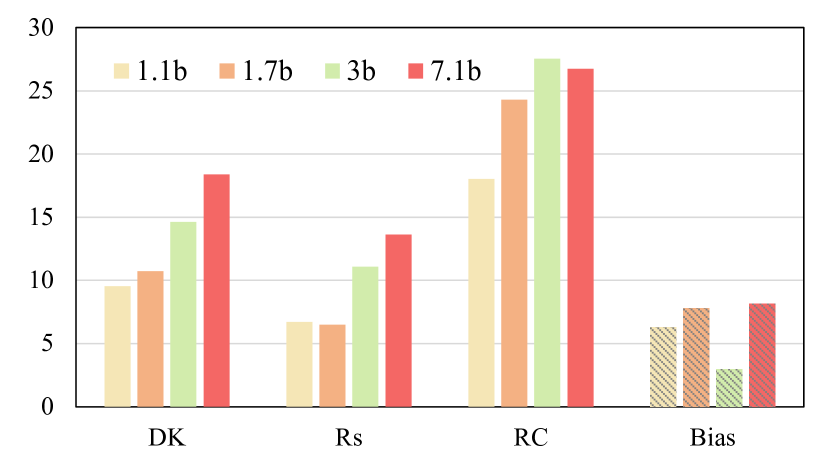
- Forgetting generally increases with model scale, especially in domain knowledge and reading comprehension.
- Decoder-only BLOOMZ tends to forget less than encoder-decoder mT0 at comparable scales."
- General instruction tuning (ALPACA, LLAMA+ALPACA) can help mitigate forgetting in subsequent fine-tuning, depending on initial performance.
- Bias measures show mitigation of some biases during continual tuning, indicating a bias-reduction effect.
- Reading comprehension shows the strongest forgetting among the evaluated domains (e.g., large FG values at higher scales).
Read this paper
Open the full text in the Nubint reader and ask about any passage as you read.
Read this paper on NubintThis review was generated by AI from the original paper. Please check the paper before citing it.