
[Paper Review] An Empirical Study of Training End-to-End Vision-and-Language Transformers
This paper introduces Meter, a framework for end-to-end training of vision-and-language transformers using vision transformers (ViTs) as image encoders. Through systematic ablation across vision encoders, text encoders, fusion modules, and pre-training objectives, Meter achieves 77.64% accuracy on VQAv2 using only 4M images—surpassing state-of-the-art region-based models by 1.04% and prior fully transformer-based models by 1.6%.
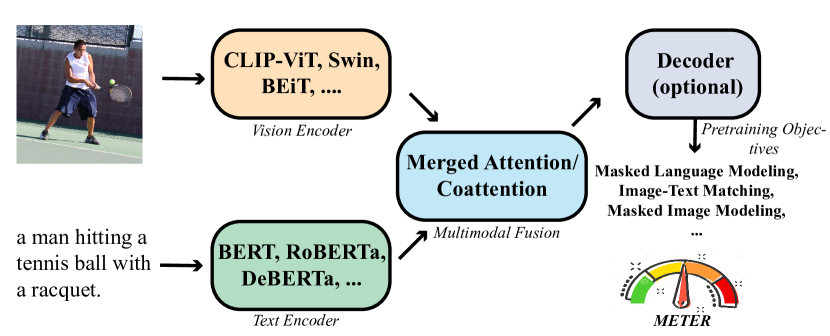
Vision-and-language (VL) pre-training has proven to be highly effective on various VL downstream tasks. While recent work has shown that fully transformer-based VL models can be more efficient than previous region-feature-based methods, their performance on downstream tasks often degrades significantly. In this paper, we present METER, a Multimodal End-to-end TransformER framework, through which we investigate how to design and pre-train a fully transformer-based VL model in an end-to-end manner. Specifically, we dissect the model designs along multiple dimensions: vision encoders (e.g., CLIP-ViT, Swin transformer), text encoders (e.g., RoBERTa, DeBERTa), multimodal fusion module (e.g., merged attention vs. co-attention), architectural design (e.g., encoder-only vs. encoder-decoder), and pre-training objectives (e.g., masked image modeling). We conduct comprehensive experiments and provide insights on how to train a performant VL transformer. METER achieves an accuracy of 77.64% on the VQAv2 test-std set using only 4M images for pre-training, surpassing the state-of-the-art region-feature-based model by 1.04%, and outperforming the previous best fully transformer-based model by 1.6%. Notably, when further scaled up, our best VQA model achieves an accuracy of 80.54%. Code and pre-trained models are released at https://github.com/zdou0830/METER.
Motivation & Objective
- To close the performance gap between region-feature-based and fully transformer-based vision-and-language pre-training models.
- To investigate how to effectively design and pre-train end-to-end vision-and-language transformers using vision transformers (ViTs) as image encoders.
- To identify optimal architectural components and pre-training objectives for high-performing end-to-end VL models.
- To demonstrate that ViT-based models can outperform region-based models when properly designed and pre-trained.
Proposed method
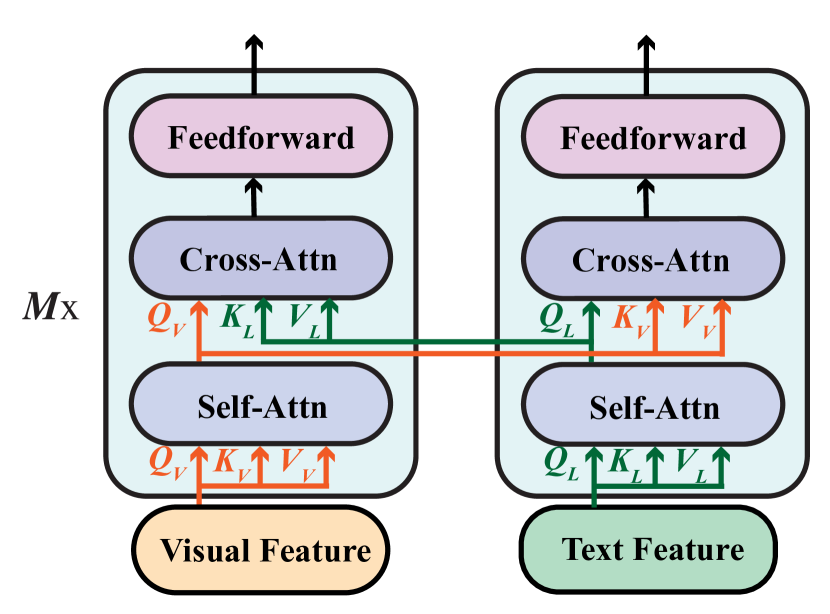
- Proposes Meter, a unified framework for systematic ablation of vision encoders (e.g., CLIP-ViT, Swin Transformer), text encoders (e.g., RoBERTa, DeBERTa), and multimodal fusion modules (merged attention vs. co-attention).
- Employs encoder-only and encoder-decoder architectures for comparative analysis, with a focus on downstream performance on VQA, retrieval, and visual reasoning tasks.
- Pre-trains models on four large-scale datasets: COCO, Conceptual Captions, SBU Captions, and Visual Genome, using a combination of masked language modeling (MLM), image-text matching (ITM), and masked image modeling (MIM).
- Uses co-attention mechanisms to enhance multimodal fusion, showing consistent improvements over self-attention-only approaches.
- Employs a fair comparison protocol across model variants, ensuring consistent hyperparameters and training schedules.
- Scales the best-performing configuration to 14M images using CoSwin-Huge and RoBERTa-base, achieving state-of-the-art performance on VQAv2.
Experimental results
Research questions
- RQ1Can vision transformers (ViTs) serve as effective image encoders in end-to-end vision-and-language pre-training, outperforming region-based methods?
- RQ2How do different vision and text encoders (e.g., CLIP-ViT, RoBERTa) impact downstream performance in end-to-end VL models?
- RQ3Does the inclusion of cross-attention in the multimodal fusion module improve performance compared to self-attention-only mechanisms?
- RQ4Is the encoder-only architecture more effective than encoder-decoder for discriminative tasks like VQA and zero-shot retrieval?
- RQ5Does masked image modeling (MIM) improve downstream performance in ViT-based VL models, or does it introduce conflicting supervision?
Key findings
- Vision transformers (ViTs) play a more critical role than language transformers in vision-and-language pre-training, and performance on unimodal tasks is not a reliable predictor of VL performance.
- The inclusion of cross-attention in the multimodal fusion module leads to better downstream performance than self-attention-only mechanisms.
- The encoder-only architecture outperforms the encoder-decoder architecture on VQA and zero-shot image-text retrieval tasks under fair comparison.
- Masked image modeling (MIM) degrades performance on both VQAv2 and Flickr30k retrieval tasks, suggesting conflicting objectives or noisy patch supervision.
- Meter achieves 77.64% accuracy on the VQAv2 test-std set using only 4M images—surpassing the previous state-of-the-art region-feature-based model (VinVL) by 1.04% and the prior best fully transformer-based model (ALBEF) by 1.6%.
- Scaling the best model to 14M images using CoSwin-Huge and RoBERTa-base yields 80.54% accuracy on VQAv2, setting a new state of the art and outperforming models pre-trained on 1.8B images.
Read this paper
Open the full text in the Nubint reader and ask about any passage as you read.
Read this paper on NubintThis review was generated by AI from the original paper. Please check the paper before citing it.