
[Paper Review] An Energy-Efficient Reconfigurable Autoencoder Implementation on FPGA
This paper presents an energy-efficient, reconfigurable convolutional autoencoder hardware accelerator implemented on an FPGA (Xilinx ZU7EV, 16nm) for real-time denoising of MNIST images. The design achieves 21.12 GOP/s throughput at 5.93W power consumption (100 MHz), demonstrating 3.56 GOP/s/W energy efficiency—surpassing prior FPGA and GPU-based implementations in energy efficiency and flexibility.
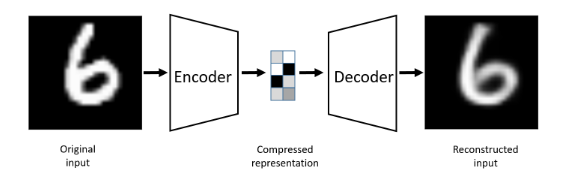
Autoencoders are unsupervised neural networks that are used to process and compress input data and then reconstruct the data back to the original data size. This allows autoencoders to be used for different processing applications such as data compression, image classification, image noise reduction, and image coloring. Hardware-wise, re-configurable architectures like Field Programmable Gate Arrays (FPGAs) have been used for accelerating computations from several domains because of their unique combination of flexibility, performance, and power efficiency. In this paper, we look at the different autoencoders available and use the convolutional autoencoder in both FPGA and GPU-based implementations to process noisy static MNIST images. We compare the different results achieved with the FPGA and GPU-based implementations and then discuss the pros and cons of each implementation. The evaluation of the proposed design achieved 80%accuracy and our experimental results show that the proposed accelerator achieves a throughput of 21.12 Giga-Operations Per Second (GOP/s) with a 5.93 W on-chip power consumption at 100 MHz. The comparison results with off-the-shelf devices and recent state-of-the-art implementations illustrate that the proposed accelerator has obvious advantages in terms of energy efficiency and design flexibility. We also discuss future work that can be done with the use of our proposed accelerator.
Motivation & Objective
- To design a reconfigurable, energy-efficient hardware accelerator for convolutional autoencoders targeting real-time image denoising.
- To compare FPGA-based and GPU-based implementations of convolutional autoencoders in terms of performance, power efficiency, and design flexibility.
- To achieve high throughput and low power consumption for embedded and edge AI applications using FPGA acceleration.
- To evaluate the model's accuracy and efficiency on noisy static MNIST images under constrained hardware resources.
- To enable future integration into autonomous systems requiring real-time image preprocessing, such as robotic vision.
Proposed method
- Implemented a convolutional autoencoder in VHDL targeting the Xilinx ZU7EV FPGA, using a pipelined architecture with dedicated blocks for matrix operations, channel distribution, encoding/decoding, arbitration, and output control.
- Employed convolutional layers with ReLU activation and max-pooling in the encoder, and transposed convolutions (deconvolution) with up-sampling in the decoder for feature reconstruction.
- Used a round-robin arbitration unit to manage data flow between processing units and a FIFO-based channel distributor to enable parallel data handling across eight channels.
- Optimized the design for 100 MHz clock frequency and 16nm process technology to minimize area and power consumption.
- Benchmarked the FPGA implementation against GPU (NVIDIA K80, GTX 1080 Ti) and prior FPGA-based autoencoder accelerators using standard metrics: throughput, latency, power, and energy efficiency.
- Trained the autoencoder in Python using a standard MNIST dataset with added noise, then deployed the inference model on both FPGA and GPU platforms for comparative evaluation.
Experimental results
Research questions
- RQ1How does the energy efficiency of an FPGA-based convolutional autoencoder compare to GPU-based and prior FPGA-based implementations for image denoising?
- RQ2What is the achievable throughput and power consumption of a reconfigurable autoencoder accelerator on a modern FPGA for MNIST image denoising?
- RQ3To what extent does hardware acceleration on FPGAs improve performance and energy efficiency compared to general-purpose GPUs for autoencoder inference?
- RQ4Can the proposed FPGA design maintain high accuracy (e.g., 80%) while achieving low power and high throughput for real-time image processing?
- RQ5What architectural choices (e.g., channel distribution, arbitration, pipelining) are most effective in minimizing area and power while maximizing throughput?
Key findings
- The proposed FPGA-based autoencoder achieved 80% accuracy in reconstructing denoised MNIST images, demonstrating effective feature learning and reconstruction.
- The accelerator delivered a throughput of 21.12 GOP/s at 100 MHz with only 5.93W on-chip power consumption, resulting in 3.56 GOP/s/W energy efficiency.
- Compared to the NVIDIA K80 GPU (733.33 GOP/s/W), the FPGA implementation showed significantly lower energy efficiency but offered superior design flexibility and reconfigurability.
- The FPGA design outperformed other prior FPGA-based autoencoders (e.g., Chakradhar et al. [12], Gokhale et al. [11], Zhang et al. [5]) in energy efficiency, with 3.56 GOP/s/W vs. 1.06–3.31 GOP/s/W.
- The round-robin arbitration and FIFO-based channel distribution enabled efficient data pipelining, contributing to high throughput and low latency (2.91ms for a single inference).
- The design’s reconfigurability and low power make it suitable for integration into autonomous robotic systems requiring real-time, on-device image denoising.
Read this paper
Open the full text in the Nubint reader and ask about any passage as you read.
Read this paper on NubintThis review was generated by AI from the original paper. Please check the paper before citing it.