
[Paper Review] An Exploration of Self-Supervised Pretrained Representations for End-to-End Speech Recognition
This paper evaluates self-supervised pretrained speech representations—particularly HuBERT and Wav2Vec2.0—within end-to-end automatic speech recognition (E2E-ASR) systems using state-of-the-art models like Transformers and Conformers. Without modifying model architectures or training strategies, these representations achieve or surpass SOTA performance on multiple public ASR corpora, demonstrating strong generalization and fast convergence.
Self-supervised pretraining on speech data has achieved a lot of progress. High-fidelity representation of the speech signal is learned from a lot of untranscribed data and shows promising performance. Recently, there are several works focusing on evaluating the quality of self-supervised pretrained representations on various tasks without domain restriction, e.g. SUPERB. However, such evaluations do not provide a comprehensive comparison among many ASR benchmark corpora. In this paper, we focus on the general applications of pretrained speech representations, on advanced end-to-end automatic speech recognition (E2E-ASR) models. We select several pretrained speech representations and present the experimental results on various open-source and publicly available corpora for E2E-ASR. Without any modification of the back-end model architectures or training strategy, some of the experiments with pretrained representations, e.g., WSJ, WSJ0-2mix with HuBERT, reach or outperform current state-of-the-art (SOTA) recognition performance. Moreover, we further explore more scenarios for whether the pretraining representations are effective, such as the cross-language or overlapped speech. The scripts, configuratons and the trained models have been released in ESPnet to let the community reproduce our experiments and improve them.
Motivation & Objective
- To assess the generalization and performance of self-supervised pretrained speech representations (SSLRs) in advanced end-to-end ASR systems.
- To compare SSLRs across diverse public ASR corpora, including those with different speech characteristics (e.g., read vs. spontaneous, single- vs. multi-speaker).
- To investigate the effectiveness of SSLRs in challenging scenarios such as cross-lingual and overlapped speech recognition.
- To provide a reproducible benchmark by releasing scripts, configurations, and trained models in ESPnet for community use.
Proposed method
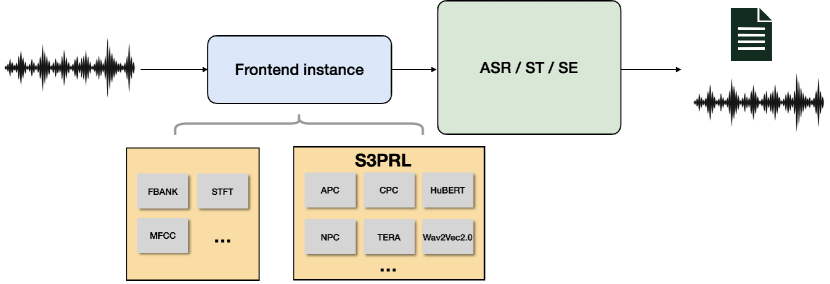
- Integrated SSLRs from the S3PRL toolkit into the ESPnet E2E speech processing framework for seamless evaluation.
- Evaluated multiple SSLR models—including HuBERT, Wav2Vec2.0, APC, Mockingjay, TERA, NPC, and VQ-APC—on various ASR corpora using the same back-end model architecture.
- Explored three feature fusion strategies: weighted-sum of all encoder layers, last-layer representation, and fine-tuned last-layer features.
- Used joint CTC/attention-based Transformer and Conformer encoder-decoder models for end-to-end ASR training with fixed SSLR features.
- Applied standard training techniques including gradient accumulation, dropout regularization, and utterance-level normalization to improve training stability.
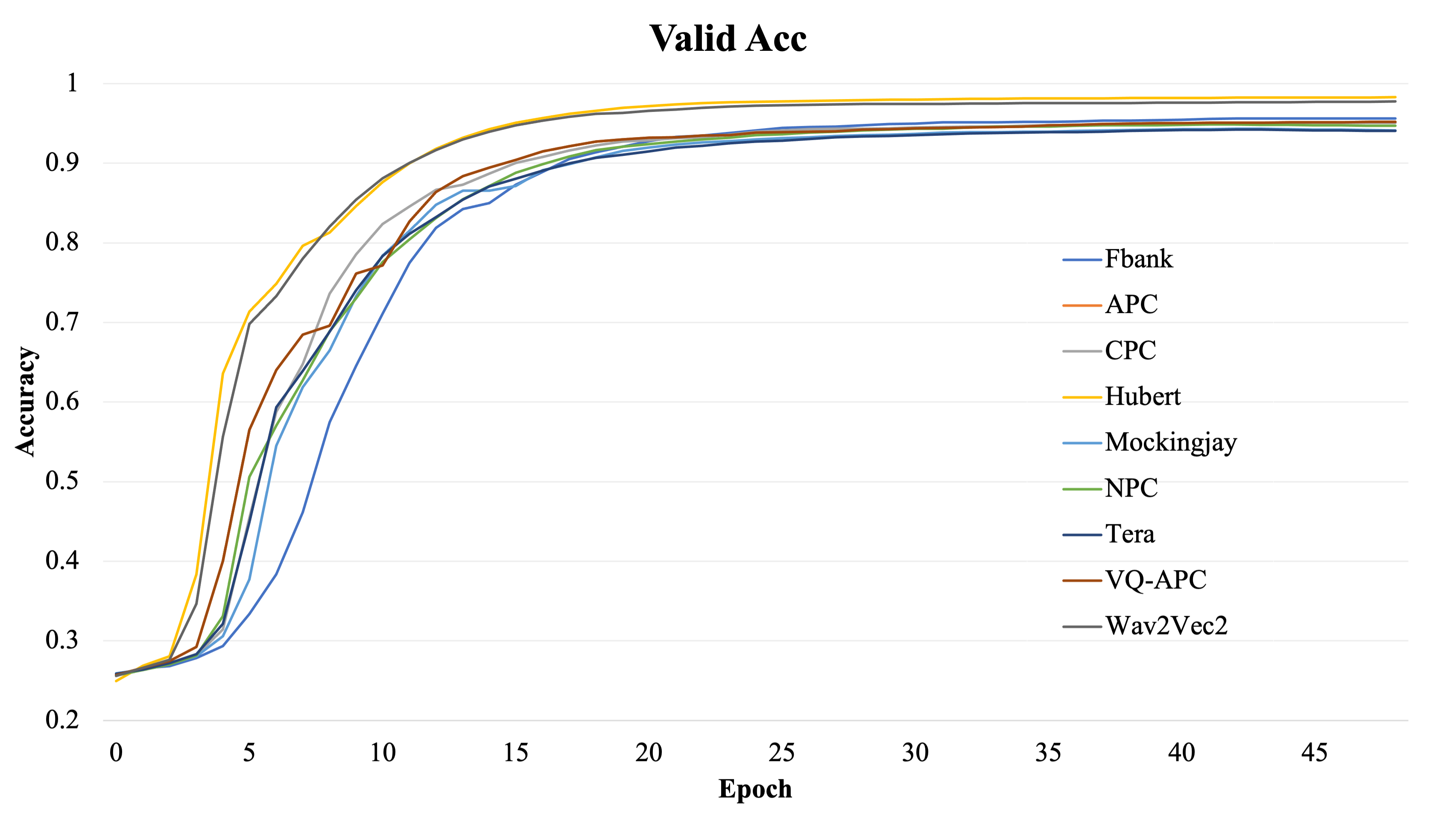
- Monitored training dynamics using validation accuracy curves to assess convergence and robustness of SSLR features.
Experimental results
Research questions
- RQ1How do self-supervised pretrained representations compare to traditional log-Mel FBANK features in terms of E2E-ASR performance across diverse corpora?
- RQ2Can SSLRs like HuBERT and Wav2Vec2.0 generalize beyond LibriSpeech and achieve SOTA results on other open-source ASR datasets?
- RQ3What is the optimal way to utilize multi-layer representations from SSLRs—weighted-sum, last-layer, or fine-tuned last-layer features?
- RQ4How do SSLRs perform in challenging scenarios such as cross-lingual or overlapped speech recognition?
Key findings
- HuBERT and Wav2Vec2.0 representations significantly outperform log-Mel FBANK features, achieving SOTA or near-SOTA results on multiple corpora including WSJ, LibriTTS, and AISHELL.
- On the WSJ dataset, HuBERT with weighted-sum features achieved a WER of 3.0% (with LM) and 4.9% (without LM), surpassing the FBANK baseline with LM (5.3% and 5.5%).
- Wav2Vec2.0 with weighted-sum features achieved a WER of 3.7% (with LM), matching or exceeding the performance of prior SOTA systems on WSJ.
- The learning curves of SSLR-based models showed faster convergence than FBANK, with HuBERT and Wav2Vec2.0 maintaining superior accuracy from early training epochs.
- HuBERT features showed a strong concentration on the last layer, while Wav2Vec2.0 benefited from combining multiple layers via weighted-sum, indicating richer intermediate representations.
- The pretrained representations were robust to hyperparameter variations such as learning rate and batch size, suggesting their reliability in diverse training setups.
Read this paper
Open the full text in the Nubint reader and ask about any passage as you read.
Read this paper on NubintThis review was generated by AI from the original paper. Please check the paper before citing it.