
[Paper Review] An Implementation of Multimodal Fusion System for Intelligent Digital Human Generation
This paper proposes a multimodal fusion system for intelligent 2D digital human generation that integrates text, speech, and image inputs using large language models, voice cloning, and image-to-video synthesis. The system enables person-independent and person-dependent digital human driving, age transformation, style transfer, and super-resolution, achieving high-quality, interactive digital human videos with state-of-the-art performance in visual quality and user experience.
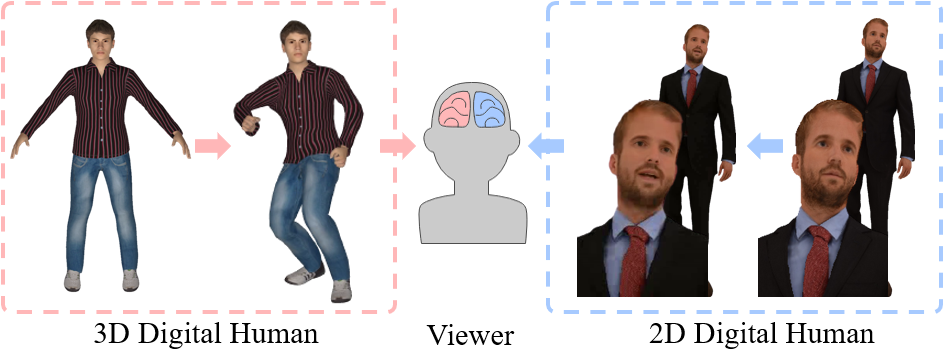
With the rapid development of artificial intelligence (AI), digital humans have attracted more and more attention and are expected to achieve a wide range of applications in several industries. Then, most of the existing digital humans still rely on manual modeling by designers, which is a cumbersome process and has a long development cycle. Therefore, facing the rise of digital humans, there is an urgent need for a digital human generation system combined with AI to improve development efficiency. In this paper, an implementation scheme of an intelligent digital human generation system with multimodal fusion is proposed. Specifically, text, speech and image are taken as inputs, and interactive speech is synthesized using large language model (LLM), voiceprint extraction, and text-to-speech conversion techniques. Then the input image is age-transformed and a suitable image is selected as the driving image. Then, the modification and generation of digital human video content is realized by digital human driving, novel view synthesis, and intelligent dressing techniques. Finally, we enhance the user experience through style transfer, super-resolution, and quality evaluation. Experimental results show that the system can effectively realize digital human generation. The related code is released at https://github.com/zyj-2000/CUMT_2D_PhotoSpeaker.
Motivation & Objective
- To address the high development cost and long cycle of traditional digital human creation by automating the process using AI.
- To enable interactive, personalized digital human generation through multimodal inputs (text, speech, image).
- To enhance user experience via age transformation, style transfer, super-resolution, and intelligent dressing.
- To develop a system that supports both person-independent and person-dependent digital human driving for flexible application.
- To validate the system's effectiveness using comprehensive image and video quality assessment metrics.
Proposed method
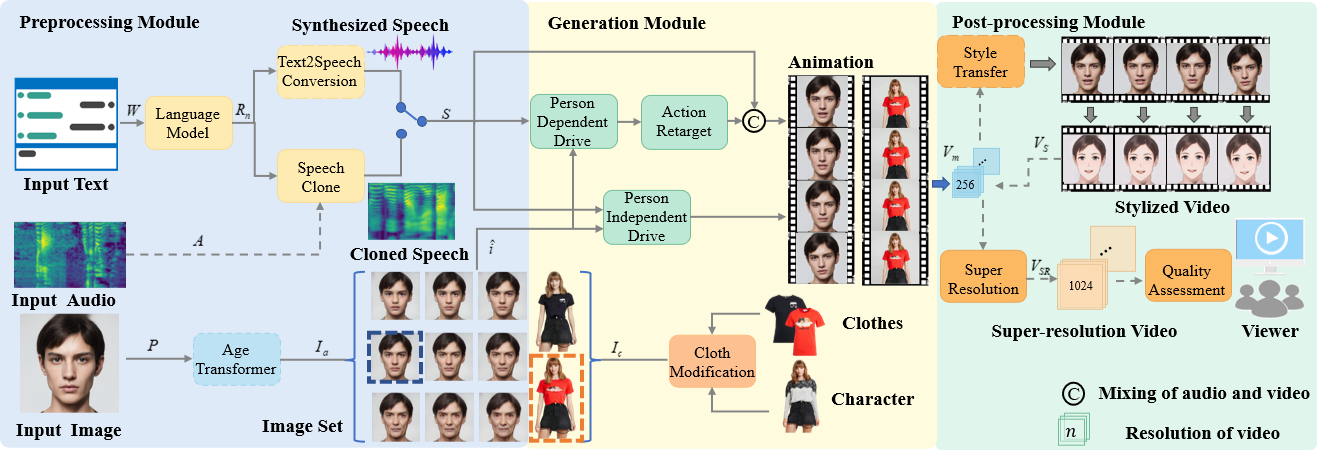
- Preprocessing involves text understanding via a large language model (LLM), voiceprint extraction, and text-to-speech (TTS) synthesis for speech generation.
- Input images are age-transformed using the SAM model to generate age-adjusted facial images for personalized digital humans.
- Digital human video generation is achieved through person-independent (SadTalker) and person-dependent (LiveSpeechPortraits) driving methods with motion retargeting via Thin-Plate-Spline-Motion-Model.
- Intelligent dressing is implemented using the VITON-HD model to modify clothing in the generated video frames.
- Post-processing includes style transfer via DCT-Net, super-resolution using BasicVSR++, and quality evaluation using VSFA, FastVQA, CGIQA, and CPBD.
- The system integrates all components into a unified pipeline for end-to-end digital human video generation from multimodal inputs.
Experimental results
Research questions
- RQ1Can a multimodal fusion system effectively generate high-quality, interactive 2D digital human videos from text, speech, and image inputs?
- RQ2How well does the system perform in generating personalized digital humans with age transformation and style transfer?
- RQ3What is the visual and perceptual quality of the generated digital human videos compared to existing benchmarks?
- RQ4To what extent does the integration of person-independent and person-dependent driving methods improve flexibility and realism?
- RQ5How effective are post-processing techniques like super-resolution and style transfer in enhancing user experience?
Key findings
- The system successfully generates realistic 2D digital human videos from multimodal inputs, including face and full-body animations, as demonstrated in Fig. 3 and Fig. 4.
- The average CPBD score across all generated videos was above 0.28, indicating low blur and high sharpness in generated frames.
- The CGIQA metric averaged 0.57 across all test cases, showing strong performance in CG animation quality assessment.
- VSFA scores ranged from 0.8445 to 0.9893, with the highest value (0.9893) achieved for a long-haired woman face, indicating high perceptual video quality.
- FAST-VQA scores were consistently above 0.6, with the best result of 0.8802 for a short-haired woman face, confirming strong video quality perception.
- The system demonstrated robust performance across diverse inputs, including different facial types, clothing, and audio inputs, confirming its generalization capability.
Read this paper
Open the full text in the Nubint reader and ask about any passage as you read.
Read this paper on NubintThis review was generated by AI from the original paper. Please check the paper before citing it.