
[Paper Review] An Independent Evaluation of ChatGPT on Mathematical Word Problems (MWP)
The paper independently evaluates ChatGPT on DRAW-1K math word problems, showing dramatic performance drops when asked to show work, identifies factors that raise failure probability, and releases a ChatGPT MWP response dataset for further research.
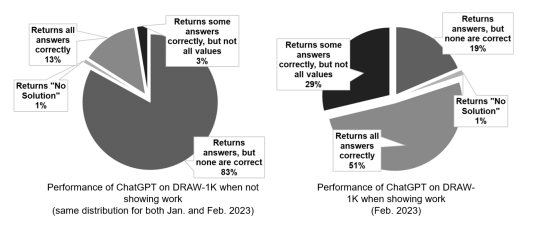
We study the performance of a commercially available large language model (LLM) known as ChatGPT on math word problems (MWPs) from the dataset DRAW-1K. To our knowledge, this is the first independent evaluation of ChatGPT. We found that ChatGPT's performance changes dramatically based on the requirement to show its work, failing 20% of the time when it provides work compared with 84% when it does not. Further several factors about MWPs relating to the number of unknowns and number of operations that lead to a higher probability of failure when compared with the prior, specifically noting (across all experiments) that the probability of failure increases linearly with the number of addition and subtraction operations. We also have released the dataset of ChatGPT's responses to the MWPs to support further work on the characterization of LLM performance and present baseline machine learning models to predict if ChatGPT can correctly answer an MWP. We have released a dataset comprised of ChatGPT's responses to support further research in this area.
Motivation & Objective
- Assess ChatGPT’s ability to solve math word problems from DRAW-1K.
- Examine how requiring ChatGPT to show work affects accuracy.
- Identify problem factors (unknowns, operations) that influence failure rates.
- Release a dataset of ChatGPT responses to MWPs to enable future research.
Proposed method
- Use the DRAW-1K dataset with 1,000 MWPs and template algebraic equations.
- Interact with ChatGPT at scale via a ChatGPT CLI wrapper to test prompts.
- Run experiments with and without showing work, across multiple time frames.
- Analyze failure rates and correlations with problem features (unknowns, operations).
- Provide baseline models (random forest, XGBoost) to predict ChatGPT performance using ground-truth equations.
Experimental results
Research questions
- RQ1How does showing work versus providing final answers affect ChatGPT’s accuracy on DRAW-1K MWPs?
- RQ2What factors in MWPs (e.g., number of unknowns, number of operations) correlate with ChatGPT failure?
- RQ3Can features derived from problem templates predict ChatGPT performance?
- RQ4What is the dataset and baseline model support for studying LLM performance on MWPs?
Key findings
- ChatGPT failures without work are high (e.g., 84% in January/February experiments).
- Introducing work reduces failure rate to around 20% in the February experiment with work.
- Number of additions and subtractions correlates strongly with higher failure probability (R^2 up to 0.915 when work is shown).
- Strong linear relationship exists between multiplication/division operations and failure when work is shown (R^2 = 0.802).
- Baseline predictive models (Random Forest, XGBoost) using equation features achieve higher precision than random for predicting incorrect answers and reasonable recall for correct ones.
Read this paper
Open the full text in the Nubint reader and ask about any passage as you read.
Read this paper on NubintThis review was generated by AI from the original paper. Please check the paper before citing it.