
[Paper Review] An Investigation into Pre-Training Object-Centric Representations for Reinforcement Learning
The paper evaluates unsupervised object-centric representations (OCR) as pre-training for image-based RL, using a new simple 2D object-centric benchmark and a 3D robotics task to study when OCR pre-training helps, its sample efficiency, and generalization.
Unsupervised object-centric representation (OCR) learning has recently drawn attention as a new paradigm of visual representation. This is because of its potential of being an effective pre-training technique for various downstream tasks in terms of sample efficiency, systematic generalization, and reasoning. Although image-based reinforcement learning (RL) is one of the most important and thus frequently mentioned such downstream tasks, the benefit in RL has surprisingly not been investigated systematically thus far. Instead, most of the evaluations have focused on rather indirect metrics such as segmentation quality and object property prediction accuracy. In this paper, we investigate the effectiveness of OCR pre-training for image-based reinforcement learning via empirical experiments. For systematic evaluation, we introduce a simple object-centric visual RL benchmark and conduct experiments to answer questions such as ``Does OCR pre-training improve performance on object-centric tasks?'' and ``Can OCR pre-training help with out-of-distribution generalization?''. Our results provide empirical evidence for valuable insights into the effectiveness of OCR pre-training for RL and the potential limitations of its use in certain scenarios. Additionally, this study also examines the critical aspects of incorporating OCR pre-training in RL, including performance in a visually complex environment and the appropriate pooling layer to aggregate the object representations.
Motivation & Objective
- Assess whether OCR pre-training improves RL performance on object-centric tasks.
- Investigate which task types (interaction, relational reasoning) benefit most from OCR.
- Evaluate OCR pre-training in terms of sample efficiency and generalization to out-of-distribution scenarios.
- Examine the impact of visual complexity and pooling choices on OCR-based RL performance.
- Provide a benchmark, code, and insights for when OCR pre-training is advantageous for RL.
Proposed method
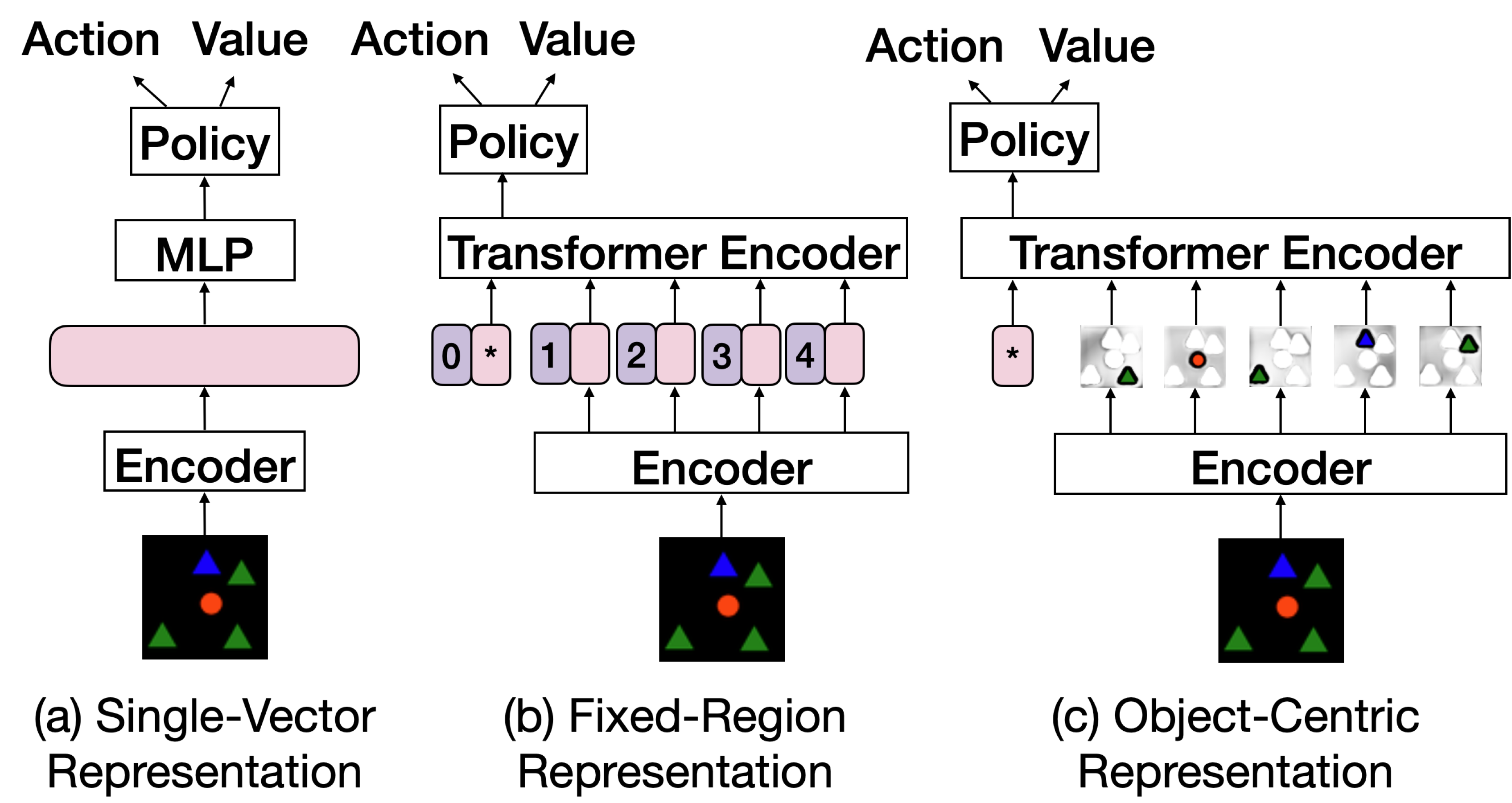
- Compare several representation types (single-vector, fixed-region, and object-centric) under end-to-end learning and OCR pre-training regimes.
- Use PPO as the RL algorithm across all experiments with a simple 2D object-centric benchmark and a 3D reaching task for evaluation.
- Evaluate multiple OCR models (IODINE, Slot-Attention, SLATE, SLATE-Large) and pooling layers (Transformer vs MLP) to study their effect on RL performance.
- Implement a 2D Spriteworld-based dataset for pre-training and a 3D CausalWorld robotics task to test complex environments.
- Analyze results across object-goal, object-interaction, object-comparison, and property-comparison tasks to assess relational reasoning abilities.
Experimental results
Research questions
- RQ1Does OCR pre-training improve performance on object-centric reinforcement learning tasks, and which task types benefit most?
- RQ2How does OCR pre-training affect sample efficiency in object-centric RL scenarios?
- RQ3Can OCR pre-training improve generalization to out-of-distribution numbers or colors of objects?
- RQ4How does OCR perform in visually complex environments where segmentation is difficult, and what pooling layer best supports RL?
- RQ5Which OCR model and architectural choices (e.g., transformer pooling) yield the best RL performance?
Key findings
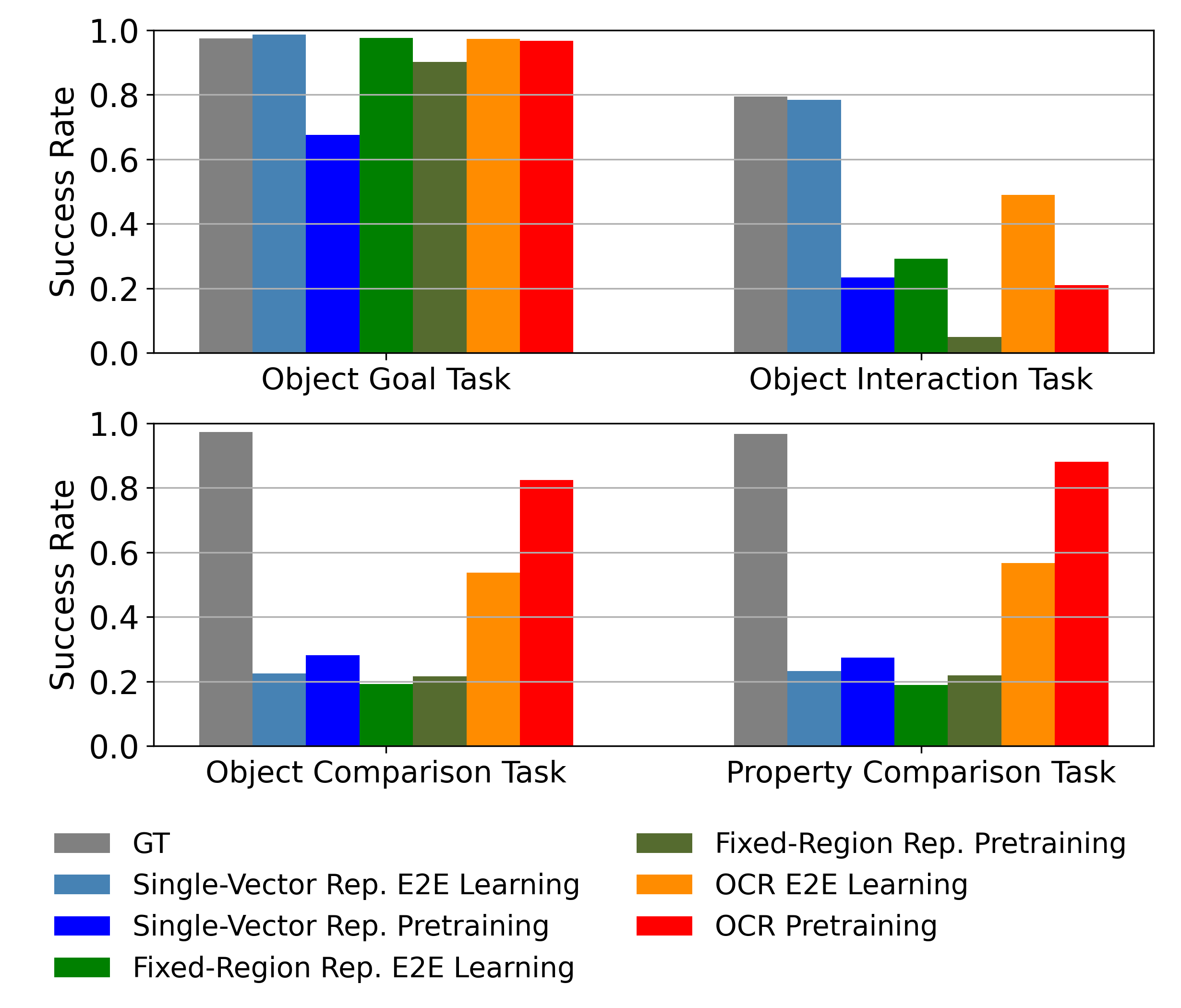
- OCR pre-training can improve performance in relational-reasoning tasks but may not consistently outperform other representations across all object-centric tasks.
- On Object Goal tasks, most models reach over 80% success except pre-trained single-vector representations, which struggle to extract per-object information.
- Only SLATE and end-to-end CNN baselines solved the Object Interaction task at around ~80% success; other OCR models often failed, suggesting decoder architecture matters.
- OCR pre-training performed similarly to ground-truth states on Object Comparison and Property Comparison tasks, with IODINE underperforming among OCR methods.
- OCR pre-training generally improves sample efficiency compared with other pre-training baselines, especially for relation-focused tasks; non-SLATE OCR methods may fail Object Interaction.
- SLATE consistently provides strong performance, including in visually complex settings (Object Reaching), while IODINE is slower and weaker.
Read this paper
Open the full text in the Nubint reader and ask about any passage as you read.
Read this paper on NubintThis review was generated by AI from the original paper. Please check the paper before citing it.