
[Paper Review] An Overview Of Temporal Commonsense Reasoning and Acquisition
This paper provides a comprehensive survey of temporal commonsense reasoning (TCS) in NLP, examining how large language models (LLMs) struggle with implicit temporal reasoning despite strong performance on surface-level tasks. It reviews methods to enhance TCS through data augmentation, knowledge graph integration, and symbolic reasoning infusion, highlighting persistent gaps between model and human performance due to shallow reasoning and linguistic biases.
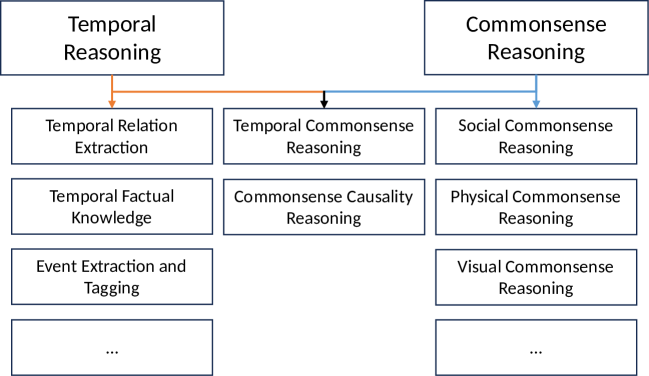
Temporal commonsense reasoning refers to the ability to understand the typical temporal context of phrases, actions, and events, and use it to reason over problems requiring such knowledge. This trait is essential in temporal natural language processing tasks, with possible applications such as timeline summarization, temporal question answering, and temporal natural language inference. Recent research on the performance of large language models suggests that, although they are adept at generating syntactically correct sentences and solving classification tasks, they often take shortcuts in their reasoning and fall prey to simple linguistic traps. This article provides an overview of research in the domain of temporal commonsense reasoning, particularly focusing on enhancing language model performance through a variety of augmentations and their evaluation across a growing number of datasets. However, these augmented models still struggle to approach human performance on reasoning tasks over temporal common sense properties, such as the typical occurrence times, orderings, or durations of events. We further emphasize the need for careful interpretation of research to guard against overpromising evaluation results in light of the shallow reasoning present in transformers. This can be achieved by appropriately preparing datasets and suitable evaluation metrics.
Motivation & Objective
- To analyze the current state of temporal commonsense reasoning (TCS) in NLP, focusing on reasoning about event orderings, durations, and typical occurrence times.
- To investigate why state-of-the-art language models, despite strong performance on classification and generation tasks, fail at deeper temporal reasoning due to shortcut learning and linguistic biases.
- To evaluate the effectiveness of data augmentation, knowledge graph integration (e.g., ATOMIC²⁰, ASER), and symbolic reasoning techniques in improving TCS capabilities.
- To identify persistent performance gaps between models and humans on TCS tasks, especially under robust evaluation metrics.
- To advocate for careful dataset curation and evaluation design to avoid overpromising model capabilities and to guide future research toward more robust reasoning.
Proposed method
- Surveying existing TCS benchmarks, datasets, and knowledge graphs such as ATOMIC²⁰, COMET, ASER, and ConceptNet to identify core TCS dimensions.
- Evaluating transformer-based models (e.g., BERT, RoBERTa, GPT-4) and specialized temporal models (e.g., TempoBERT, BiTimeBERT) on TCS tasks using explicit and implicit temporal signals.
- Applying data augmentation via crowdsourcing, rule-based web extraction, and knowledge graph distillation to improve training data quality and coverage.
- Integrating symbolic reasoning (e.g., probabilistic soft logic) with neural models to explicitly encode temporal relations such as duration, precedence, and frequency.
- Employing ensemble methods and architectural modifications (e.g., temporal attention, document creation time injection) to enhance temporal reasoning in LMs.
- Using robust evaluation metrics beyond accuracy to detect pattern recognition and bias exploitation, especially in adversarial or out-of-distribution settings.
Experimental results
Research questions
- RQ1Why do large language models fail to generalize temporal commonsense reasoning despite high performance on standard benchmarks?
- RQ2To what extent can knowledge graphs (e.g., ATOMIC²⁰, ASER) and data augmentation improve temporal reasoning in LMs?
- RQ3How effective are symbolic reasoning techniques and hybrid neural-symbolic approaches in enhancing model robustness to linguistic traps in TCS?
- RQ4What role do training objectives, data quality, and hyperparameters play in shaping TCS performance across different transformer variants?
- RQ5How do current evaluation protocols fail to detect shallow reasoning, and what metrics can better reflect true temporal understanding?
Key findings
- Despite state-of-the-art performance on standard NLP tasks, LLMs often rely on linguistic patterns and biases rather than true temporal reasoning, leading to incorrect inferences on implicit temporal relations.
- Models fine-tuned on knowledge graphs like ATOMIC²⁰ and ASER show improved performance on event ordering and temporal inference tasks, but still fall short of human-level reasoning.
- Symbolic reasoning integration—especially via probabilistic soft logic or neural-symbolic ensembling—yields more robust and explainable TCS predictions than purely end-to-end training with auxiliary objectives.
- Data augmentation through crowdsourcing and weak supervision significantly improves coverage of rare temporal relations, but performance gains are limited by annotation quality and distributional bias.
- Even GPT-4, while showing strong performance on some reasoning tasks, remains opaque in structure and inaccessible for local deployment, limiting its utility for targeted TCS research.
- Robust evaluation metrics reveal that models frequently arrive at correct answers through guesswork or pattern matching rather than genuine understanding of temporal duration, order, or frequency.
Better researchstarts right now
From reading papers to final review, dramatically reduce your research time.
No credit card · Free plan available
This review was created by AI and reviewed by human editors.