
[Paper Review] An Overview of Violence Detection Techniques: Current Challenges and Future Directions
This paper provides a comprehensive survey of violence detection (VD) techniques in video surveillance, reviewing traditional methods based on handcrafted features and modern deep learning approaches, including 2D/3D CNNs, transformers, and hybrid models. It highlights challenges such as data scarcity, computational cost, and real-world robustness, while proposing future directions like edge-compatible models, reinforcement learning, and explainable AI for practical, real-time VD systems.
The Big Video Data generated in today's smart cities has raised concerns from its purposeful usage perspective, where surveillance cameras, among many others are the most prominent resources to contribute to the huge volumes of data, making its automated analysis a difficult task in terms of computation and preciseness. Violence Detection (VD), broadly plunging under Action and Activity recognition domain, is used to analyze Big Video data for anomalous actions incurred due to humans. The VD literature is traditionally based on manually engineered features, though advancements to deep learning based standalone models are developed for real-time VD analysis. This paper focuses on overview of deep sequence learning approaches along with localization strategies of the detected violence. This overview also dives into the initial image processing and machine learning-based VD literature and their possible advantages such as efficiency against the current complex models. Furthermore,the datasets are discussed, to provide an analysis of the current models, explaining their pros and cons with future directions in VD domain derived from an in-depth analysis of the previous methods.
Motivation & Objective
- To provide a systematic review of violence detection (VD) techniques from traditional image processing to modern deep learning-based approaches.
- To analyze the limitations of current VD models, including high computational cost, data scarcity, and poor generalization in non-stationary real-world environments.
- To identify key challenges such as effective localization of violent actions, robustness to environmental disturbances, and real-time performance on edge devices.
- To explore underutilized future directions like reinforcement learning, vision transformers, and explainable AI for improved VD system reliability and interpretability.
Proposed method
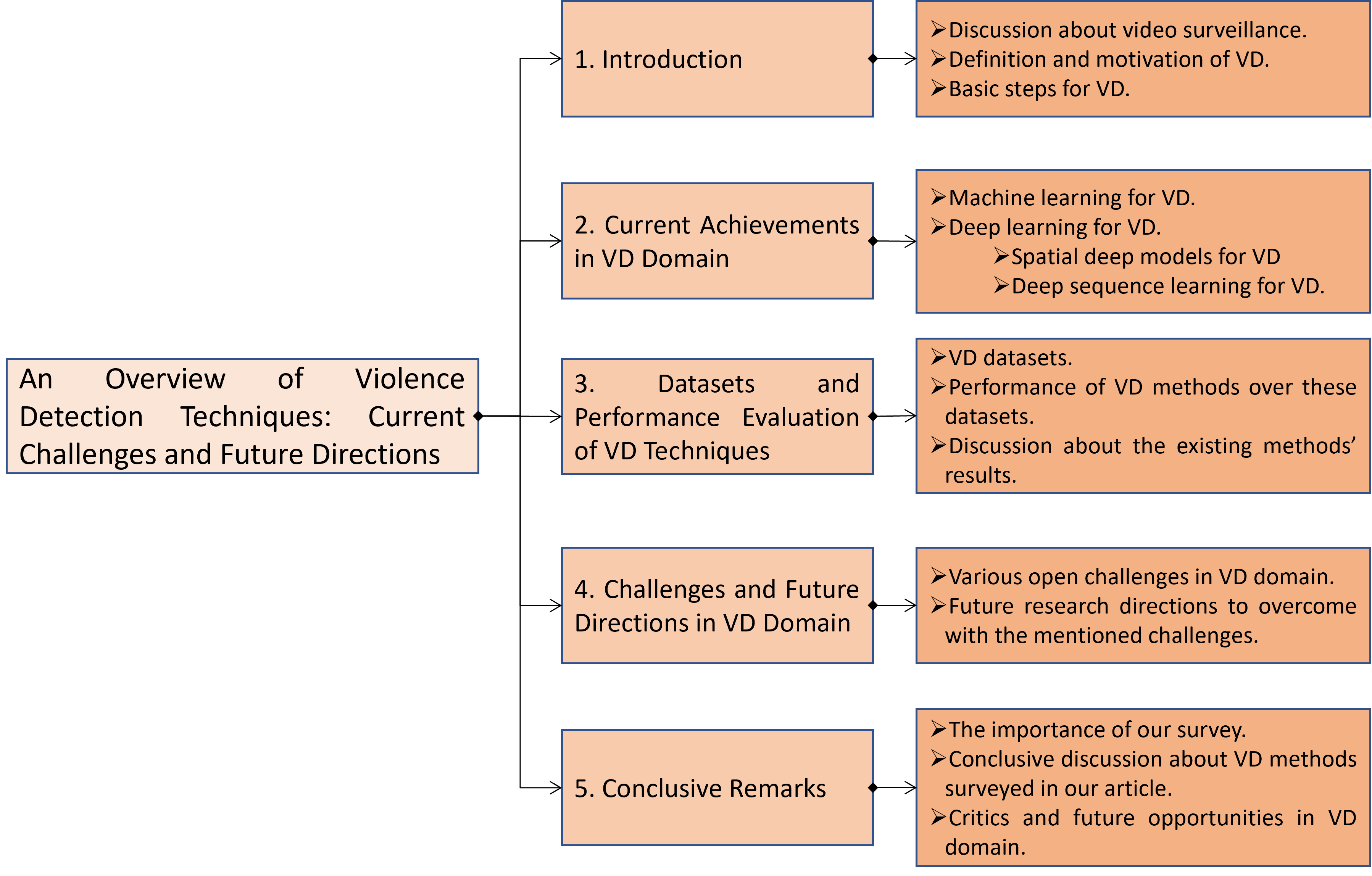
- Surveying and categorizing VD techniques across three generations: traditional feature-based (e.g., HOG, motion vectors), deep learning-based (2D/3D CNNs), and sequence modeling (e.g., RNNs, Transformers).
- Evaluating performance using benchmark datasets such as UCF-Crime, HMDB51, and UCSD Pedestrian, focusing on accuracy, inference speed, and localization capability.
- Analyzing model architectures for end-to-end video classification, including temporal modeling via 3D convolutions and attention mechanisms in TimeSformer.
- Assessing edge deployment feasibility by evaluating model complexity, inference latency, and quantization potential for embedded systems.
- Proposing hybrid models combining handcrafted features with deep learning to improve efficiency and robustness in low-data regimes.
- Exploring emerging techniques such as vision transformers for video understanding and reinforcement learning for adaptive anomaly detection in dynamic scenes.
Experimental results
Research questions
- RQ1What are the key technical and computational challenges in deploying real-time violence detection systems in smart city surveillance?
- RQ2How do traditional feature-based methods compare to deep learning-based models in terms of accuracy, robustness, and deployment feasibility?
- RQ3What are the limitations of current VD models in handling non-stationary environments with sudden scene changes or occlusions?
- RQ4How can edge computing and lightweight models improve the practicality of VD systems in real-world surveillance deployments?
- RQ5What emerging technologies—such as vision transformers, reinforcement learning, and explainable AI—can enhance the performance and reliability of future VD systems?
Key findings
- Traditional VD methods relying on handcrafted features like HOG and motion vectors are computationally efficient but lack robustness to complex motion patterns and environmental variations.
- 2D and 3D CNN-based models achieve high accuracy on standard datasets but suffer from high computational cost and poor generalization in real-world dynamic environments.
- Vision transformers such as TimeSformer show strong performance in video action recognition tasks, indicating potential for improved temporal modeling in VD.
- Current models often fail to localize violent actions effectively, highlighting the need for joint detection and localization frameworks.
- Edge deployment remains a major challenge due to the high inference cost of mainstream deep learning models, necessitating lightweight and quantized architectures.
- Future directions such as reinforcement learning and explainable AI are underexplored but hold promise for improving adaptability and interpretability in real-world VD systems.
Read this paper
Open the full text in the Nubint reader and ask about any passage as you read.
Read this paper on NubintThis review was generated by AI from the original paper. Please check the paper before citing it.