
[Paper Review] Analyzing Leakage of Personally Identifiable Information in Language Models
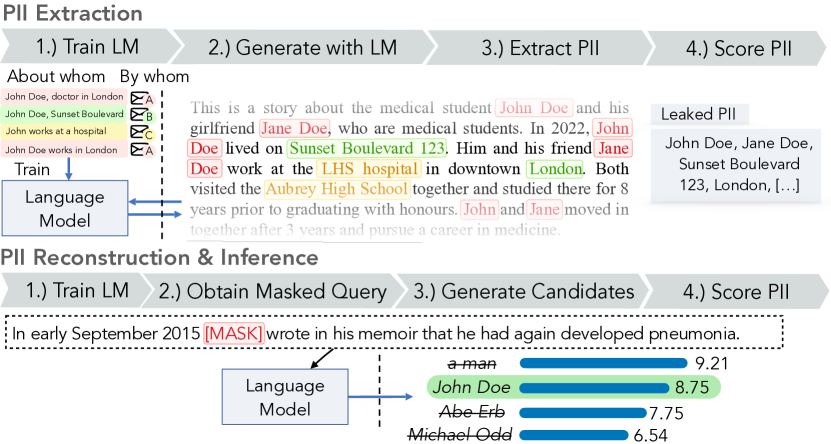
The paper introduces three PII leakage attacks (extraction, reconstruction, inference), evaluates them on GPT-2 variants fine-tuned in law, health, and emails domains with and without defenses, and analyzes how scrubbing and differential privacy affect PII leakage.
Language Models (LMs) have been shown to leak information about training data through sentence-level membership inference and reconstruction attacks. Understanding the risk of LMs leaking Personally Identifiable Information (PII) has received less attention, which can be attributed to the false assumption that dataset curation techniques such as scrubbing are sufficient to prevent PII leakage. Scrubbing techniques reduce but do not prevent the risk of PII leakage: in practice scrubbing is imperfect and must balance the trade-off between minimizing disclosure and preserving the utility of the dataset. On the other hand, it is unclear to which extent algorithmic defenses such as differential privacy, designed to guarantee sentence- or user-level privacy, prevent PII disclosure. In this work, we introduce rigorous game-based definitions for three types of PII leakage via black-box extraction, inference, and reconstruction attacks with only API access to an LM. We empirically evaluate the attacks against GPT-2 models fine-tuned with and without defenses in three domains: case law, health care, and e-mails. Our main contributions are (i) novel attacks that can extract up to 10$ imes$ more PII sequences than existing attacks, (ii) showing that sentence-level differential privacy reduces the risk of PII disclosure but still leaks about 3% of PII sequences, and (iii) a subtle connection between record-level membership inference and PII reconstruction. Code to reproduce all experiments in the paper is available at https://github.com/microsoft/analysing_pii_leakage.
Motivation & Objective
- Motivate the need to study PII leakage in LMs beyond general memorization, especially for direct or contextual PII exposure.
- Develop a formal taxonomy and game-based definitions for PII leakage via extraction, reconstruction, and inference.
- Empirically evaluate PII leakage using black-box API access on GPT-2 variants fine-tuned in three domains, with undefended, scrubbed, and DP-trained models.
- Quantify privacy-utility trade-offs and provide actionable insights for defense design and policy.
Proposed method
- Propose three PII leakage threats: extraction, reconstruction, and inference, with formal game-based definitions.
- Define metrics for PII leakage, including extractability and recall under black-box LM access.
- Develop concrete attack algorithms that approximate ideal leakage, using suffix/prefix information and masked outputs.
- Evaluate attacks on GPT-2 variants fine-tuned in law, health care, and email domains, under undefended, scrubbed, and DP-trained setups.
- Analyze how scrubbing and DP affect model perplexity and PII leakage risk.
- Provide code to reproduce experiments.
Experimental results
Research questions
- RQ1How much PII is leaked by language models under black-box API access through extraction, reconstruction, and inference attacks?
- RQ2Does PII scrubbing or differential privacy sufficiently mitigate PII leakage, and what is the resulting privacy/utility trade-off?
- RQ3What is the relationship between record-level membership inference and PII reconstruction in practice?
- RQ4Do DP defenses at the record level limit PII leakage without crippling model utility?
Key findings
- The attacks can extract up to 10× more PII sequences than existing attacks.
- Sentence-level differential privacy reduces PII leakage risk but still leaks about 3% of PII sequences.
- There is a subtle connection between record-level membership inference and PII reconstruction.
- DP offers substantial but not complete protection against PII leakage, highlighting the need for complementary defenses.
- Scrubbing and DP trade-offs can be tuned to balance privacy and utility, suggesting potential for combined or lighter scrubbing when DP is present.

Read this paper
Open the full text in the Nubint reader and ask about any passage as you read.
Read this paper on NubintThis review was generated by AI from the original paper. Please check the paper before citing it.