
[Paper Review] Andes: Defining and Enhancing Quality-of-Experience in LLM-Based Text Streaming Services
Andes proposes a QoE-aware LLM serving system that optimizes token streaming by dynamic, preemptive scheduling and a client-side token buffer, achieving up to 3.2x QoE gains or 1.6x higher throughput under bursty loads compared with baselines like vLLM.
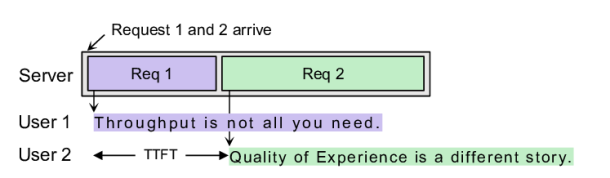
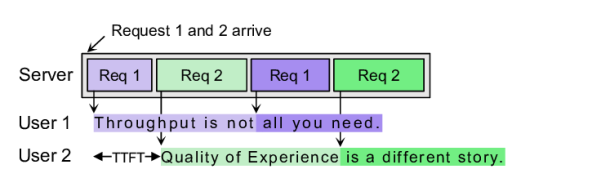
Large language models (LLMs) are now at the core of conversational AI services such as real-time translation and chatbots, which provide live user interaction by incrementally streaming text to the user. However, existing LLM serving systems fail to provide good user experience because their optimization metrics are not always aligned with user experience. In this paper, we first introduce and define the notion of Quality-of-Experience (QoE) for text streaming services by considering each user's end-to-end interaction timeline. Based on this, we propose Andes, a QoE-aware LLM serving system that enhances user experience by ensuring that users receive the first token promptly and subsequent tokens at a smooth, digestible pace, even during surge periods. This is enabled by Andes's preemptive request scheduler that dynamically prioritizes requests at the token granularity based on each request's expected QoE gain and GPU resource usage. Our evaluations demonstrate that, compared to state-of-the-art LLM serving systems, Andes improves the average QoE by up to $4.7 imes$ given the same GPU resource, or saves up to 61% GPU resources while maintaining the same high QoE.
Motivation & Objective
- Define a formal Quality-of-Experience (QoE) metric for text streaming services where tokens are delivered incrementally.
- Design Andes to optimize QoE via dynamic, token-level scheduling and preemption.
- Co-design a client-side token buffer to normalize user experience amid server fluctuations.
- Evaluate Andes on OPT models (13B–175B) and compare to state-of-the-art baselines (e.g., vLLM).
- Demonstrate that Andes improves QoE and/or throughput without additional resources.
Proposed method
- Formal QoE metric comparing actual token delivery timeline to an expected timeline defined by TTFT and TDS.
- QoE-aware online preemptive scheduler that operates on token granularity to maximize QoE over a time quantum Δt.
- Knapsack-like formulation where the batch size and GPU memory constraints define the optimization problem for which requests to serve.
- Greedy packing algorithm with a priority function that balances QoE gain, memory usage, and starvation avoidance (Equation 5).
- Two preemption mechanisms (swapping and recomputation) to move or recompute KV cache during preemption if needed.
- Client-side token buffer that smooths token delivery to match user’s expected TDS regardless of server-side pacing.
Experimental results
Research questions
- RQ1How can QoE be formally defined for incremental, streaming LLM interactions?
- RQ2Can a QoE-aware scheduler improve user experience under bursty/request-rate pressure without over-provisioning resources?
- RQ3What scheduling algorithm and batch-size strategy maximize average QoE while respecting memory constraints?
- RQ4What is the impact of preemption overhead on token delivery latency and overall QoE?
- RQ5How does Andes perform across different model sizes (13B–175B OPT) and compare to baselines like vLLM?
Key findings
- Andes increases average QoE by up to 3.2x under high/bursty load compared with baselines.
- Andes can handle up to 1.6x higher request rates while preserving high QoE, without provisioning extra resources.
- Throughput remains similar to baselines with only up to 10% throughput reduction as load rises.
- TTFT is significantly improved while maintaining TDS above user-expected speeds.
- A greedy knapsack-based scheduling solution with O(N log N) complexity achieves comparable performance to a DP solution with lower overhead.
- The client-side token buffer smooths token delivery, decoupling user experience from server-side scheduling and network fluctuations.
Read this paper
Open the full text in the Nubint reader and ask about any passage as you read.
Read this paper on NubintThis review was generated by AI from the original paper. Please check the paper before citing it.