
[Paper Review] Anomalies, Representations, and Self-Supervision
This paper introduces AnomalyCLR, a self-supervised contrastive learning method for model-agnostic anomaly detection in high-energy physics that uses anomaly-augmented background data to learn robust, invariant representations via a permutation-invariant Transformer encoder. It achieves 14–70% significance improvements over raw data baselines at 30% signal efficiency across multiple benchmark signals in the CMS ADC2021 dataset.
We develop a self-supervised method for density-based anomaly detection using contrastive learning, and test it using event-level anomaly data from CMS ADC2021. The AnomalyCLR technique is data-driven and uses augmentations of the background data to mimic non-Standard-Model events in a model-agnostic way. It uses a permutation-invariant Transformer Encoder architecture to map the objects measured in a collider event to the representation space, where the data augmentations define a representation space which is sensitive to potential anomalous features. An AutoEncoder trained on background representations then computes anomaly scores for a variety of signals in the representation space. With AnomalyCLR we find significant improvements on performance metrics for all signals when compared to the raw data baseline.
Motivation & Objective
- Address the challenge of model-agnostic new physics searches at the LHC, where traditional hypothesis-driven methods may miss unexpected signals.
- Overcome limitations of existing density-based anomaly detection methods, which are sensitive to coordinate system choices and lack invariance under data reparameterizations.
- Develop a representation learning framework that is invariant to physical symmetries and sensitive to generic anomalous features without requiring truth labels or signal-specific priors.
- Improve anomaly detection performance using self-supervision by constructing pseudo-labels from data augmentations that mimic non-Standard Model physics.
- Demonstrate the effectiveness of anomaly-augmented contrastive learning in learning robust, discriminative representations for downstream anomaly scoring using AutoEncoders.
Proposed method
- Propose a self-supervised contrastive learning framework using anomaly-augmented data as positive pairs, where augmentations are designed to emulate generic anomalous features in the background data.
- Use a permutation-invariant Transformer encoder to map collider events (e.g., particle jets or objects) into a high-dimensional representation space, preserving invariance under object ordering.
- Define a novel contrastive loss function that encourages the model to map original events close to their augmented counterparts while pushing them apart from other background events.
- Train the model end-to-end on background data alone, using the anomaly-augmentations as a form of pseudo-supervision to learn representations sensitive to potential anomalies.
- Apply a pre-trained AutoEncoder on the learned representations to compute anomaly scores, with reconstruction error serving as the anomaly metric.
- Optimize the representation space through hyperparameter tuning of the representation dimension and AutoEncoder architecture, evaluating performance across varying signal models and efficiencies.
Experimental results
Research questions
- RQ1Can self-supervised contrastive learning with anomaly-augmented data improve the performance of density-based anomaly detection in high-energy physics?
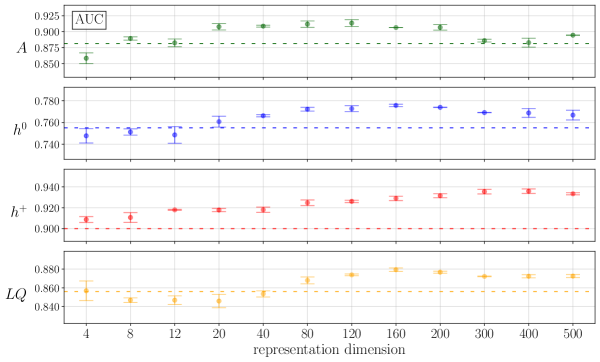
- RQ2How does the choice of representation dimension affect anomaly detection significance across different signal models?
- RQ3To what extent does the use of anomaly-augmentations enhance robustness and invariance in representation learning compared to standard data augmentations?
- RQ4Does the AnomalyCLR framework outperform raw data baselines in terms of significance and error reduction for diverse signal models?
- RQ5Can the method generalize across different signal types without requiring signal-specific tuning or ground-truth labels?
Key findings
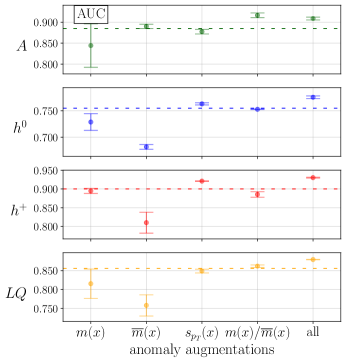
- AnomalyCLR achieves 14–70% significance improvements over the raw data baseline at a fixed signal efficiency of 30% across all four benchmark signals in the CMS ADC2021 dataset.
- The method shows consistent performance gains across all signals, demonstrating its model-agnostic nature and robustness to diverse anomalous topologies.
- Anomaly detection performance improves significantly with increasing representation dimension, peaking between 120 and 200 dimensions for most signals, with the h+ signal showing continued improvement up to 400 dimensions.
- The relative error on significance improvement decreases with increasing representation dimension, indicating more stable and reliable performance at higher dimensions.
- The use of anomaly-augmentations leads to a more invariant and discriminative representation space, reducing sensitivity to coordinate system reparameterizations.
- The method outperforms standard AutoEncoder baselines on raw data, demonstrating the value of self-supervised pre-training with physics-motivated augmentations.
Read this paper
Open the full text in the Nubint reader and ask about any passage as you read.
Read this paper on NubintThis review was generated by AI from the original paper. Please check the paper before citing it.