
[Paper Review] Anomaly Detection of Time Series with Smoothness-Inducing Sequential Variational Auto-Encoder
This paper proposes SISVAE, a smoothness-inducing sequential variational auto-encoder for robust anomaly detection in multi-dimensional time series. By incorporating a temporal smoothness prior as a regularizer in the VAE framework, the model improves density estimation and reconstruction robustness, outperforming state-of-the-art methods on both synthetic and real-world benchmarks, especially in handling point-level and sub-sequence anomalies with reduced false positives and negatives.
Deep generative models have demonstrated their effectiveness in learning latent representation and modeling complex dependencies of time series. In this paper, we present a Smoothness-Inducing Sequential Variational Auto-Encoder (SISVAE) model for robust estimation and anomaly detection of multi-dimensional time series. Our model is based on Variational Auto-Encoder (VAE), and its backbone is fulfilled by a Recurrent Neural Network to capture latent temporal structures of time series for both generative model and inference model. Specifically, our model parameterizes mean and variance for each time-stamp with flexible neural networks, resulting in a non-stationary model that can work without the assumption of constant noise as commonly made by existing Markov models. However, such a flexibility may cause the model fragile to anomalies. To achieve robust density estimation which can also benefit detection tasks, we propose a smoothness-inducing prior over possible estimations. The proposed prior works as a regularizer that places penalty at non-smooth reconstructions. Our model is learned efficiently with a novel stochastic gradient variational Bayes estimator. In particular, we study two decision criteria for anomaly detection: reconstruction probability and reconstruction error. We show the effectiveness of our model on both synthetic datasets and public real-world benchmarks.
Motivation & Objective
- To address the challenge of robust density estimation in multi-dimensional time series contaminated with anomalies.
- To improve anomaly detection performance by modeling temporal continuity and normal patterns more effectively.
- To develop a flexible, non-stationary generative model that does not assume constant noise across time.
- To incorporate a smoothness-inducing prior that regularizes non-smooth reconstructions, enhancing robustness.
- To evaluate the model on both point-level and sub-sequence anomaly detection tasks using real-world and synthetic datasets.
Proposed method
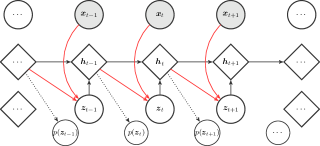
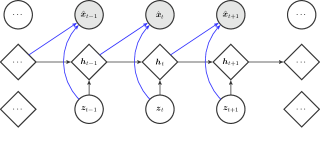
- The model uses a recurrent neural network (RNN) backbone in both inference and generative networks to capture temporal dependencies in time series.
- It parameterizes the mean and variance of the latent distribution at each time step using flexible neural networks, enabling a non-stationary model without assuming constant noise.
- A novel smoothness-inducing prior is introduced as a regularizer that penalizes non-smooth reconstructions in the latent space.
- The model is trained using a stochastic gradient variational Bayes estimator to optimize the variational lower bound.
- Two decision criteria are used for anomaly detection: reconstruction probability and reconstruction error.
- The smoothness prior is integrated into the VAE objective to encourage the model to learn smooth, normal patterns even when anomalies are present.
Experimental results
Research questions
- RQ1Can a sequential VAE with a smoothness-inducing prior improve robust density estimation in anomaly-contaminated time series?
- RQ2How does the proposed smoothness prior enhance reconstruction robustness compared to standard VAEs?
- RQ3Does the SISVAE model outperform state-of-the-art unsupervised anomaly detection methods on multi-dimensional time series?
- RQ4Can the model effectively detect both point-level and sub-sequence anomalies in real-world and synthetic datasets?
- RQ5How stable is the performance of SISVAE across different latent dimension settings and data types?
Key findings
- SISVAE-p achieves superior performance on the SMD and NAB benchmarks, outperforming models like STORN and Donut in both precision and recall.
- The anomaly detection scores of SISVAE-p are smoother than those of other models, indicating better robustness to normal data fluctuations.
- On the Mackey-Glass dataset, SISVAE-p outperforms Donut in both ROC and PRC curves, especially in sub-sequence anomaly detection.
- The smoothness prior enables SISVAE to estimate a more accurate, stable probability density function, even when anomalies are present in the training data.
- SISVAE shows stable performance across different latent dimension settings, while Donut’s performance is highly sensitive to z_dim selection.
- In sub-sequence anomaly detection, SISVAE-p successfully identifies most anomaly windows, whereas STORN and Donut suffer from high false negative and false positive rates.
Read this paper
Open the full text in the Nubint reader and ask about any passage as you read.
Read this paper on NubintThis review was generated by AI from the original paper. Please check the paper before citing it.