
[Paper Review] Anomaly Detection with Conditioned Denoising Diffusion Models
DDAD introduces a conditioned denoising diffusion framework that reconstructs anomaly-free images guided by the input target, enabling precise pixel- and feature-based anomaly localization and domain-adapted feature extraction, achieving state-of-the-art results on MVTec, VisA, and MTD.
Traditional reconstruction-based methods have struggled to achieve competitive performance in anomaly detection. In this paper, we introduce Denoising Diffusion Anomaly Detection (DDAD), a novel denoising process for image reconstruction conditioned on a target image. This ensures a coherent restoration that closely resembles the target image. Our anomaly detection framework employs the conditioning mechanism, where the target image is set as the input image to guide the denoising process, leading to a defectless reconstruction while maintaining nominal patterns. Anomalies are then localised via a pixel-wise and feature-wise comparison of the input and reconstructed image. Finally, to enhance the effectiveness of the feature-wise comparison, we introduce a domain adaptation method that utilises nearly identical generated examples from our conditioned denoising process to fine-tune the pretrained feature extractor. The veracity of DDAD is demonstrated on various datasets including MVTec and VisA benchmarks, achieving state-of-the-art results of \(99.8 \%\) and \(98.9 \%\) image-level AUROC respectively.
Motivation & Objective
- Motivate reconstruction-based anomaly detection and address limitations of prior methods in reconstruction quality and nominal distribution coverage.
- Propose a conditioning mechanism for diffusion-based reconstruction that guides denoising toward a target image to remove anomalies.
- Combine pixel-wise and feature-wise comparisons to accurately detect and localize anomalies.
- Introduce an unsupervised domain adaptation technique to adapt the feature extractor to the problem domain.
- Demonstrate state-of-the-art performance on industrial anomaly datasets (MVTec, VisA) and a new dataset (MTD).
Proposed method
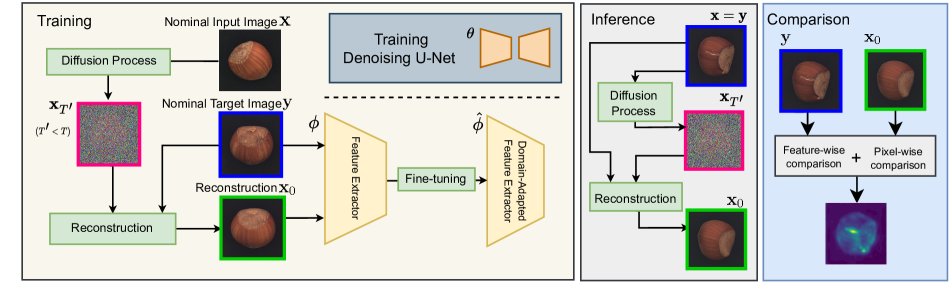
- Develop a conditioned denoising process for reconstruction where the target image y guides the denoising of a perturbed input x_t toward a nominal reconstruction x_0.
- Formulate posterior score gradient ∇_{x_t} log p_theta(x_t|y_t) as the sum of an unconditional score and a likelihood correction term, with a conditioning weight w.
- Update denoiser predictions to produce x_{t-1} using a modified epsilon_hat that accounts for the difference y_t−x_t (Equation 7).
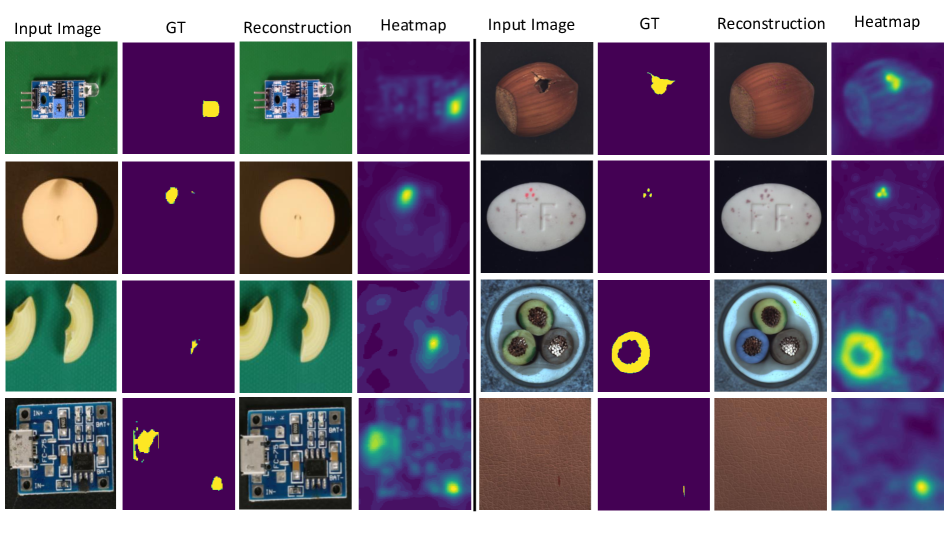
- Perform anomaly detection by setting the target y to the input x and reconstructing an anomaly-free version; anomalies are localized via pixel distance D_p and feature distance D_f (cosine-based) between x_0 and y.
- Fuse pixel- and feature-level distances into a final anomaly score D_anomaly to achieve robust localization.
- Apply an unsupervised domain adaptation (and distillation) to tailor a pretrained feature extractor to the target domain by minimizing feature distance between reconstructed and target images, with a distillation loss to prevent forgetting.
Experimental results
Research questions
- RQ1Can conditioning diffusion-based reconstruction on the target image improve anomaly-free restoration and thus anomaly detection performance?
- RQ2Does combining pixel-wise and feature-wise comparisons improve localization accuracy for anomalies?
- RQ3Can unsupervised domain adaptation of the feature extractor further boost detection and localization in domain-specific industrial data?
- RQ4What is the performance of DDAD on standard benchmarks (MVTec, VisA) and additional datasets (MTD) compared to state-of-the-art methods?
Key findings
- DDAD achieves image-level AUROC of 99.8% on MVTec and 98.9% on VisA after domain adaptation and feature fusion.
- Conditioning the diffusion process increases Image AUROC from 85.7% to 92.4% (MVTec) and 87.0% to 94.1% (VisA) over unconditional denoising with pixel-level guidance.
- Domain adaptation of the feature extractor yields an 8.2% (anomaly detection) and 4.8% (localization) improvement in the feature-based branch on MVTec/VisA datasets.
- Combining pixel-wise and feature-wise comparisons plus conditioning achieves superior localization, with DDAD surpassing both reconstruction-based and representation-based baselines on the reported benchmarks.
- A compact variant DDAD-S (~8M parameters) maintains competitive performance with faster inference, suitable for edge deployment.
- On MTD, DDAD-10 achieves 98.3% image AUROC, demonstrating strong generalization to single-category defect datasets.
Read this paper
Open the full text in the Nubint reader and ask about any passage as you read.
Read this paper on NubintThis review was generated by AI from the original paper. Please check the paper before citing it.