
[Paper Review] AnyLoc: Towards Universal Visual Place Recognition
AnyLoc builds a universal VPR solution by extracting per-pixel features from self-supervised foundation models (DINO/DINOv2 ViTs) and aggregating them with unsupervised methods (VLAD/GeM), achieving state-of-the-art or competitive results across 12 diverse datasets without VPR-specific training.
Visual Place Recognition (VPR) is vital for robot localization. To date, the most performant VPR approaches are environment- and task-specific: while they exhibit strong performance in structured environments (predominantly urban driving), their performance degrades severely in unstructured environments, rendering most approaches brittle to robust real-world deployment. In this work, we develop a universal solution to VPR -- a technique that works across a broad range of structured and unstructured environments (urban, outdoors, indoors, aerial, underwater, and subterranean environments) without any re-training or fine-tuning. We demonstrate that general-purpose feature representations derived from off-the-shelf self-supervised models with no VPR-specific training are the right substrate upon which to build such a universal VPR solution. Combining these derived features with unsupervised feature aggregation enables our suite of methods, AnyLoc, to achieve up to 4X significantly higher performance than existing approaches. We further obtain a 6% improvement in performance by characterizing the semantic properties of these features, uncovering unique domains which encapsulate datasets from similar environments. Our detailed experiments and analysis lay a foundation for building VPR solutions that may be deployed anywhere, anytime, and across anyview. We encourage the readers to explore our project page and interactive demos: https://anyloc.github.io/.
Motivation & Objective
- Motivate the need for a universal Visual Place Recognition (VPR) solution that works across structured and unstructured environments.
- Explore whether general-purpose, self-supervised foundation model features can serve as a universal substrate for VPR without task-specific retraining.
- Identify effective per-pixel feature extraction, aggregation, and vocabulary strategies to maximize cross-domain VPR performance.
- Demonstrate the diversity and robustness of AnyLoc across urban, indoor, aerial, underwater, and subterranean datasets.
- Provide insights into how semantic properties of aggregated features influence VPR performance and vocabulary design.
Proposed method
- Evaluate three foundation model families (DINO, DINOv2, CLIP) and compare per-image versus per-pixel feature extraction for VPR.
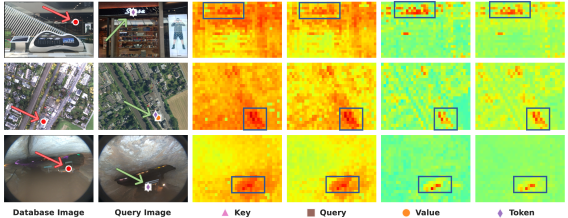
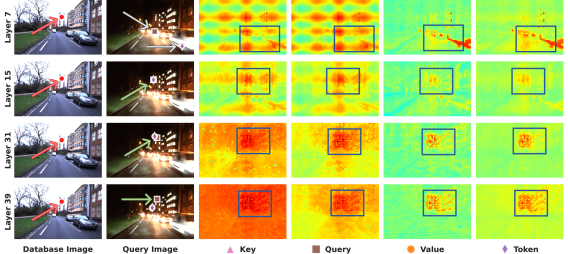
- Extract per-pixel features from intermediate ViT layers and discard CLS tokens to maintain fine-grained locality.
- Apply unsupervised aggregation methods (GAP, GMP, GeM, hard/soft VLAD) to per-pixel features.
- Construct domain-aware VLAD vocabularies using PCA-projected global descriptors to capture semantic domains (Urban, Indoor, Aerial, SubT, Degraded, Underwater).
- Assess AnyLoc variants (AnyLoc-GeM-DINOv2, AnyLoc-VLAD-DINO, AnyLoc-VLAD-DINOv2) on structured and unstructured datasets, including day-night and viewpoint variation scenarios.
- Compare against VPR baselines (NetVLAD, CosPlace, MixVPR) and CLS-token baselines (CLIP, DINO, DINOv2).
- Investigate the influence of ViT size, layer/facet choice, and vocabulary type on performance and descriptor size.
Experimental results
Research questions
- RQ1Can universal VPR be achieved without any VPR-specific training by leveraging self-supervised foundation-model features?
- RQ2Which combination of foundation-model, per-pixel feature extraction strategy, aggregation method, and vocabulary design yields robust performance across diverse environments and viewpoint changes?
- RQ3How does domain-aware vocabulary construction affect cross-dataset transfer and recall@1?
- RQ4Do self-supervised ViTs outperform VPR-specific ViTs when paired with unsupervised aggregation for universal VPR?
- RQ5What are the trade-offs between descriptor dimensionality and retrieval accuracy across environments?
Key findings
- AnyLoc variants surpass state-of-the-art baselines by substantial margins on unstructured environments (e.g., Nardo-Air, VP-Air) and show strong performance across all 12 datasets.
- Per-pixel features from self-supervised ViTs with unsupervised aggregation (GeM, VLAD) outperform per-image CLS-based descriptors for VPR.
- Domain-aware vocabulary construction via PCA projection of global descriptors yields improved Recall@1, particularly in aerial and urban domains.
- Hard-assignment VLAD generally provides the best performance among unsupervised aggregations, with GeM offering favorable descriptor size/accuracy trade-offs.
- Self-supervised ViTs (DINO, DINOv2) with AnyLoc-VLAD achieve higher Recall@1 across structured and unstructured environments than VPR-trained ViTs (CosPlace), often with smaller or comparable descriptor sizes.
- Longitudinal and cross-domain experiments demonstrate AnyLoc’s robustness to time (day-night, seasons) and viewpoint variations (anyview).
Read this paper
Open the full text in the Nubint reader and ask about any passage as you read.
Read this paper on NubintThis review was generated by AI from the original paper. Please check the paper before citing it.