
[Paper Review] AnyMAL: An Efficient and Scalable Any-Modality Augmented Language Model
AnyMAL is a scalable, efficient multimodal language model that aligns diverse inputs—text, images, video, audio, and IMU sensor data—into the text embedding space of a 70B-parameter LLaMA-2 model via modality-specific adapters. It achieves state-of-the-art performance on multimodal benchmarks, including +7.0% accuracy on VQAv2 and +14.5% CIDEr on AudioCaps, through instruction tuning on a novel, high-quality multimodal instruction dataset (MM-IT).
We present Any-Modality Augmented Language Model (AnyMAL), a unified model that reasons over diverse input modality signals (i.e. text, image, video, audio, IMU motion sensor), and generates textual responses. AnyMAL inherits the powerful text-based reasoning abilities of the state-of-the-art LLMs including LLaMA-2 (70B), and converts modality-specific signals to the joint textual space through a pre-trained aligner module. To further strengthen the multimodal LLM's capabilities, we fine-tune the model with a multimodal instruction set manually collected to cover diverse topics and tasks beyond simple QAs. We conduct comprehensive empirical analysis comprising both human and automatic evaluations, and demonstrate state-of-the-art performance on various multimodal tasks.
Motivation & Objective
- Address the lack of open-source, scalable multimodal LLMs that support diverse modalities beyond text and image.
- Enable joint reasoning over interleaved multimodal inputs (e.g., image + audio + motion sensor) using a unified text-based reasoning framework.
- Overcome limitations in existing models by extending instruction tuning to complex, unconstrained multimodal tasks beyond simple QA.
- Develop a scalable, efficient training recipe that preserves the reasoning strength of large language models while enabling multimodal understanding.
Proposed method
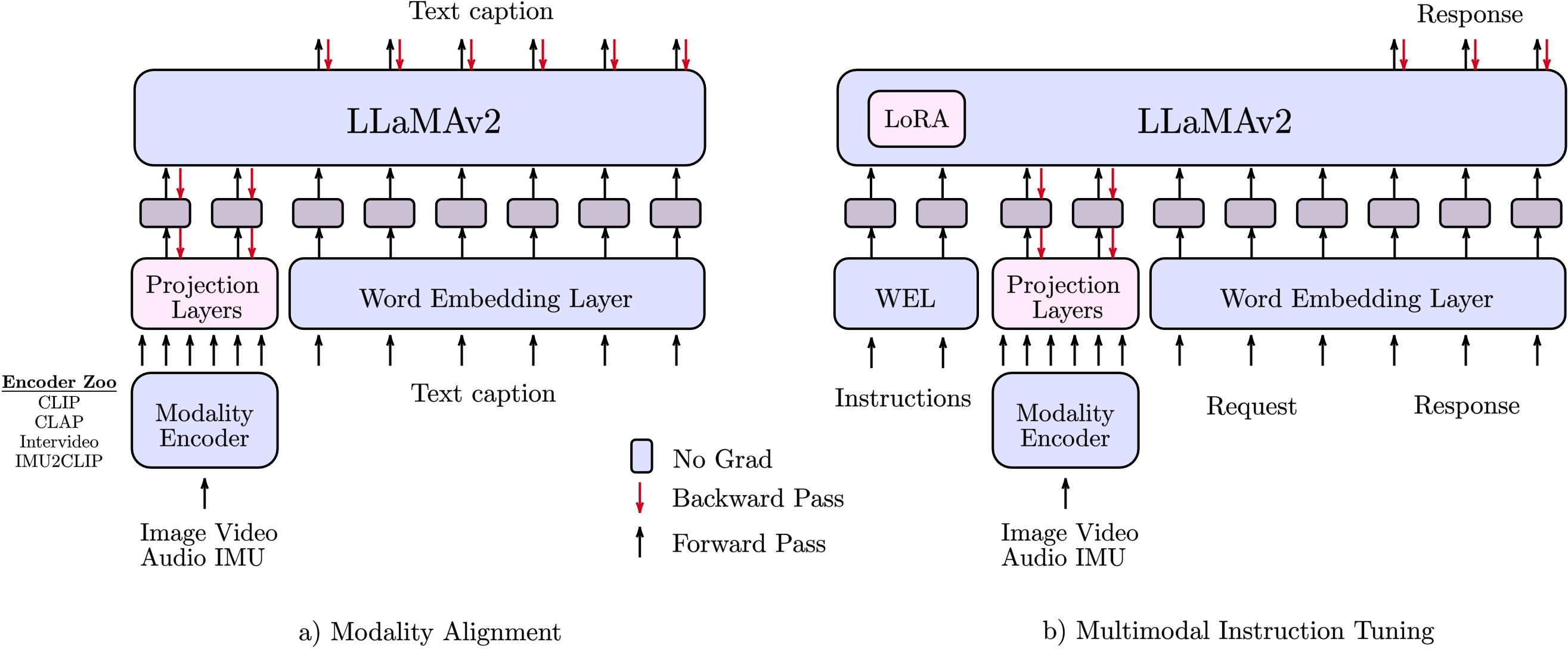
- Use modality-specific lightweight adapters to project inputs from images, video, audio, and IMU signals into the text embedding space of a pre-trained LLaMA-2-70B model.
- Leverage pre-trained encoders (e.g., CLIP, CLAP, IMU2CLIP) that are already aligned to the text space, ensuring feature compatibility and reducing training cost.
- Fix the LLM parameters during pre-training to preserve its reasoning capabilities and accelerate convergence, while fine-tuning only the adapter and projection layers.
- Train the alignment using contrastive objectives between paired modality signals and text narrations, using a shared joint token space.
- Fine-tune the full model on a newly collected, high-quality multimodal instruction tuning dataset (MM-IT) covering image, video, and audio tasks across diverse domains.
- Apply safety mechanisms at inference time, including image, text, and multimodal classifiers to detect and reject harmful inputs or outputs.
Experimental results
Research questions
- RQ1Can a unified, scalable framework effectively align diverse modalities—text, image, video, audio, and IMU—into a single text-based reasoning space without compromising model performance?
- RQ2How does instruction tuning on a diverse, manually curated multimodal instruction dataset improve reasoning capabilities beyond standard QA tasks?
- RQ3To what extent can a large-scale, open-source multimodal LLM achieve state-of-the-art performance across multiple benchmarks while maintaining safety and integrity?
- RQ4What are the key architectural and training choices that enable efficient, scalable multimodal alignment without fine-tuning the base LLM?
Key findings
- AnyMAL achieves a +7.0% relative accuracy improvement on the VQAv2 benchmark compared to prior models, demonstrating strong visual reasoning capabilities.
- The model sets a new SOTA on zero-shot COCO image captioning with a +8.4% CIDEr score improvement over existing models.
- On the AudioCaps benchmark, AnyMAL achieves a +14.5% CIDEr score improvement in zero-shot captioning, indicating strong audio understanding and generation.
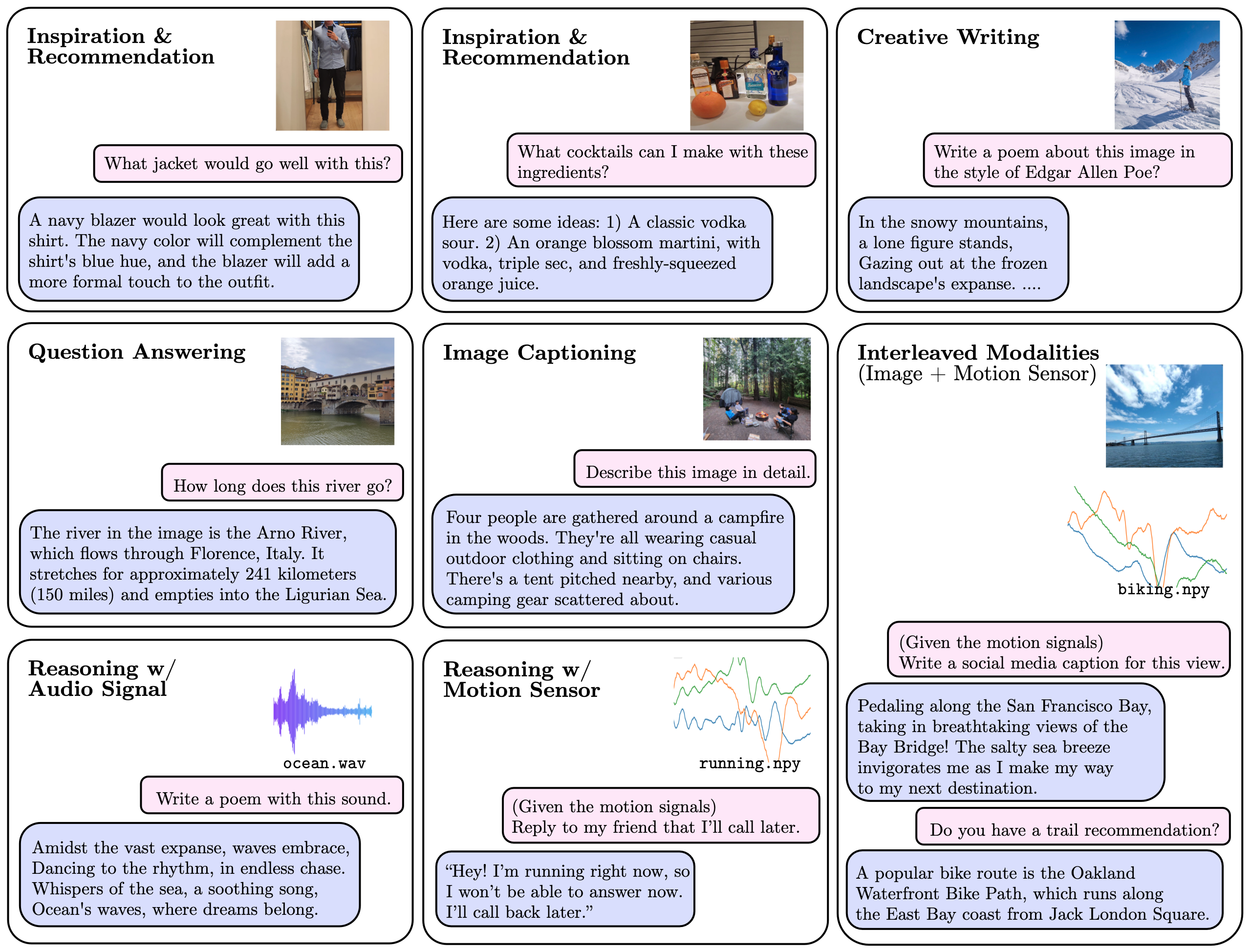
- The model successfully supports interleaved multimodal prompting (e.g., image + IMU + text), enabling joint reasoning over combined sensory inputs.
- Human evaluations confirm that AnyMAL generates more accurate, coherent, and contextually grounded responses across diverse multimodal tasks.
- Safety mechanisms at inference time effectively detect and reject harmful inputs and outputs, including multimodal associations that could produce biased or unsafe content.
Read this paper
Open the full text in the Nubint reader and ask about any passage as you read.
Read this paper on NubintThis review was generated by AI from the original paper. Please check the paper before citing it.