
[Paper Review] Approximating Online Human Evaluation of Social Chatbots with Prompting
This paper proposes DEP, a prompting-based framework that uses large language models (LLMs) to automatically approximate online human evaluation of social chatbots. By conditioning an LLM to play specific social roles and applying instruction-tuned prompting, DEP generates synthetic dialog logs and evaluation scores with up to 0.95 Pearson correlation to human judgments, enabling scalable, cost-effective, and accurate chatbot evaluation in real-world interaction settings.
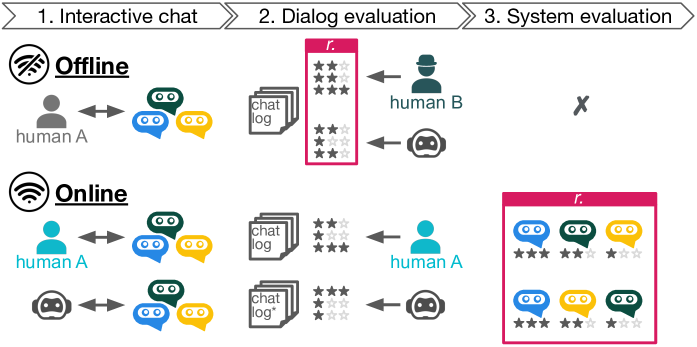
As conversational models become increasingly available to the general public, users are engaging with this technology in social interactions. Such unprecedented interaction experiences may pose considerable social and psychological risks to the users unless the technology is properly controlled. This highlights the need for scalable and robust evaluation metrics for conversational chatbots. Existing evaluation metrics aim to automate offline user evaluation and approximate human judgment of pre-curated dialogs. However, they are limited in their ability to capture subjective perceptions of users who actually interact with the bots and might not generalize to real-world settings. To address this limitation, we propose an approach to approximate online human evaluation leveraging large language models (LLMs) from the GPT family. We introduce a new Dialog system Evaluation framework based on Prompting (DEP), which enables a fully automatic evaluation pipeline that replicates live user studies and achieves an impressive correlation with human judgment (up to Pearson r=0.95 on a system level). The DEP approach involves collecting synthetic chat logs of evaluated bots with an LLM in the other-play setting, where the LLM is carefully conditioned to follow a specific scenario. We further explore different prompting approaches to produce evaluation scores with the same LLM. The best performing prompts, which contain few-shot demonstrations and instructions, show outstanding performance on the tested dataset and demonstrate the ability to generalize to other dialog corpora.
Motivation & Objective
- To address the gap in existing evaluation metrics that fail to capture real users' subjective perceptions in live interactions with social chatbots.
- To develop an automated, scalable, and cost-effective alternative to online human evaluation that replicates live user study dynamics.
- To explore whether LLMs can be effectively prompted to simulate human-like social roles and evaluation behaviors in dialog systems.
- To achieve high correlation between automated evaluation scores and human judgments in empathetic and open-domain dialog settings.
- To enable generalization of evaluation across different dialog corpora and social phenomena beyond basic quality metrics.
Proposed method
- Using a GPT-family LLM as a synthetic conversational partner to generate realistic dialog logs with evaluated chatbots in an 'other-play' setting.
- Conditioning the LLM with role-specific prompts to simulate specific social roles (e.g., empathetic listener, emotional speaker) during dialog generation.
- Applying few-shot prompting with annotated examples to guide the LLM in assigning fine-grained evaluation scores based on dialog quality dimensions.
- Designing instruction prompts that explicitly link fine-grained attributes (e.g., empathy, coherence) to overall dialog scores to improve alignment with human judgment.
- Aggregating evaluation scores across multiple dialog sessions to compute system-level rankings for comparative analysis.
- Validating the framework using benchmark datasets (iEval, FED, DSTC9) and measuring correlation with human-annotated ground truth.
Experimental results
Research questions
- RQ1Can LLMs be effectively prompted to simulate human-like social roles in dialog interactions, enabling realistic synthetic dialog logs?
- RQ2To what extent can instruction-tuned prompting produce evaluation scores that correlate with human judgments in online evaluation settings?
- RQ3How well does the DEP framework generalize across different dialog corpora and social interaction phenomena (e.g., empathy, toxicity)?
- RQ4What prompting strategies (e.g., few-shot demonstrations, detailed instructions) yield the highest correlation with human evaluation?
- RQ5Can the framework be adapted to evaluate complex social behaviors beyond basic response quality, such as emotional support or humor?
Key findings
- The DEP framework achieves a Pearson correlation of up to 0.95 with human judgment at the system level on the iEval dataset, demonstrating strong alignment with human evaluation.
- Few-shot prompting with detailed instructions significantly improves evaluation score accuracy, outperforming zero-shot or generic prompting approaches.
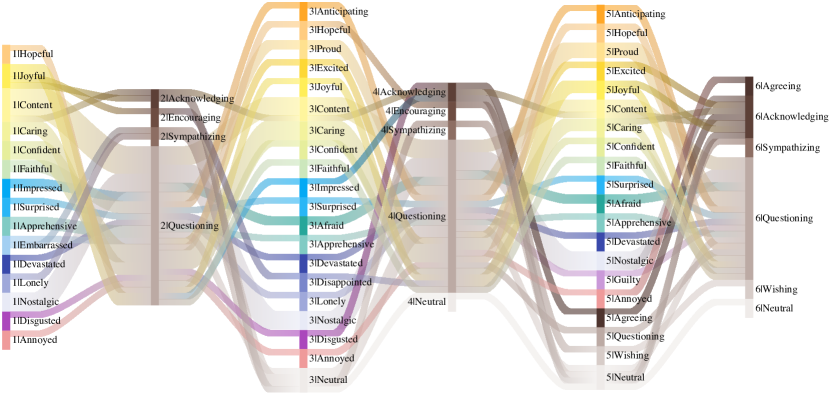
- The LLM's behavior in synthetic dialog logs closely mirrors human conversational patterns, including emotion and intent distributions, though some sub-flows (e.g., gratitude) show signs of model personality due to RLHF training.
- The framework generalizes well to other dialog corpora, including FED and DSTC9, indicating robustness across different evaluation contexts.
- The synthetic dialog logs and evaluation annotations are publicly released, enabling reproducibility and future benchmarking.
- The framework enables fast, automated chatbot evaluation without human annotators, reducing time and cost while maintaining high reliability.
Read this paper
Open the full text in the Nubint reader and ask about any passage as you read.
Read this paper on NubintThis review was generated by AI from the original paper. Please check the paper before citing it.