
[Paper Review] ARB: Advanced Reasoning Benchmark for Large Language Models
ARB is a challenging, graduate-level reasoning benchmark spanning math, physics, chemistry, biology, and law. It introduces a rubric-based self-evaluation approach and shows current LLMs still underperform on advanced quantitative tasks.
Large Language Models (LLMs) have demonstrated remarkable performance on various quantitative reasoning and knowledge benchmarks. However, many of these benchmarks are losing utility as LLMs get increasingly high scores, despite not yet reaching expert performance in these domains. We introduce ARB, a novel benchmark composed of advanced reasoning problems in multiple fields. ARB presents a more challenging test than prior benchmarks, featuring problems in mathematics, physics, biology, chemistry, and law. As a subset of ARB, we introduce a challenging set of math and physics problems which require advanced symbolic reasoning and domain knowledge. We evaluate recent models such as GPT-4 and Claude on ARB and demonstrate that current models score well below 50% on more demanding tasks. In order to improve both automatic and assisted evaluation capabilities, we introduce a rubric-based evaluation approach, allowing GPT-4 to score its own intermediate reasoning steps. Further, we conduct a human evaluation of the symbolic subset of ARB, finding promising agreement between annotators and GPT-4 rubric evaluation scores.
Motivation & Objective
- Introduce ARB as a new benchmark to assess expert, graduate-level reasoning across multiple domains.
- Provide a diverse set of problems (math, physics, biology, chemistry, law) sourced from professional/graduate materials.
- Propose and validate rubric-based evaluation enabling self-assessment of intermediate reasoning steps.
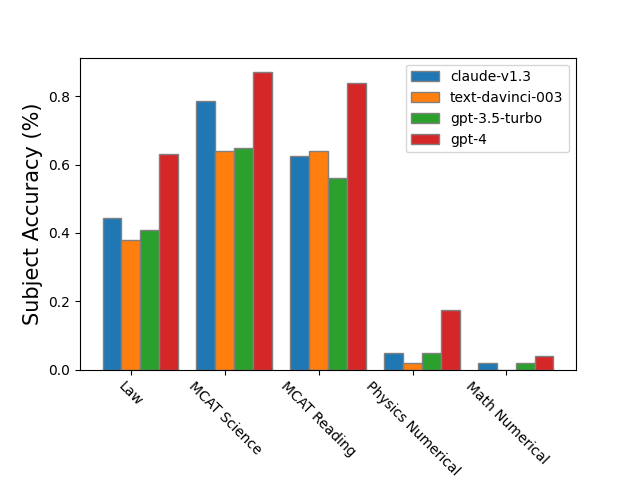
- Demonstrate model performance (GPT-4, GPT-3.5, Claude) and analyze error types and evaluation reliability.
Proposed method
- Benchmark consists of three question types: multiple choice, short answer, and open response, with a higher proportion of short/open-ended questions.
- Problems are sourced from standardized tests, problem books, graduate exams, and bar/law materials to ensure graduate-level difficulty.
- Automated parsing and scoring procedures are used for multiple-choice and numerical answers, with SymPy-based parsing for symbolic answers.
- A model-based rubric evaluation approach is introduced, where GPT-4 generates rubrics from a reference solution and uses them to score solutions.
- Human evaluation is performed on symbolic subset to compare with rubric-based scores, assessing coverage and credit allocation.
Experimental results
Research questions
- RQ1How do current LLMs (e.g., GPT-4, GPT-3.5, Claude) perform on ARB's advanced reasoning tasks across domains?
- RQ2Can rubric-generated, model-based evaluation reliably approximate human grading for symbolic and proof-like problems?
- RQ3What types of errors do LLMs make on advanced mathematics and physics problems, and how do these errors differ by problem type?
- RQ4Does self-evaluation via rubrics correlate with human judgments and improve robustness of automatic scoring?
Key findings
- Current models score well below expert levels on many demanding quantitative tasks in ARB.
- GPT-4 can simplify complex expressions but still struggles with long-context arithmetic and symbolic manipulation.
- Symbolic and proof-like problems show substantial failure rates across models, with explicit table-based percentages reported for several categories.
- Rubric-based evaluation by GPT-4 shows moderately high correlation with human scoring (e.g., physics symbolic, math symbolic, and proof-like problems).
- GPT-4-generated rubrics cover crucial solution steps well but can misallocate points; rubric-based scoring reduces evaluation effort and aligns with manual grading.
- Model-based evaluation via rubrics is promising as an automated proxy for correctness, though not a full replacement for human grading.
Read this paper
Open the full text in the Nubint reader and ask about any passage as you read.
Read this paper on NubintThis review was generated by AI from the original paper. Please check the paper before citing it.