
[Paper Review] Are Chatbots Reliable Text Annotators? Sometimes
The paper systematically compares open-source LLMs, ChatGPT, and traditional supervised classifiers for binary text annotation tasks on US political Tweets, finding supervised models consistently outperform LLMs, with ChatGPT only intermittently competitive and open-source models offering no clear Open Science advantage.
Recent research highlights the significant potential of ChatGPT for text annotation in social science research. However, ChatGPT is a closed-source product which has major drawbacks with regards to transparency, reproducibility, cost, and data protection. Recent advances in open-source (OS) large language models (LLMs) offer an alternative without these drawbacks. Thus, it is important to evaluate the performance of OS LLMs relative to ChatGPT and standard approaches to supervised machine learning classification. We conduct a systematic comparative evaluation of the performance of a range of OS LLMs alongside ChatGPT, using both zero- and few-shot learning as well as generic and custom prompts, with results compared to supervised classification models. Using a new dataset of tweets from US news media, and focusing on simple binary text annotation tasks, we find significant variation in the performance of ChatGPT and OS models across the tasks, and that the supervised classifier using DistilBERT generally outperforms both. Given the unreliable performance of ChatGPT and the significant challenges it poses to Open Science we advise caution when using ChatGPT for substantive text annotation tasks.
Motivation & Objective
- Evaluate the performance of open-source LLMs (OS LLMs) relative to ChatGPT and traditional supervised models for binary annotation tasks in social science texts.
- Assess the impact of zero-shot and few-shot learning and generic vs. custom prompts on model performance.
- Examine Open Science implications by comparing transparency, reproducibility, and cost across modeling approaches.
Proposed method
- Use a new dataset of 2,900 human-annotated Tweets from US news media as ground truth.
- Evaluate two binary classification tasks: political vs. non-political and exemplar vs. non-exemplar content.
- Compare DistilBERT (supervised) to OS LLMs (Beluga-13B, FLAN-T5-XXL, all-MiniLM-L6, BGE-large-en) and ChatGPT (GPT-3.5-turbo, GPT-4).
- Experiment with zero-shot and few-shot settings and with generic and custom prompts.
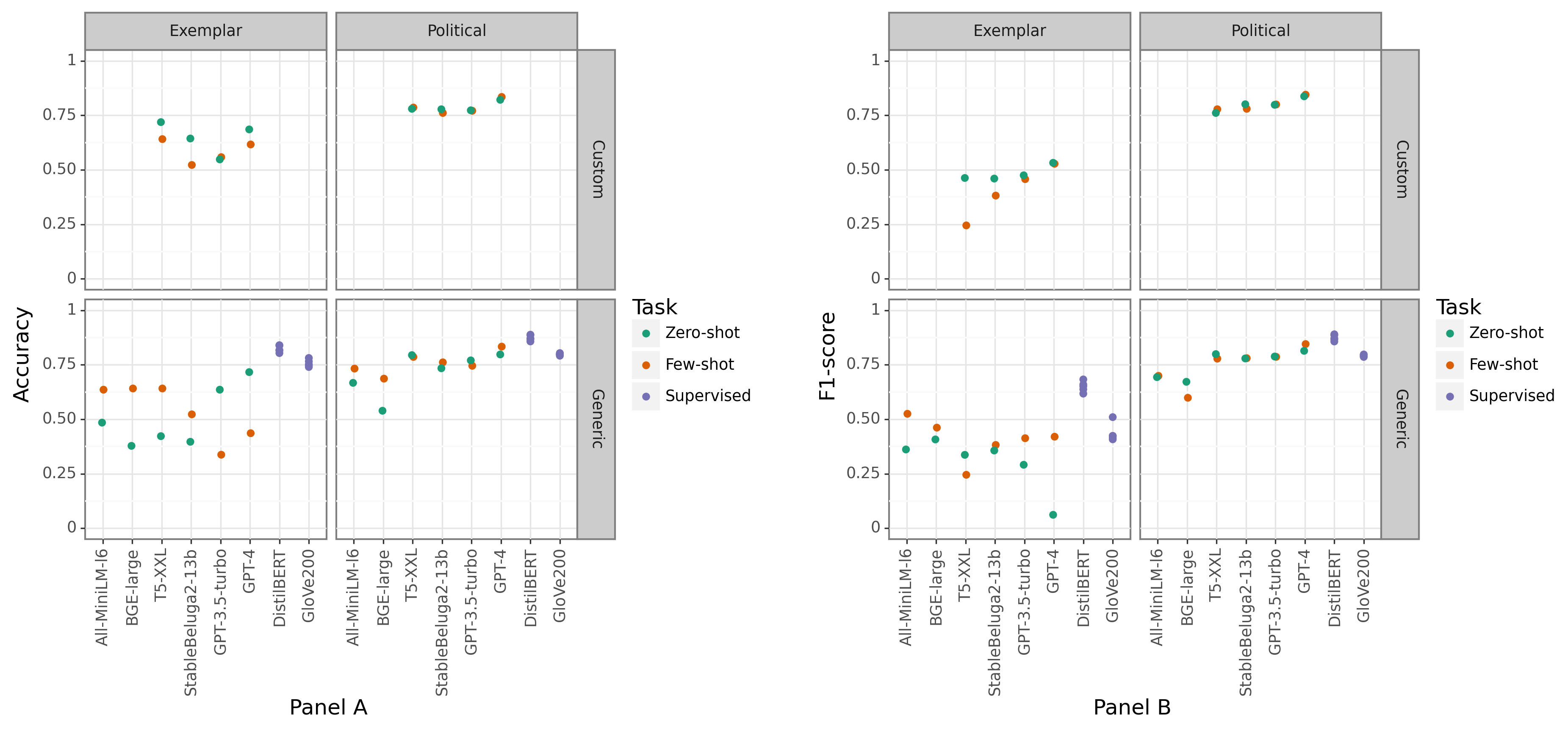
- Measure performance using accuracy and F1-score, with Krippendorf reliability on the annotations guiding the ground truth.
Experimental results
Research questions
- RQ1Do OS LLMs and ChatGPT achieve competitive performance compared to traditional supervised classifiers on simple binary social science annotation tasks?
- RQ2How do zero-shot vs. few-shot and generic vs. custom prompts affect performance across model families?
- RQ3Is there a trade-off between classification accuracy and Open Science principles when using LLMs for text annotation?
- RQ4How consistent and reliable are LLMs across different tasks (political vs. exemplar) and models?
Key findings
- DistilBERT, a supervised model, achieves the highest performance on both tasks.
- OS LLMs can approach ChatGPT performance for political content with custom prompts, despite being smaller models.
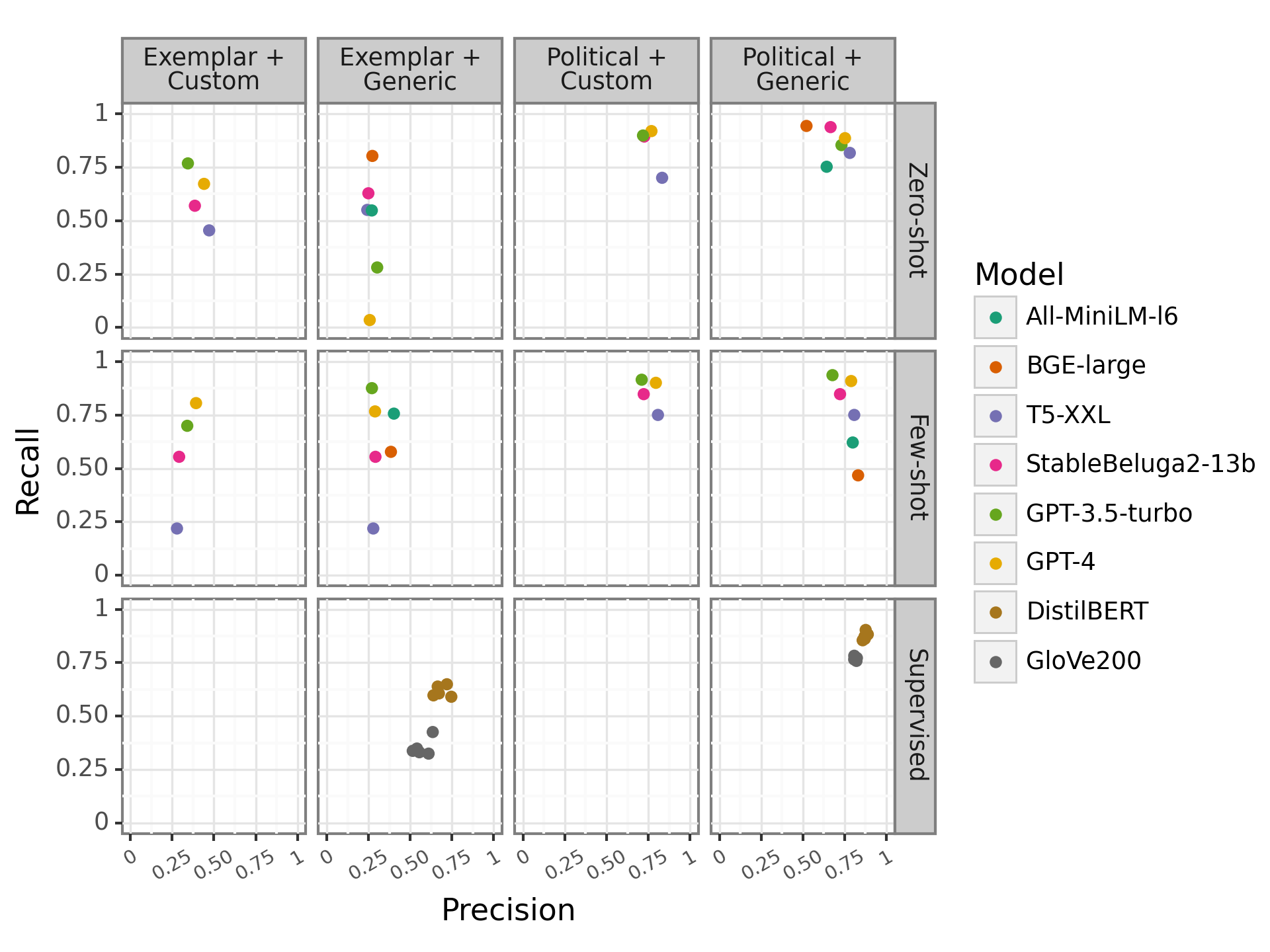
- All LLMs struggle more with the exemplar task (an esoteric category), showing high variability and lower precision for the minority class.
- GPT-4 can show strong performance in some setups but can exhibit very low recall for exemplar detection in zero-shot, depending on prompt type.
- Overall, supervised models consistently outperform both ChatGPT and OS LLMs across tasks and prompting regimes.
- Custom prompting and few-shot learning can improve LLM performance in some cases, but effects are inconsistent; smaller open models (e.g., StableBeluga-13B) offer practical advantages for local, cost-effective experimentation.
Read this paper
Open the full text in the Nubint reader and ask about any passage as you read.
Read this paper on NubintThis review was generated by AI from the original paper. Please check the paper before citing it.