
[Paper Review] Are Defenses for Graph Neural Networks Robust?
The paper evaluates 7 popular GNN defenses with adaptive attacks and finds that most defenses offer little to no robustness gains, with some performing worse than undefended baselines; it also provides a methodology for designing strong adaptive attacks and proposes robustness unit tests.
A cursory reading of the literature suggests that we have made a lot of progress in designing effective adversarial defenses for Graph Neural Networks (GNNs). Yet, the standard methodology has a serious flaw - virtually all of the defenses are evaluated against non-adaptive attacks leading to overly optimistic robustness estimates. We perform a thorough robustness analysis of 7 of the most popular defenses spanning the entire spectrum of strategies, i.e., aimed at improving the graph, the architecture, or the training. The results are sobering - most defenses show no or only marginal improvement compared to an undefended baseline. We advocate using custom adaptive attacks as a gold standard and we outline the lessons we learned from successfully designing such attacks. Moreover, our diverse collection of perturbed graphs forms a (black-box) unit test offering a first glance at a model's robustness.
Motivation & Objective
- Survey 49 defenses proposed for GNN robustness across graph, architecture, and training categories.
- Design custom adaptive attacks for 7 representative defenses to measure true robustness.
- Provide a transparent methodology and practical guidelines for robust evaluation of GNN defenses.
- Offer a robustness unit test collection (perturbed graphs) to quickly gauge defense robustness.
Proposed method
- Classify defenses using an extended taxonomy incorporating graph preprocessing, training modifications, and architectural adaptations.
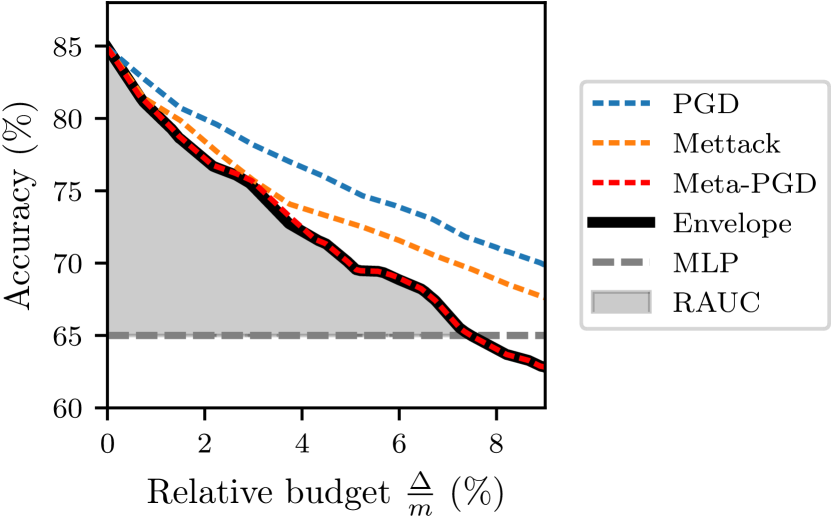
- Develop and apply strong adaptive attacks (including FGA, PGD, Metattack, Meta-PGD) with perfect knowledge of models and defenses.
- Use a budgeted L0 perturbation framework for both global (test-set level) and local (per-node) perturbations, including poisoning and evasion settings.
- Tune attack losses (logit margin variants like LM, TLM, PM) and hyperparameters to maximize attack strength.
- Demonstrate how to handle gradient issues, non-differentiable components, and attack transfer between models to form a robust evaluation protocol.
- Provide a case study (SVD-GCN, ProGNN) illustrating how adaptive attacks are engineered against composite defenses.
Experimental results
Research questions
- RQ1How robust are popular GNN defenses when evaluated under adaptive (white-box) attacks?
- RQ2Do defenses provide meaningful robustness gains against strong adaptive perturbations across poisoning and evasion, local and global settings?
- RQ3What common weaknesses do defenses exhibit under adaptive attacks, and can a universal perturbation bypass multiple defenses?
- RQ4Can a set of perturbed graphs serve as a practical robustness unit test for GNNs?
- RQ5How do defense performance and robustness vary across datasets such as Cora ML and Citeseer?
Key findings
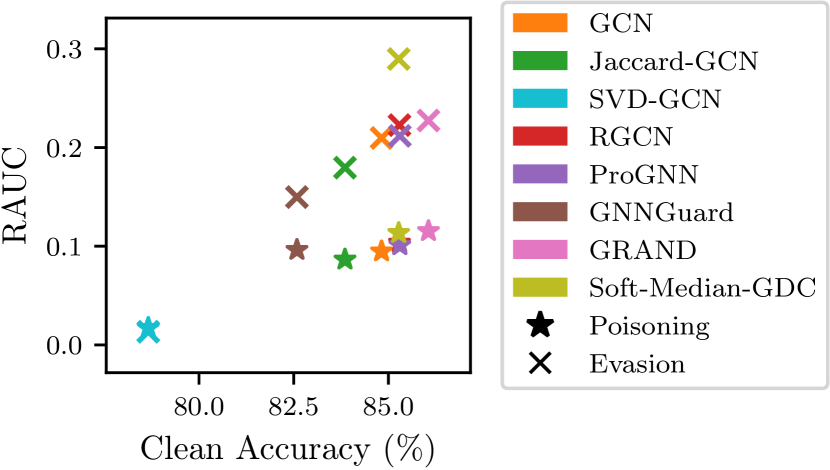
- Adaptive attacks reduce robustness of defenses by about 40% on average compared to non-adaptive evaluations.
- Nearly half of the defenses perform worse than an undefended GCN under adaptive attacks, with some defenses showing negligible robustness improvements.
- Defense effectiveness depends on dataset; robustness gains are not uniform across Cora ML and Citeseer.
- Higher clean accuracy does not imply lower robustness in this domain; some robust defenses maintain or exceed baseline accuracy under attack.
- Adaptive attacks reveal distinct attack vectors per defense, indicating no-one-fits-all perturbation; transferability of attacks is common but not universal.
- The authors provide a robustness unit test: perturbed graphs from adaptive attacks transfer well in most cases, serving as a practical evaluation resource.
Read this paper
Open the full text in the Nubint reader and ask about any passage as you read.
Read this paper on NubintThis review was generated by AI from the original paper. Please check the paper before citing it.