
[Paper Review] Are Emergent Abilities in Large Language Models just In-Context Learning?
The paper evaluates emergent abilities in 18 models (60M–175B params) across 22 tasks, controlling for in-context learning and instruction tuning, and finds that emergent abilities are largely explained by in-context learning rather than true emergent reasoning.
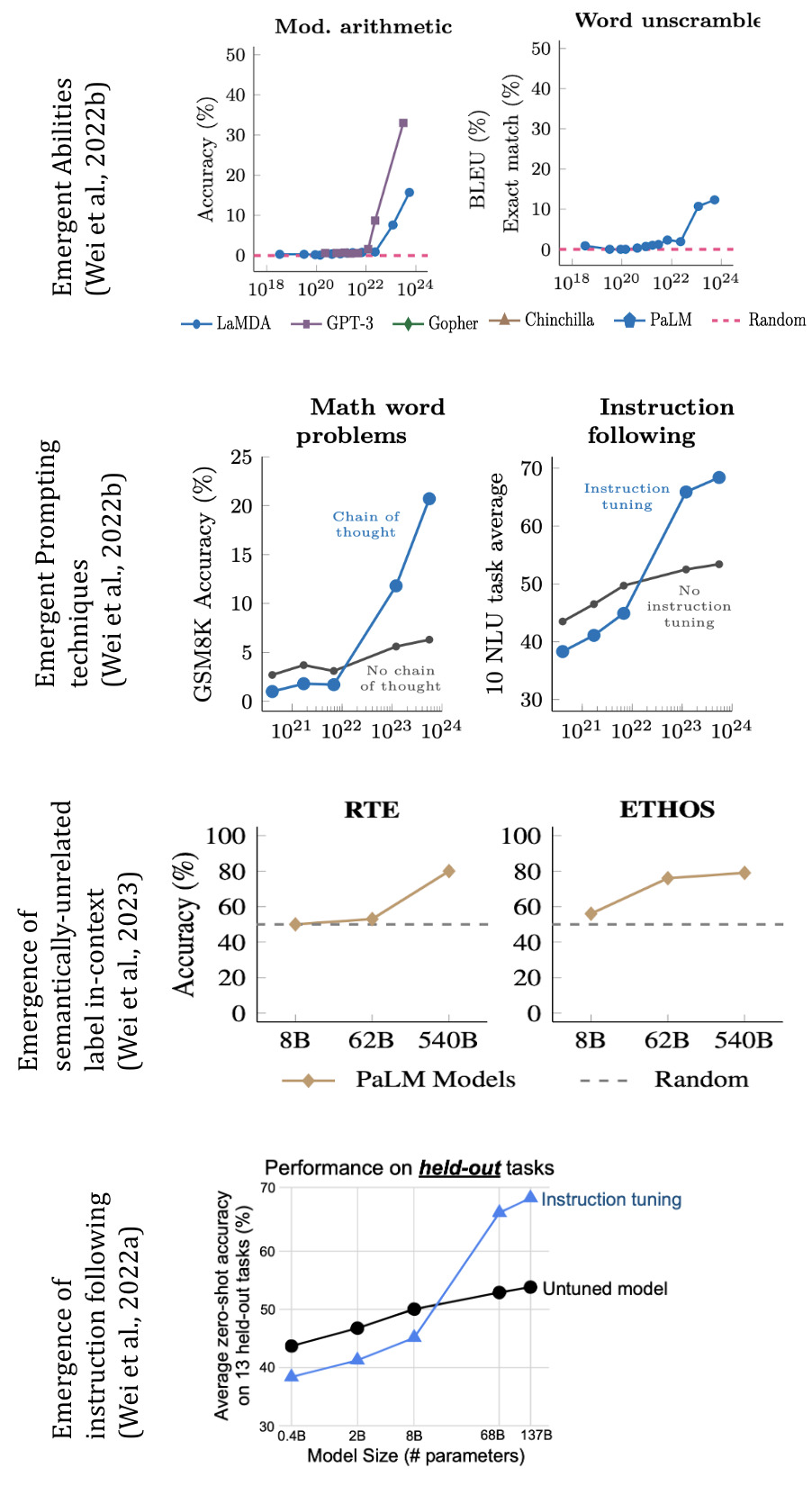
Large language models, comprising billions of parameters and pre-trained on extensive web-scale corpora, have been claimed to acquire certain capabilities without having been specifically trained on them. These capabilities, referred to as "emergent abilities," have been a driving force in discussions regarding the potentials and risks of language models. A key challenge in evaluating emergent abilities is that they are confounded by model competencies that arise through alternative prompting techniques, including in-context learning, which is the ability of models to complete a task based on a few examples. We present a novel theory that explains emergent abilities, taking into account their potential confounding factors, and rigorously substantiate this theory through over 1000 experiments. Our findings suggest that purported emergent abilities are not truly emergent, but result from a combination of in-context learning, model memory, and linguistic knowledge. Our work is a foundational step in explaining language model performance, providing a template for their efficient use and clarifying the paradox of their ability to excel in some instances while faltering in others. Thus, we demonstrate that their capabilities should not be overestimated.
Motivation & Objective
- Assess which abilities are truly emergent when in-context learning and instruction tuning are removed.
- Distinguish emergent abilities from effects of prompting techniques.
- Evaluate whether instruction tuning triggers in-context learning or reveals genuine reasoning capabilities.
Proposed method
- Evaluate non-instruction-tuned models in a zero-shot setting to remove in-context learning effects.
- Compare model families (GPT, T5, Falcon, LLaMA) with and without instruction tuning across varied scales.
- Use a curated set of tasks including both emergent and non-emergent ones from prior work, with careful bias controls.
- Manually classify tasks into memorisable, formal, and functional categories to interpret results.
- Analyse whether instruction tuning can account for additional capabilities by leveraging in-context learning (Occam’s Razor).
Experimental results
Research questions
- RQ1Which abilities are truly emergent in the absence of in-context learning and instruction tuning?
- RQ2Does instruction tuning induce or rely on in-context learning to explain observed capabilities?
- RQ3Are observed abilities attributable to formal linguistic skills, memorisation, or functional reasoning?
- RQ4Can a simpler explanation (in-context learning) account for the gains seen in instruction-tuned models?
Key findings
- Emergent abilities largely attributable to in-context learning rather than intrinsic emergence.
- No evidence for emergence of reasoning abilities in the absence of prompting techniques.
- Instruction tuning improves task performance primarily through efficient use of in-context capabilities rather than true emergent reasoning.
- Formal linguistic abilities and memorisation remain distinct from functional reasoning abilities in these analyses.
- The study provides open access to code and results for replication.
Read this paper
Open the full text in the Nubint reader and ask about any passage as you read.
Read this paper on NubintThis review was generated by AI from the original paper. Please check the paper before citing it.