
[Paper Review] Are Language Models Puzzle Prodigies? Algorithmic Puzzles Unveil Serious Challenges in Multimodal Reasoning
This paper introduces AlgoPuzzleVQA, a novel multimodal benchmark that evaluates language models on algorithmic visual puzzles requiring integrated visual, linguistic, and algorithmic reasoning. Generated automatically from human-written code, the dataset tests reasoning across topics like graph theory and optimization; results show GPT-4V and Gemini Pro perform near-random on multi-choice puzzles, revealing critical gaps in multimodal reasoning capabilities.
This paper introduces the novel task of multimodal puzzle solving, framed within the context of visual question-answering. We present a new dataset, AlgoPuzzleVQA designed to challenge and evaluate the capabilities of multimodal language models in solving algorithmic puzzles that necessitate both visual understanding, language understanding, and complex algorithmic reasoning. We create the puzzles to encompass a diverse array of mathematical and algorithmic topics such as boolean logic, combinatorics, graph theory, optimization, search, etc., aiming to evaluate the gap between visual data interpretation and algorithmic problem-solving skills. The dataset is generated automatically from code authored by humans. All our puzzles have exact solutions that can be found from the algorithm without tedious human calculations. It ensures that our dataset can be scaled up arbitrarily in terms of reasoning complexity and dataset size. Our investigation reveals that large language models (LLMs) such as GPT4V and Gemini exhibit limited performance in puzzle-solving tasks. We find that their performance is near random in a multi-choice question-answering setup for a significant number of puzzles. The findings emphasize the challenges of integrating visual, language, and algorithmic knowledge for solving complex reasoning problems.
Motivation & Objective
- To address the lack of benchmarks that test the integration of visual, linguistic, and algorithmic reasoning in multimodal models.
- To create a scalable, automatically generated dataset of algorithmic puzzles grounded in formal mathematical and computational principles.
- To evaluate whether large language models can solve complex, self-contained puzzles requiring logical inference beyond memorization.
- To uncover limitations in current multimodal models when faced with reasoning tasks that demand precise algorithmic execution.
- To provide a benchmark that enables progressive evaluation of increasingly complex reasoning capabilities in future models.
Proposed method
- Puzzles are automatically generated from human-authored code, ensuring correctness and scalability.
- Each puzzle instance is derived by varying inputs and configurations of a known algorithmic solution, enabling control over reasoning complexity.
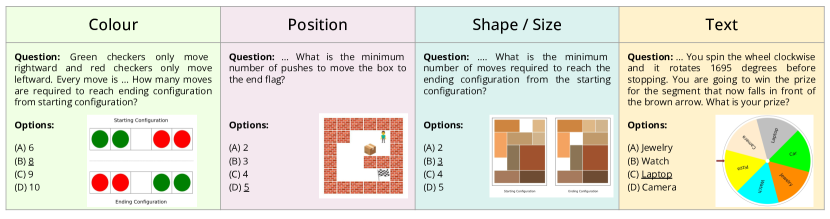
- Visual contexts depict puzzle states (e.g., jug levels, wheel segments, grid layouts), while language questions specify rules and queries.
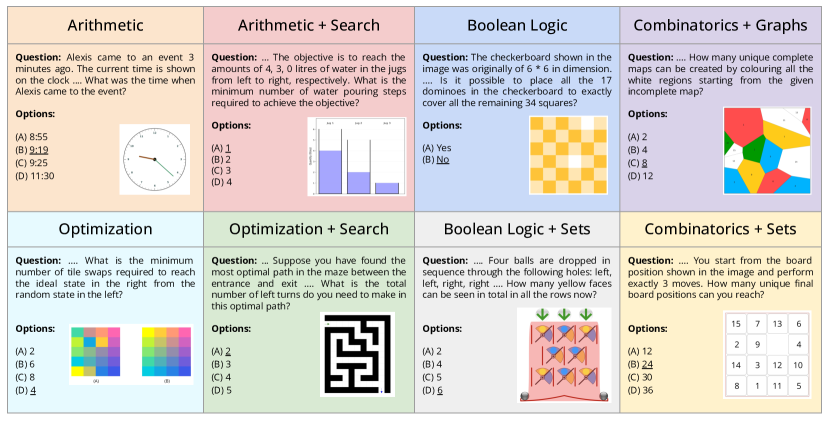
- The dataset includes diverse algorithmic categories: boolean logic, combinatorics, graph theory, optimization, search, and spatial reasoning.
- Negative choices in multiple-choice questions are generated using heuristics based on answer magnitude or plausible distractors (e.g., prizes on a wheel).
- Models are evaluated using GPT-4V and Gemini Pro via public APIs on a multi-choice VQA setup.
Experimental results
Research questions
- RQ1Can multimodal language models like GPT-4V and Gemini Pro solve algorithmic visual puzzles that require integrated visual, linguistic, and algorithmic reasoning?
- RQ2To what extent do current LLMs generalize beyond memorized facts when solving novel, self-contained algorithmic puzzles?
- RQ3How does performance vary across different algorithmic domains such as graph theory, optimization, and spatial reasoning?
- RQ4What is the impact of reasoning complexity and puzzle structure on model performance?
- RQ5Can automated, code-based generation produce scalable, high-quality benchmarks for evaluating advanced multimodal reasoning?
Key findings
- GPT-4V and Gemini Pro exhibit near-random performance on multi-choice questions for a significant portion of AlgoPuzzleVQA puzzles, indicating poor generalization in complex reasoning.
- Performance drops substantially on puzzles requiring non-trivial algorithmic reasoning, such as water jug problems and sliding block puzzles, despite exact solutions being computable from the input.
- Models struggle particularly with puzzles involving spatial reasoning (e.g., wheel rotation) and combinatorial optimization, even when the solution path is deterministic.
- The dataset’s automated generation from human code ensures scalability and consistent reasoning complexity, enabling future evaluation of increasingly advanced models.
- The results reveal a critical gap between visual and language understanding and the ability to execute algorithmic reasoning in multimodal models.
- Even with access to visual and textual context, models fail to apply logical rules systematically, suggesting limited internalization of algorithmic procedures.
Read this paper
Open the full text in the Nubint reader and ask about any passage as you read.
Read this paper on NubintThis review was generated by AI from the original paper. Please check the paper before citing it.