
[Paper Review] Argumentative Large Language Models for Explainable and Contestable Claim Verification
This paper introduces argumentative large language models (LLMs), which generate formal argumentation frameworks to enhance decision-making explainability and contestability in claim verification. By structuring LLM outputs as structured arguments for and against claims, the method enables transparent, auditable reasoning and achieves competitive performance against state-of-the-art baselines without fine-tuning.
The profusion of knowledge encoded in large language models (LLMs) and their ability to apply this knowledge zero-shot in a range of settings makes them promising candidates for use in decision-making. However, they are currently limited by their inability to provide outputs which can be faithfully explained and effectively contested to correct mistakes. In this paper, we attempt to reconcile these strengths and weaknesses by introducing \emph{argumentative LLMs (ArgLLMs)}, a method for augmenting LLMs with argumentative reasoning. Concretely, ArgLLMs construct argumentation frameworks, which then serve as the basis for formal reasoning in support of decision-making. The interpretable nature of these argumentation frameworks and formal reasoning means that any decision made by ArgLLMs may be explained and contested. We evaluate ArgLLMs' performance experimentally in comparison with state-of-the-art techniques, in the context of the decision-making task of claim verification. We also define novel properties to characterise contestability and assess ArgLLMs formally in terms of these properties.
Motivation & Objective
- To address the lack of explainability and contestability in standard LLM decision-making, especially in high-stakes settings.
- To improve LLM reasoning by enabling self-argumentation, where models generate both supporting and opposing arguments for a claim.
- To formalize reasoning outputs as interpretable argumentation frameworks that allow human intervention and verification.
- To demonstrate that argumentative LLMs yield competitive performance on claim verification benchmarks while providing faithful, traceable reasoning.
- To enable uncertainty estimation and human oversight, enhancing trust and safety in LLM-driven decisions.
Proposed method
- The method uses LLMs to generate a set of arguments both for and against a given claim, forming a structured argumentation framework.
- Each argument is assigned a strength score via direct prompting, using the LLM’s own confidence or output logits as a basis.
- The final decision is derived via a deterministic, formal evaluation of the argumentation framework using established argumentation semantics (e.g., grounded extension).
- The system operates without fine-tuning, relying solely on zero-shot prompting to generate arguments and strength scores.
- The framework supports human contestation: modifying arguments or their strengths directly alters the outcome, ensuring traceability.
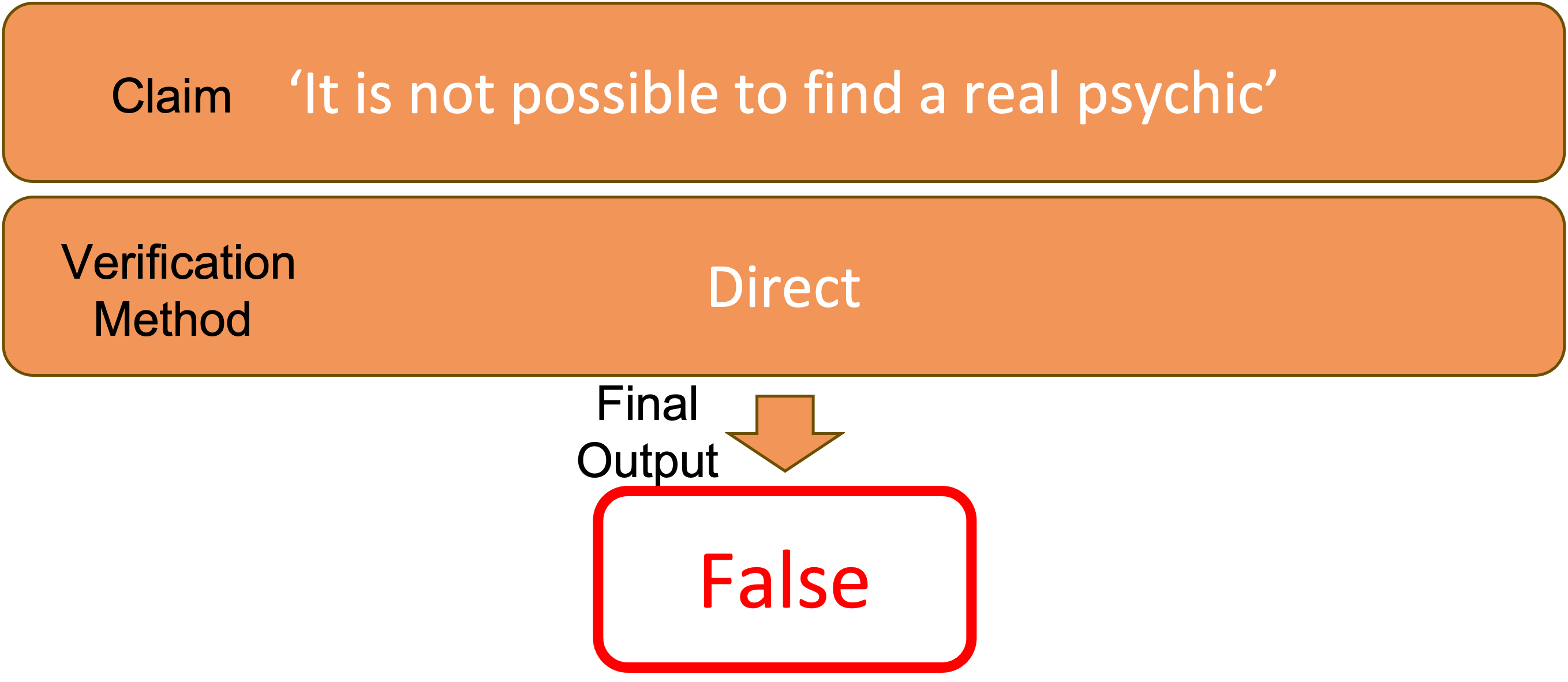
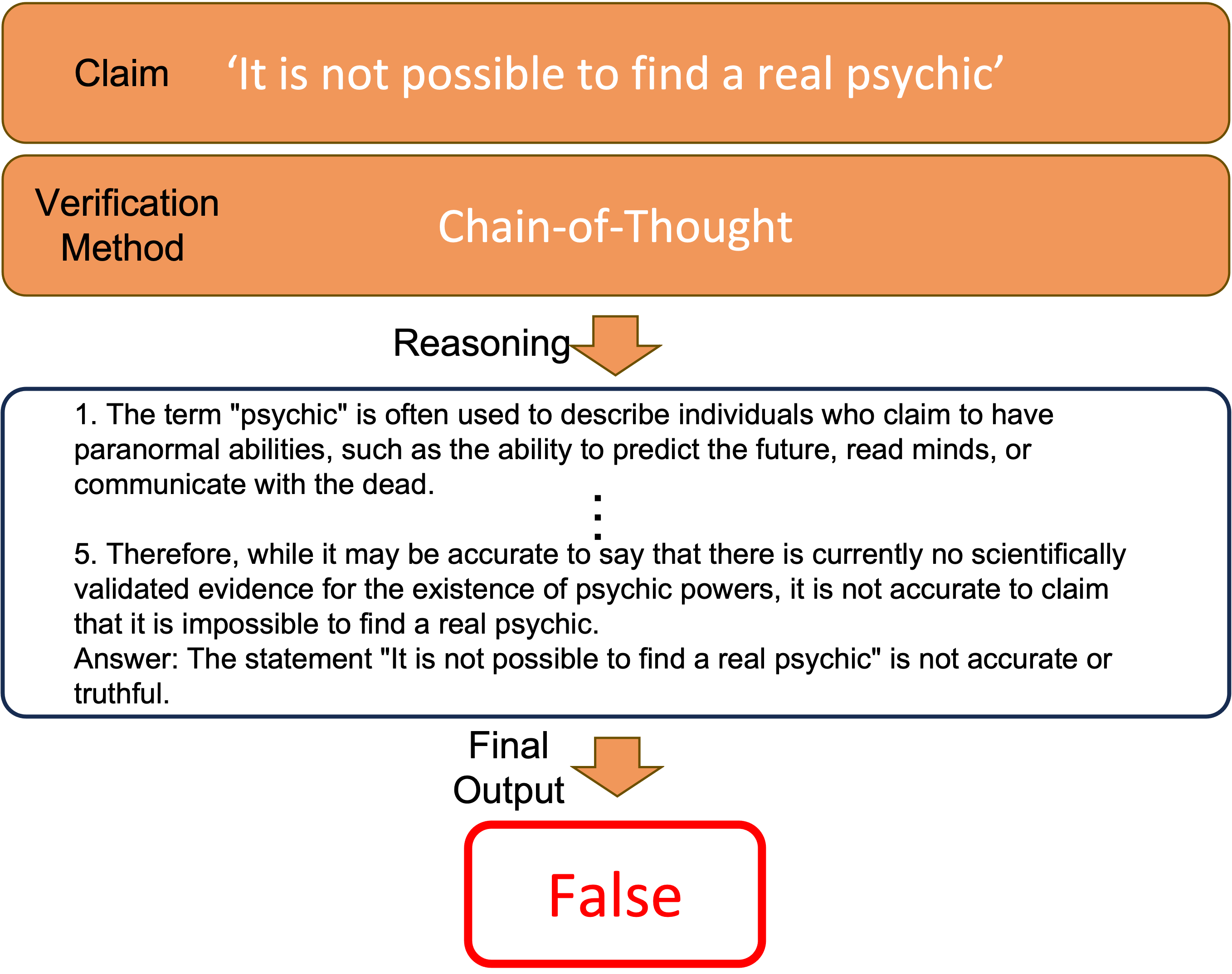
- The approach is evaluated on three claim verification datasets, with performance compared against chain-of-thought and direct-inference baselines.
Experimental results
Research questions
- RQ1Can LLMs be structured to generate both pro- and anti-arguments for a claim, enabling more balanced and transparent reasoning?
- RQ2Does formalizing LLM outputs as argumentation frameworks improve the explainability and contestability of decisions?
- RQ3Can argumentative LLMs achieve competitive performance on claim verification tasks without fine-tuning?
- RQ4How does the inclusion of argument strength estimation affect uncertainty calibration and decision reliability?
- RQ5To what extent can human users intervene meaningfully in the reasoning process, and how does this affect the final decision?
Key findings
- The argumentative LLM approach achieves competitive performance on three claim verification datasets, outperforming or matching state-of-the-art baselines in several cases.
- The method provides faithful, deterministic reasoning paths, enabling full traceability and explainability of decisions.
- Human intervention in the argumentation framework—such as adding or removing arguments—produces measurable, predictable changes in the final decision, ensuring contestability.
- The system generates better-calibrated uncertainty estimates than direct confidence reporting, as shown by improved Brier scores and AUC values.
- Prompt-based argument strength attribution yields consistent performance across models, reducing the risk of distributional shifts affecting reliability.
- The approach remains robust across diverse LLMs, demonstrating generalization potential without fine-tuning.
Read this paper
Open the full text in the Nubint reader and ask about any passage as you read.
Read this paper on NubintThis review was generated by AI from the original paper. Please check the paper before citing it.