
[Paper Review] AssemblyHands: Towards Egocentric Activity Understanding via 3D Hand Pose Estimation
This paper introduces AssemblyHands, a large-scale benchmark with 3.0M images—including 490K egocentric views—annotated with high-accuracy 3D hand poses via a multi-view feature fusion and iterative refinement pipeline. The method reduces average keypoint error to 4.20 mm (85% lower than original Assembly101 annotations), and demonstrates that improved pose quality significantly boosts egocentric action recognition accuracy, achieving 91.1% relative performance on verb classification using a single-view baseline.
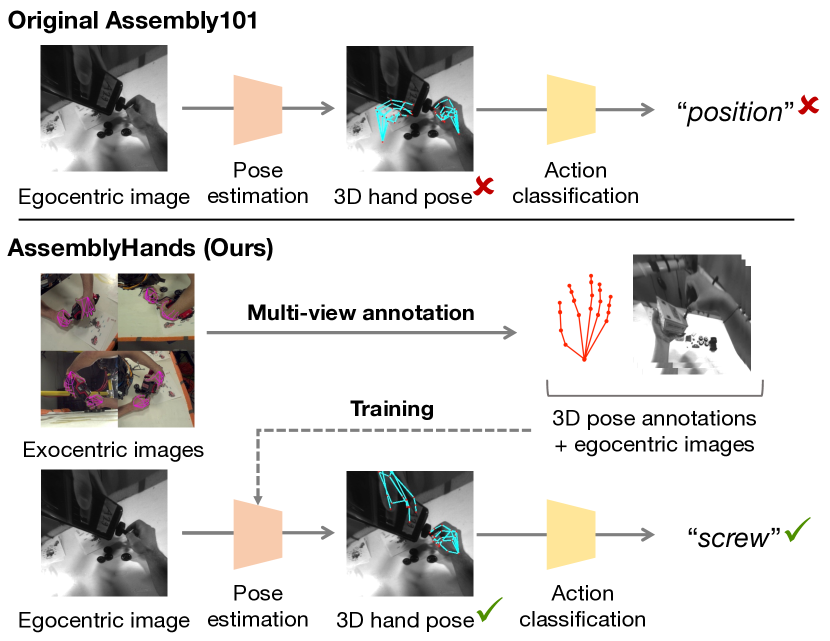
We present AssemblyHands, a large-scale benchmark dataset with accurate 3D hand pose annotations, to facilitate the study of egocentric activities with challenging hand-object interactions. The dataset includes synchronized egocentric and exocentric images sampled from the recent Assembly101 dataset, in which participants assemble and disassemble take-apart toys. To obtain high-quality 3D hand pose annotations for the egocentric images, we develop an efficient pipeline, where we use an initial set of manual annotations to train a model to automatically annotate a much larger dataset. Our annotation model uses multi-view feature fusion and an iterative refinement scheme, and achieves an average keypoint error of 4.20 mm, which is 85% lower than the error of the original annotations in Assembly101. AssemblyHands provides 3.0M annotated images, including 490K egocentric images, making it the largest existing benchmark dataset for egocentric 3D hand pose estimation. Using this data, we develop a strong single-view baseline of 3D hand pose estimation from egocentric images. Furthermore, we design a novel action classification task to evaluate predicted 3D hand poses. Our study shows that having higher-quality hand poses directly improves the ability to recognize actions.
Motivation & Objective
- To address the lack of high-quality 3D hand pose annotations in egocentric settings, especially for complex hand-object interactions.
- To develop an efficient automatic annotation pipeline that leverages multi-view exocentric images to generate accurate 3D hand poses from egocentric video.
- To establish a benchmark for egocentric 3D hand pose estimation with a novel evaluation scheme based on action classification.
- To investigate how the quality of 3D hand pose estimation affects downstream action recognition performance.
- To provide a strong single-view baseline for 3D hand pose estimation from egocentric images.
Proposed method
- Annotate 3.0M images from the Assembly101 dataset, including 490K egocentric images, using a combination of manual annotations and a learned automatic annotation model.
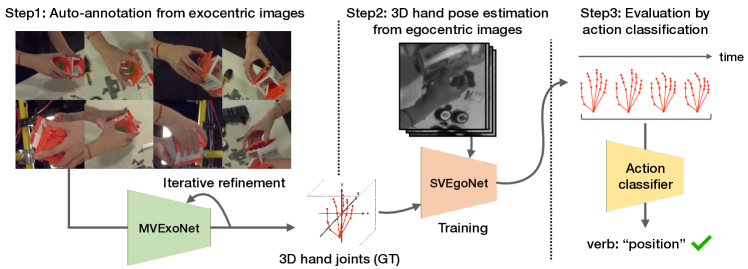
- Train an automatic annotation model (MVExoNet) using multi-view feature fusion from synchronized exocentric cameras to improve 3D hand pose estimation accuracy.
- Apply an iterative refinement scheme to enhance pose estimation quality by progressively correcting errors in predicted joint locations.
- Develop a single-view 3D hand pose estimation network (SVEgoNet) that optimizes 2.5D keypoint heatmaps and classifies hand identity using only egocentric input.
- Design a novel action classification benchmark using hand pose sequences as input, evaluating performance via verb accuracy on a six-verb action set.
- Use a MS-G3D model for verb classification, trained on sequences of predicted 3D hand poses, to evaluate the utility of estimated poses for action understanding.
Experimental results
Research questions
- RQ1How does the quality of 3D hand pose annotations affect the performance of egocentric action recognition models?
- RQ2Can a multi-view, multi-stage automatic annotation pipeline achieve significantly higher accuracy than egocentric-only hand tracking?
- RQ3To what extent can a single-view egocentric hand pose estimator achieve performance comparable to multi-view baselines in action recognition?
- RQ4What is the impact of improved 3D hand pose estimation on verb classification accuracy in procedural tasks like toy assembly?
- RQ5How does the proposed benchmark facilitate the study of egocentric hand-object interactions and action understanding?
Key findings
- The proposed automatic annotation pipeline reduces average keypoint error to 4.20 mm, representing an 85% improvement over the original Assembly101 annotations.
- The single-view 3D hand pose estimator (SVEgoNet) achieves 21.92 mm MPJPE, a 33% reduction compared to the UmeTrack baseline (32.91 mm).
- Using SVEgoNet-predicted hand poses for verb classification yields 54.7% average verb accuracy, a significant improvement over UmeTrack’s 50.3%.
- SVEgoNet achieves 91.1% relative performance compared to the empirical upper bound (60.0% verb accuracy on automatically annotated poses), indicating strong utility of predicted poses.
- Confusion matrices show that SVEgoNet reduces misclassification errors across all verbs, especially for 'position' and 'screw', with improvements of 13.1% and 4.1% respectively.
- The study confirms that higher-quality 3D hand pose estimation directly leads to better performance in egocentric action recognition tasks.
Read this paper
Open the full text in the Nubint reader and ask about any passage as you read.
Read this paper on NubintThis review was generated by AI from the original paper. Please check the paper before citing it.