
[Paper Review] Assessing LLMs for Moral Value Pluralism
This paper proposes a method to assess implicit moral values in large language models (LLMs) using the Recognizing Value Resonance (RVR) model to compare LLM-generated text against the World Values Survey (WVS), revealing significant moral value misalignment—particularly a WEIRD (Western, Educated, Industrialized, Rich, Democratic) bias and age-related inaccuracies—across non-WEIRD nations and demographic groups.
The fields of AI current lacks methods to quantitatively assess and potentially alter the moral values inherent in the output of large language models (LLMs). However, decades of social science research has developed and refined widely-accepted moral value surveys, such as the World Values Survey (WVS), eliciting value judgments from direct questions in various geographies. We have turned those questions into value statements and use NLP to compute to how well popular LLMs are aligned with moral values for various demographics and cultures. While the WVS is accepted as an explicit assessment of values, we lack methods for assessing implicit moral and cultural values in media, e.g., encountered in social media, political rhetoric, narratives, and generated by AI systems such as LLMs that are increasingly present in our daily lives. As we consume online content and utilize LLM outputs, we might ask, which moral values are being implicitly promoted or undercut, or -- in the case of LLMs -- if they are intending to represent a cultural identity, are they doing so consistently? In this paper we utilize a Recognizing Value Resonance (RVR) NLP model to identify WVS values that resonate and conflict with a given passage of output text. We apply RVR to the text generated by LLMs to characterize implicit moral values, allowing us to quantify the moral/cultural distance between LLMs and various demographics that have been surveyed using the WVS. In line with other work we find that LLMs exhibit several Western-centric value biases; they overestimate how conservative people in non-Western countries are, they are less accurate in representing gender for non-Western countries, and portray older populations as having more traditional values. Our results highlight value misalignment and age groups, and a need for social science informed technological solutions addressing value plurality in LLMs.
Motivation & Objective
- To address the lack of methods for assessing implicit moral and cultural values in AI-generated text, especially in non-WEIRD cultural contexts.
- To investigate whether LLMs accurately represent diverse moral perspectives, particularly those of underrepresented nations and age groups.
- To quantify moral and cultural distance between LLM-generated responses and real-world survey data from the World Values Survey (WVS).
- To challenge the assumption that LLMs reflect a universal or median human moral perspective, given their training data biases.
- To support the development of ethically aligned AI by identifying and measuring implicit value pluralism in LLM outputs.
Proposed method
- Utilize the Recognizing Value Resonance (RVR) NLP model to detect which WVS moral values resonate or conflict with a given passage of text.
- Apply RVR to LLM-generated responses to prompts asking about demographic-specific moral judgments (e.g., 'What would a 60-year-old in Japan think about X?').
- Compare LLM-generated responses to actual WVS survey data from the same demographic groups to compute moral/cultural distance.
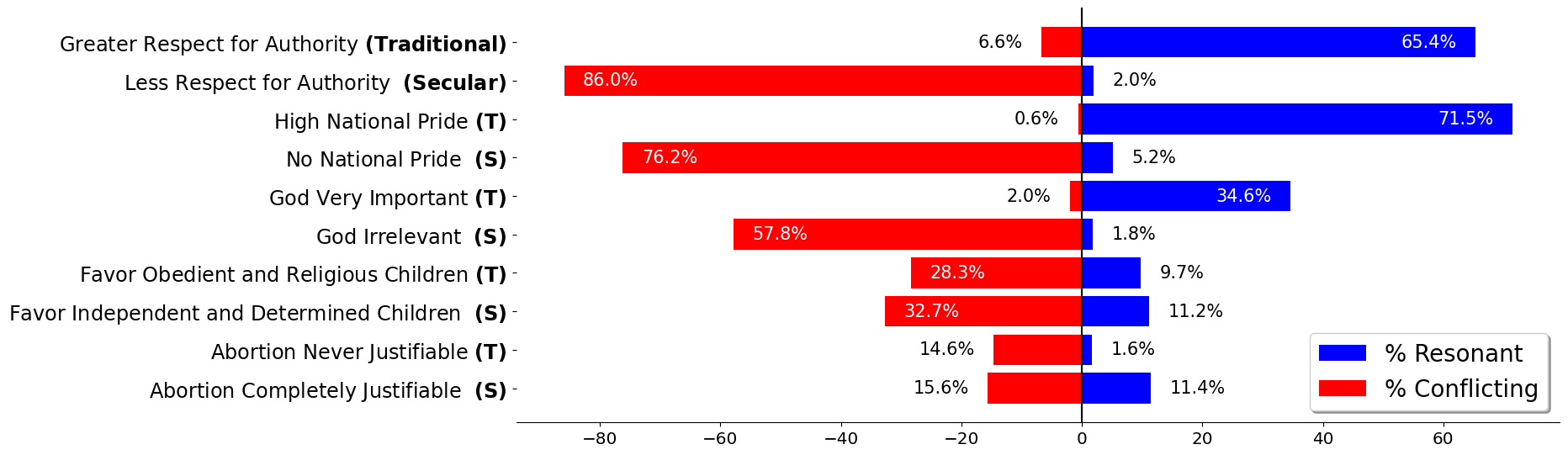
- Use a subset of WVS questions aligned with the traditional vs. secular values spectrum to assess value pluralism in LLM outputs.
- Focus on moral values related to tradition, individualism, secularism, and autonomy to evaluate cultural consistency and bias.
- Use the WVS as a validated, cross-cultural benchmark to anchor and evaluate implicit moral values in LLM outputs.
Experimental results
Research questions
- RQ1To what extent do LLMs accurately reflect the moral values of non-WEIRD nations as measured by the World Values Survey?
- RQ2How does the LLM’s moral perspective compare to actual demographic responses in terms of traditional vs. secular values?
- RQ3Does the LLM exhibit age-related misalignment in moral value expression, particularly in over-representing younger demographic values?
- RQ4How does the LLM’s value alignment vary across different cultural clusters on the WVS cultural map?
- RQ5Can the RVR model effectively detect implicit moral value pluralism or misalignment in LLM-generated text compared to real-world survey data?
Key findings
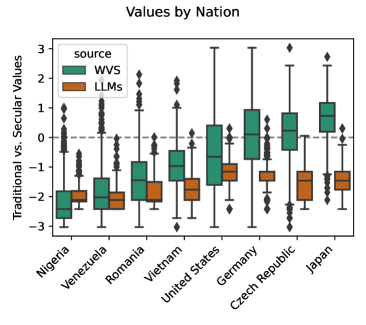
- LLMs exhibit significant moral value misalignment with non-WEIRD nations, particularly in expressing traditional-affirming values that do not match actual WVS survey results.
- The LLMs over-represent secular-affirming values and under-represent traditional values for older demographics, contradicting WVS data showing higher traditionalism among older adults in many cultures.
- LLMs display a WEIRD moral bias, consistently reflecting values dominant in Western, English-speaking, young, and educated populations.
- The model's responses show a disproportionate alignment with younger demographics' moral perspectives, even when prompted to assume older identities.
- The RVR model successfully identifies value resonances and conflicts between LLM outputs and WVS data, enabling quantification of moral and cultural distance.
- These findings suggest that LLMs are not neutral or representative of global moral value pluralism but instead reflect the dominant cultural and linguistic biases in their training data.
Read this paper
Open the full text in the Nubint reader and ask about any passage as you read.
Read this paper on NubintThis review was generated by AI from the original paper. Please check the paper before citing it.