
[Paper Review] Assessing the Extrapolation Capability of Template-Free Retrosynthesis Models
This study evaluates the extrapolation capability of template-free retrosynthesis models by constructing a diverse out-of-distribution (OOD) reaction dataset from USPTO-480k, revealing that while these models can generate novel reaction templates, their top-10 exact-match accuracy on OOD reactions is below 1%, and over half of the predicted novel reactions are chemically implausible. The findings advocate for integrating chemical feasibility into future model design to enable reliable exploration of uncharted reaction space.
Despite the acknowledged capability of template-free models in exploring unseen reaction spaces compared to template-based models for retrosynthesis prediction, their ability to venture beyond established boundaries remains relatively uncharted. In this study, we empirically assess the extrapolation capability of state-of-the-art template-free models by meticulously assembling an extensive set of out-of-distribution (OOD) reactions. Our findings demonstrate that while template-free models exhibit potential in predicting precursors with novel synthesis rules, their top-10 exact-match accuracy in OOD reactions is strikingly modest (< 1%). Furthermore, despite the capability of generating novel reactions, our investigation highlights a recurring issue where more than half of the novel reactions predicted by template-free models are chemically implausible. Consequently, we advocate for the future development of template-free models that integrate considerations of chemical feasibility when navigating unexplored regions of reaction space.
Motivation & Objective
- To assess whether template-free retrosynthesis models can accurately predict reactions outside the distribution of their training data.
- To investigate the novelty and chemical feasibility of reaction templates generated by template-free models in out-of-distribution settings.
- To evaluate the extent to which these models can extrapolate beyond known reaction templates and discover truly novel, viable synthesis pathways.
- To identify the limitations of current template-free models in generating chemically plausible novel reactions, especially in unseen reaction spaces.
Proposed method
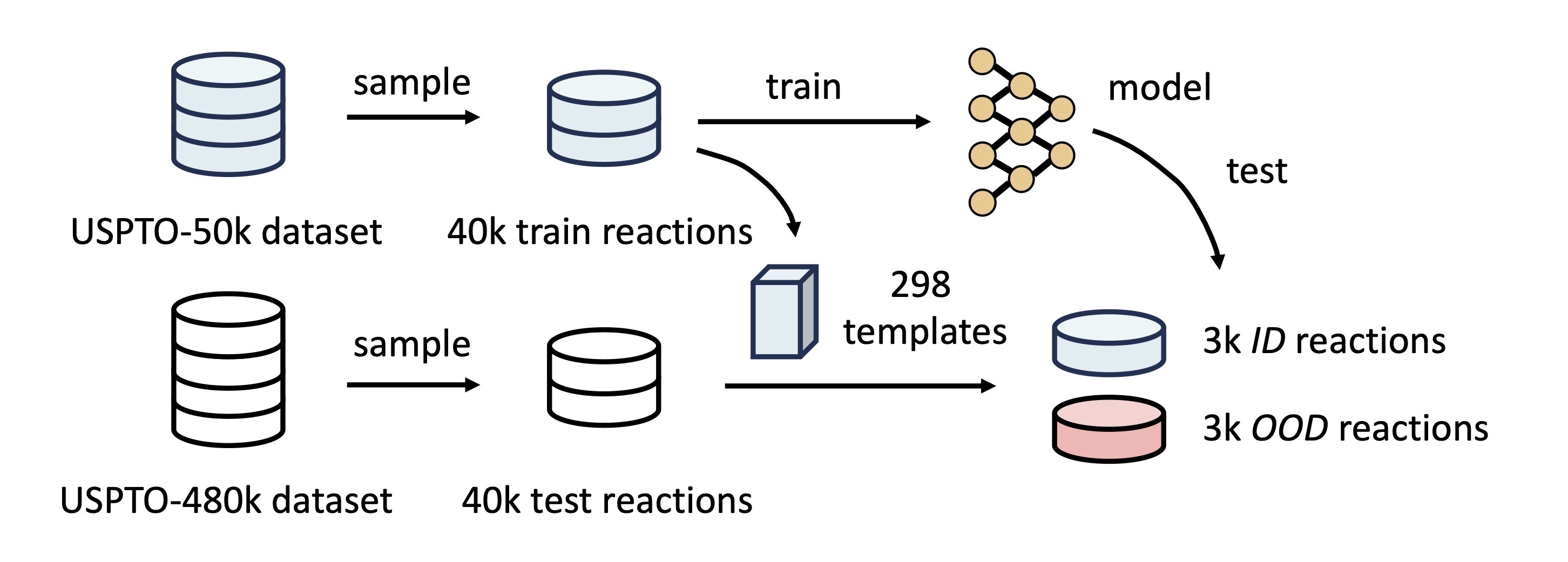
- Curated an out-of-distribution (OOD) reaction dataset by extracting reactions from the USPTO-480k test set that do not share any Generalized Reaction Templates (GRTs) with the USPTO-50k training set.
- Used GRTs to represent the reaction template distribution in the training data and identify OOD reactions based on template dissimilarity.
- Evaluated three state-of-the-art template-free models—Transformer, Retroformer, and Chemformer—on both in-distribution (ID) and OOD reactions using top-10 prediction accuracy and round-trip accuracy metrics.
- Analyzed the validity, uniqueness, and novelty of top-10 predictions across ID and OOD sets to assess extrapolation behavior.
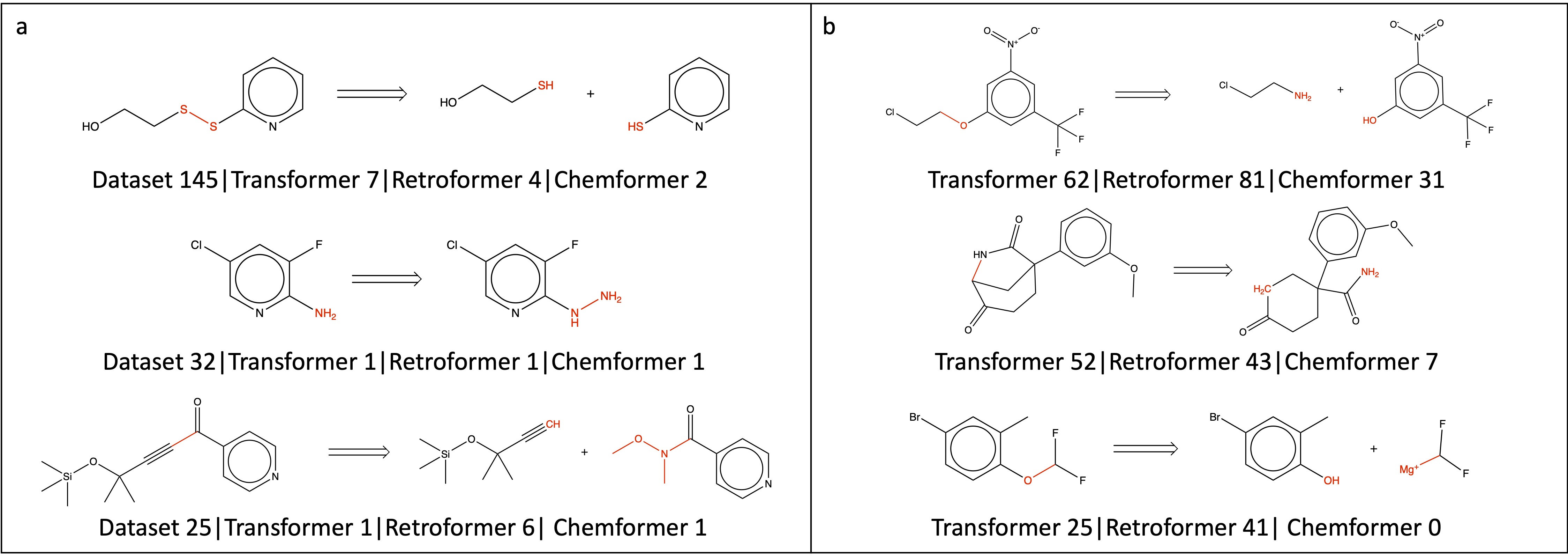
- Conducted qualitative analysis of novel reaction templates generated by models to assess their chemical plausibility, focusing on unusual functional group transformations or leaving group patterns.
- Compared model performance on OOD reactions with known reaction rules to assess whether models can generalize beyond their training distribution.
Experimental results
Research questions
- RQ1Can template-free retrosynthesis models accurately predict synthesis pathways for reactions that use novel reaction templates not seen during training?
- RQ2How do the top-10 prediction accuracies of template-free models compare between in-distribution and out-of-distribution reactions?
- RQ3To what extent are the novel reaction templates generated by template-free models chemically plausible?
- RQ4Do template-free models generate more unique and novel reactions on OOD targets compared to ID targets, indicating an attempt to extrapolate?
- RQ5What types of chemically implausible reaction patterns are commonly generated by template-free models in out-of-distribution settings?
Key findings
- The top-10 exact-match accuracy of all tested template-free models on out-of-distribution (OOD) reactions is below 1%, indicating extremely limited ability to reproduce known novel pathways.
- Over 50% of the novel reactions predicted by template-free models on OOD reactions are chemically implausible, with common issues including nucleophiles as leaving groups or direct cleavage of C–N single bonds.
- Despite low exact-match accuracy, template-free models generate more unique and novel reactions on OOD targets than on ID targets, suggesting an attempt to extrapolate beyond the training distribution.
- Chemformer achieves the highest validity (98.6%) on ID reactions but the lowest uniqueness (15.6%) and novelty (1.4%), indicating overfitting to common patterns.
- Retroformer and Transformer generate more novel templates than Chemformer, but their OOD prediction accuracy does not improve proportionally, indicating poor generalization to truly novel cases.
- The round-trip accuracy of the best-performing model (Retroformer) on OOD reactions is only 4.8%, confirming limited reliability in reconstructing valid reaction pathways from predicted precursors.
Read this paper
Open the full text in the Nubint reader and ask about any passage as you read.
Read this paper on NubintThis review was generated by AI from the original paper. Please check the paper before citing it.