
[Paper Review] AssistGPT: A General Multi-modal Assistant that can Plan, Execute, Inspect, and Learn
AssistGPT is a general multi-modal AI system that interleaves language and code reasoning (Plan, Execute, Inspect, Learn) to orchestrate diverse tools for complex visual tasks, achieving state-of-the-art results on A-OKVQA and NExT-QA benchmarks.
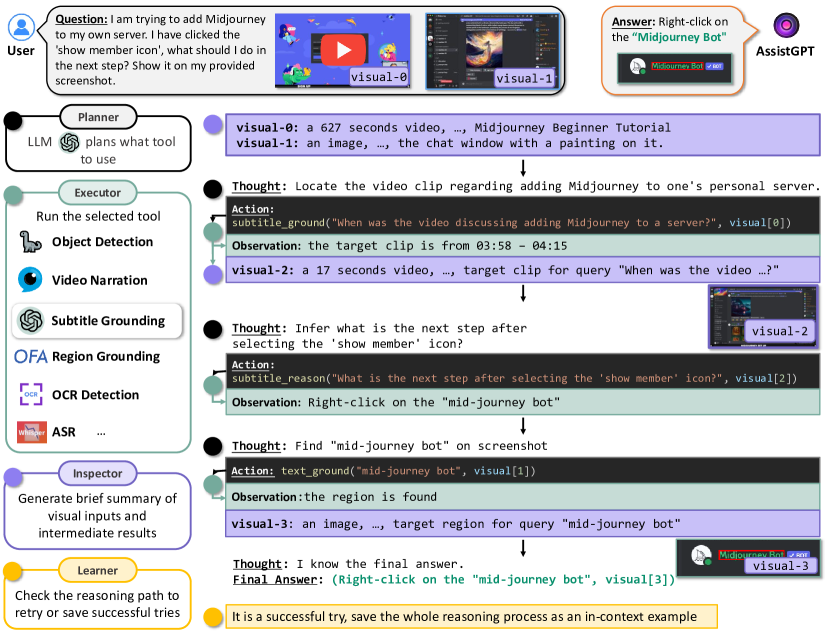
Recent research on Large Language Models (LLMs) has led to remarkable advancements in general NLP AI assistants. Some studies have further explored the use of LLMs for planning and invoking models or APIs to address more general multi-modal user queries. Despite this progress, complex visual-based tasks still remain challenging due to the diverse nature of visual tasks. This diversity is reflected in two aspects: 1) Reasoning paths. For many real-life applications, it is hard to accurately decompose a query simply by examining the query itself. Planning based on the specific visual content and the results of each step is usually required. 2) Flexible inputs and intermediate results. Input forms could be flexible for in-the-wild cases, and involves not only a single image or video but a mixture of videos and images, e.g., a user-view image with some reference videos. Besides, a complex reasoning process will also generate diverse multimodal intermediate results, e.g., video narrations, segmented video clips, etc. To address such general cases, we propose a multi-modal AI assistant, AssistGPT, with an interleaved code and language reasoning approach called Plan, Execute, Inspect, and Learn (PEIL) to integrate LLMs with various tools. Specifically, the Planner is capable of using natural language to plan which tool in Executor should do next based on the current reasoning progress. Inspector is an efficient memory manager to assist the Planner to feed proper visual information into a specific tool. Finally, since the entire reasoning process is complex and flexible, a Learner is designed to enable the model to autonomously explore and discover the optimal solution. We conducted experiments on A-OKVQA and NExT-QA benchmarks, achieving state-of-the-art results. Moreover, showcases demonstrate the ability of our system to handle questions far more complex than those found in the benchmarks.
Motivation & Objective
- Motivate the need for a general multi-modal assistant capable of handling diverse visual inputs and flexible tasks beyond single-image reasoning.
- Propose a four-module PEIL framework that interleaves language and code to plan tool usage and manage intermediate results.
- Demonstrate the system’s effectiveness via state-of-the-art results on A-OKVQA and NExT-QA, and illustrate its handling of complex real-world scenarios.
- Show how the Learner component enables self-improvement through in-context learning and re-use of successful traces.
Proposed method
- Planner uses an LLM (GPT-4) to generate a two-part output: a natural language Thought guiding the next step and a structured Action invoking external tools.
- Executor validates, executes the tool-specific code, and post-processes results to produce Observations fed back to the Planner.
- Inspector manages visual inputs and intermediate results by recording metadata and summaries to assist the Planner in selecting sources and tools.
- Learner evaluates reasoning, performs self-checks, and stores successful traces as in-context examples to improve future predictions.
Experimental results
Research questions
- RQ1Can AssistGPT achieve strong performance on complex multi-modal tasks via interleaved language and code planning?
- RQ2What is the impact of each PEIL component (Planner, Executor, Inspector, Learner) on task performance and robustness?
- RQ3How does AssistGPT compare to existing multi-modal systems on benchmarks like A-OKVQA and NExT-QA?
- RQ4Can the Learner enable meaningful in-context learning and self-improvement over time?
- RQ5Are flexible inputs (images, videos, transcripts, subtitles) effectively handled by the Inspectors and tool set?
Key findings
- AssistGPT variants achieve competitive to state-of-the-art results on A-OKVQA in the multi-choice track, and are comparable on direct-answer tasks.
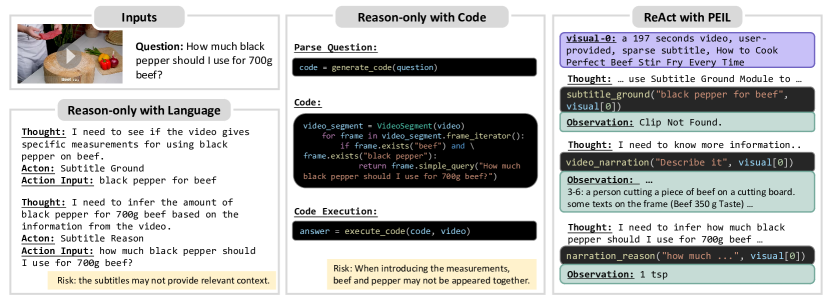
- Ablation shows that interleaved language-and-code reasoning (PEIL) with Learner components yields the strongest performance, surpassing reasoning-only and pure ReAct baselines.
- On NExT-QA, AssistGPT attains competitive causal, temporal, and descriptive question answering scores, outperforming several recent baselines.
- The Learner’s self-check and GT-check variants notably improve robustness and in-context learning capability, with successful traces stored for future queries.
- Compared to prior LLM-driven modular systems, AssistGPT demonstrates improved handling of complex, multi-source visual inputs and long-form video reasoning.
- Qualitative results illustrate effective decomposition of complex questions and self-correction behavior through plan revisions and tool re-invocation.
Read this paper
Open the full text in the Nubint reader and ask about any passage as you read.
Read this paper on NubintThis review was generated by AI from the original paper. Please check the paper before citing it.