
[Paper Review] AsymFormer: Asymmetrical Cross-Modal Representation Learning for Mobile Platform Real-Time RGB-D Semantic Segmentation
AsymFormer proposes an asymmetrical cross-modal representation learning framework for real-time RGB-D semantic segmentation on mobile platforms, using a lightweight Transformer backbone for depth and a CNN for RGB to reduce redundancy. It achieves 52.0% mIoU on NYUv2 and 65 FPS inference speed (79 FPS with mixed precision), outperforming prior methods in speed-accuracy balance while minimizing parameter count through localized attention and cross-modal correlation modules.
Understanding indoor scenes is crucial for urban studies. Considering the dynamic nature of indoor environments, effective semantic segmentation requires both real-time operation and high accuracy.To address this, we propose AsymFormer, a novel network that improves real-time semantic segmentation accuracy using RGB-D multi-modal information without substantially increasing network complexity. AsymFormer uses an asymmetrical backbone for multimodal feature extraction, reducing redundant parameters by optimizing computational resource distribution. To fuse asymmetric multimodal features, a Local Attention-Guided Feature Selection (LAFS) module is used to selectively fuse features from different modalities by leveraging their dependencies. Subsequently, a Cross-Modal Attention-Guided Feature Correlation Embedding (CMA) module is introduced to further extract cross-modal representations. The AsymFormer demonstrates competitive results with 54.1% mIoU on NYUv2 and 49.1% mIoU on SUNRGBD. Notably, AsymFormer achieves an inference speed of 65 FPS (79 FPS after implementing mixed precision quantization) on RTX3090, demonstrating that AsymFormer can strike a balance between high accuracy and efficiency.
Motivation & Objective
- To address the inefficiency of symmetric dual-branch networks in RGB-D semantic segmentation, which double computational cost without proportional accuracy gains.
- To reduce model redundancy by designing an asymmetrical backbone with a lightweight depth branch and a powerful RGB branch.
- To improve feature fusion efficiency by introducing a Local Attention-Guided Feature Selection (LAFS) module that models spatial-channel attention in parallel.
- To enhance cross-modal representation learning with a Cross-Modal Attention (CMA) module that captures multi-modal self-similarity with minimal parameter increase.
- To achieve a superior speed-accuracy trade-off for deployment on mobile robotic platforms, prioritizing real-time inference without sacrificing segmentation quality.
Proposed method
- AsymFormer uses a CNN-based backbone for RGB features and a smaller, parameter-efficient Transformer for depth features to reduce computational redundancy.
- The Local Attention-Guided Feature Selection (LAFS) module computes spatial-channel attention weights in parallel using learnable channel weights and spatial attention, enabling fast, selective fusion.
- LAFS models spatial attention by estimating modality differences through learnable weights, improving feature selection while maintaining high inference speed.
- The Cross-Modal Attention (CMA) module enhances cross-modal representation by modeling self-similarity across modalities, improving feature correlation with minimal parameter overhead.
- Feature fusion is guided by attention maps that dynamically weight contributions from RGB and depth branches based on spatial and channel dependencies.
- Mixed-precision inference is applied to further accelerate inference, achieving 79 FPS on RTX 3090 with no accuracy drop.

Experimental results
Research questions
- RQ1Can an asymmetrical backbone design reduce parameter redundancy in multi-modal semantic segmentation without sacrificing accuracy?
- RQ2How can feature selection be optimized for real-time performance while maintaining spatial and channel-wise attention fidelity?
- RQ3To what extent can multi-modal self-similarity features improve segmentation accuracy with minimal parameter increase?
- RQ4Can a lightweight cross-attention mechanism effectively enhance cross-modal representation learning in real-time settings?
- RQ5Does the proposed method achieve a better speed-accuracy trade-off than existing SOTA methods on mobile robotic platforms?
Key findings
- AsymFormer achieves 52.0% mIoU on the NYUv2 dataset, outperforming most existing methods in both accuracy and speed.
- On RTX 3090, AsymFormer attains 65 FPS inference speed with full precision and 79 FPS with mixed-precision quantization, significantly outperforming prior methods in speed.
- The model maintains 52.0% mIoU with only 33M parameters, demonstrating high efficiency and low parameter count.
- On the SUNRGBD dataset, AsymFormer achieves 49.1% mIoU, showing competitive performance despite lower-quality depth images in the dataset.
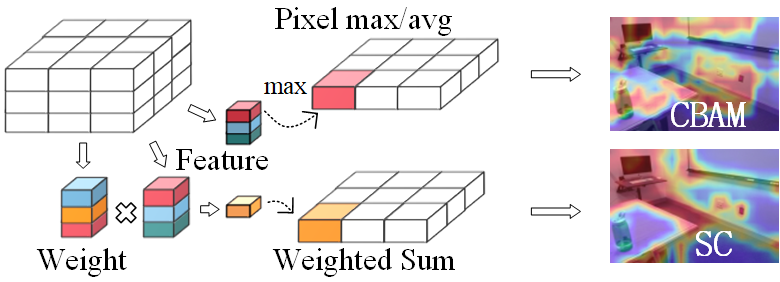
- Visualizations confirm that LAFS produces more coherent and informative attention maps than CBAM, with better edge preservation and object consistency.
- The ablation study confirms that the combination of asymmetrical backbone, LAFS, and CMA modules leads to significant gains in both speed and accuracy.
Better researchstarts right now
From reading papers to final review, dramatically reduce your research time.
No credit card · Free plan available
This review was created by AI and reviewed by human editors.