
[Paper Review] Asynchronous Multi-Agent Reinforcement Learning for Efficient Real-Time Multi-Robot Cooperative Exploration
ACE extends MAPPO to an asynchronous setting with action-delay randomization and a multi-tower CNN policy to enable real-time cooperative exploration; it outperforms planning-based and synchronous MARL baselines in grid, real-world, and Habitat environments.
We consider the problem of cooperative exploration where multiple robots need to cooperatively explore an unknown region as fast as possible. Multi-agent reinforcement learning (MARL) has recently become a trending paradigm for solving this challenge. However, existing MARL-based methods adopt action-making steps as the metric for exploration efficiency by assuming all the agents are acting in a fully synchronous manner: i.e., every single agent produces an action simultaneously and every single action is executed instantaneously at each time step. Despite its mathematical simplicity, such a synchronous MARL formulation can be problematic for real-world robotic applications. It can be typical that different robots may take slightly different wall-clock times to accomplish an atomic action or even periodically get lost due to hardware issues. Simply waiting for every robot being ready for the next action can be particularly time-inefficient. Therefore, we propose an asynchronous MARL solution, Asynchronous Coordination Explorer (ACE), to tackle this real-world challenge. We first extend a classical MARL algorithm, multi-agent PPO (MAPPO), to the asynchronous setting and additionally apply action-delay randomization to enforce the learned policy to generalize better to varying action delays in the real world. Moreover, each navigation agent is represented as a team-size-invariant CNN-based policy, which greatly benefits real-robot deployment by handling possible robot lost and allows bandwidth-efficient intra-agent communication through low-dimensional CNN features. We first validate our approach in a grid-based scenario. Both simulation and real-robot results show that ACE reduces over 10% actual exploration time compared with classical approaches. We also apply our framework to a high-fidelity visual-based environment, Habitat, achieving 28% improvement in exploration efficiency.
Motivation & Objective
- Motivate real-time cooperative exploration with multiple heterogeneous robots under asynchronous action execution.
- Develop an asynchronous MARL framework that handles action delays and offline agents without stalling exploration.
- Propose an efficient communication policy that scales with team size and minimizes bandwidth.
- Demonstrate superior exploration efficiency in grid-based, real-world, and Habitat (vision-based) environments.
Proposed method
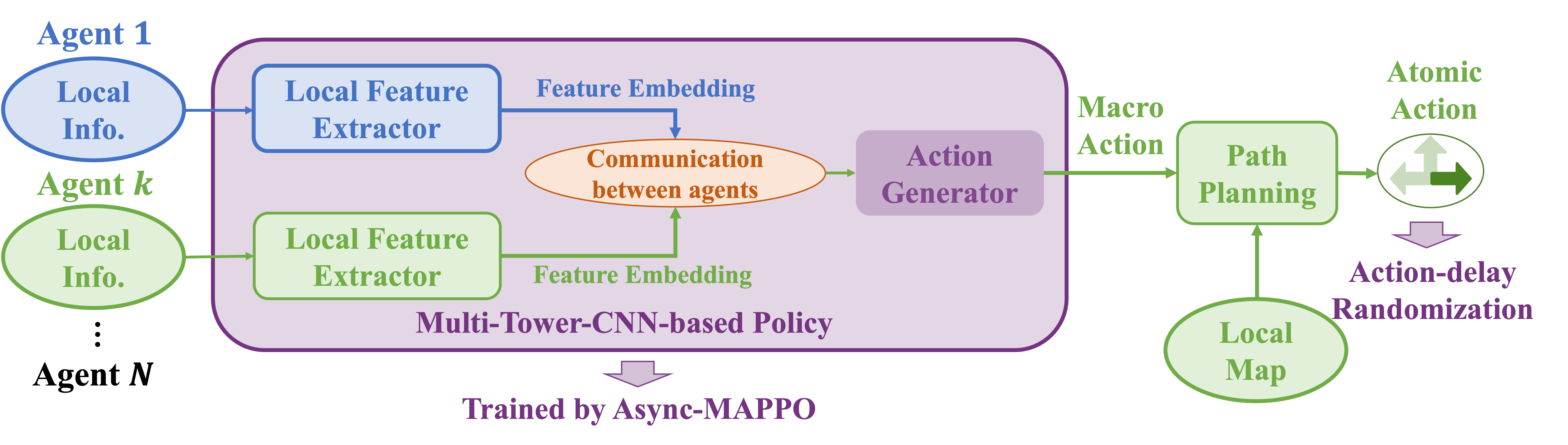
- Extend MAPPO to Async-MAPPO to support asynchronous action-making and per-agent experience buffers.
- Introduce action-delay randomization during simulation to improve sim-to-real generalization to varying delays.
- Propose Multi-tower-CNN-based Policy (MCP) with local CNN features, an attention-based relation encoder, and a decoder to output macro actions.
- Adopt a Dec-POSMDP formulation with macro actions (global goals) and atomic actions, enabling bi-level action execution.
- Use weight-sharing policy and limited-feature communication to handle varying team sizes and robust real-world deployment.

Experimental results
Research questions
- RQ1How can MARL be adapted to asynchronous action execution for multi-robot cooperative exploration?
- RQ2Does action-delay randomization improve sim-to-real transfer and robustness to real-world delays?
- RQ3Can a CNN-based, size-invariant policy efficiently coordinate multiple robots with limited bandwidth?
- RQ4What is the performance gain of asynchronous ACE versus planning-based and synchronous MARL baselines in different environments?
- RQ5How does ACE handle scenarios where agents go offline during exploration?
Key findings
- ACE reduces real-world exploration time by over 10% compared with classical planning-based approaches.
- ACE achieves a 28% improvement in exploration efficiency in Habitat (vision-based environment).
- In real-world tests with 2 robots, ACE reduces exploration time by 10.07% versus the MAPPO baseline.
- ACE reduces exploration time by 33.86% relative to the fastest planning-based method (Nearest) in real-world experiments.
- ACE generalizes to agent loss scenarios (N1 to N2) with about 10% faster exploration and lower overlap compared to baselines.
- ACE maintains competitive accumulative coverage (ACS) and lower overlap while achieving faster completion across settings.
Read this paper
Open the full text in the Nubint reader and ask about any passage as you read.
Read this paper on NubintThis review was generated by AI from the original paper. Please check the paper before citing it.