
[Paper Review] At Your Fingertips: Extracting Piano Fingering Instructions from Videos
This paper proposes a deep learning pipeline that automatically extracts piano fingering from videos and MIDI files, using pose estimation, object detection, and GAN-based domain adaptation to achieve 97% F1 score. It creates the largest publicly available piano fingering dataset (APFD) with 155,107 notes, which improves state-of-the-art performance when used for transfer learning.
Piano fingering -- knowing which finger to use to play each note in a musical piece, is a hard and important skill to master when learning to play the piano. While some sheet music is available with expert-annotated fingering information, most pieces lack this information, and people often resort to learning the fingering from demonstrations in online videos. We consider the AI task of automating the extraction of fingering information from videos. This is a non-trivial task as fingers are often occluded by other fingers, and it is often not clear from the video which of the keys were pressed, requiring the synchronization of hand position information and knowledge about the notes that were played. We show how to perform this task with high-accuracy using a combination of deep-learning modules, including a GAN-based approach for fine-tuning on out-of-domain data. We extract the fingering information with an f1 score of 97\%. We run the resulting system on 90 videos, resulting in high-quality piano fingering information of 150K notes, the largest available dataset of piano-fingering to date.
Motivation & Objective
- To automate the extraction of piano fingering from videos, which are commonly used for learning but lack structured fingering annotations.
- To address the challenge of occluded fingers and subtle key presses in video recordings through multimodal synchronization with MIDI files.
- To create a large-scale, automatically annotated piano fingering dataset (APFD) to support data-hungry deep learning models.
- To evaluate the quality and utility of the dataset by fine-tuning models on it and demonstrating improved performance on existing benchmarks.
Proposed method
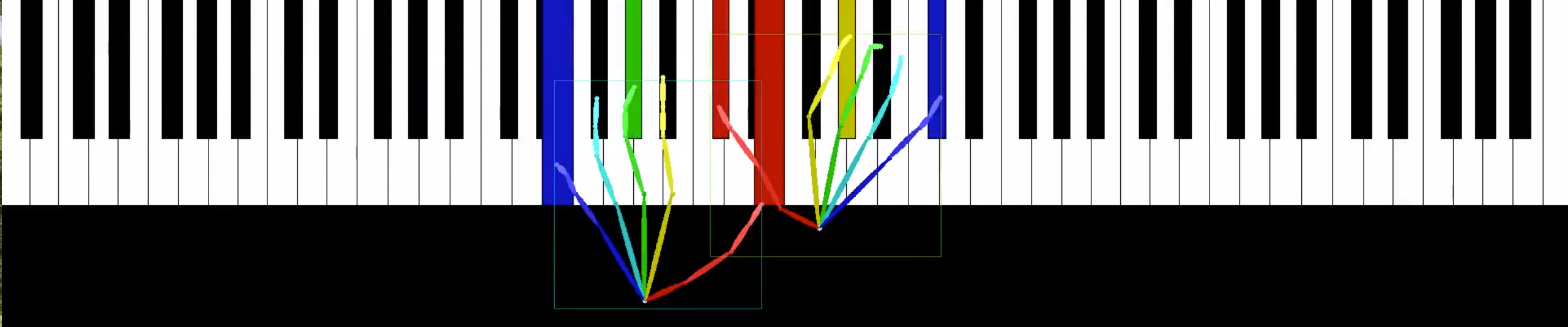
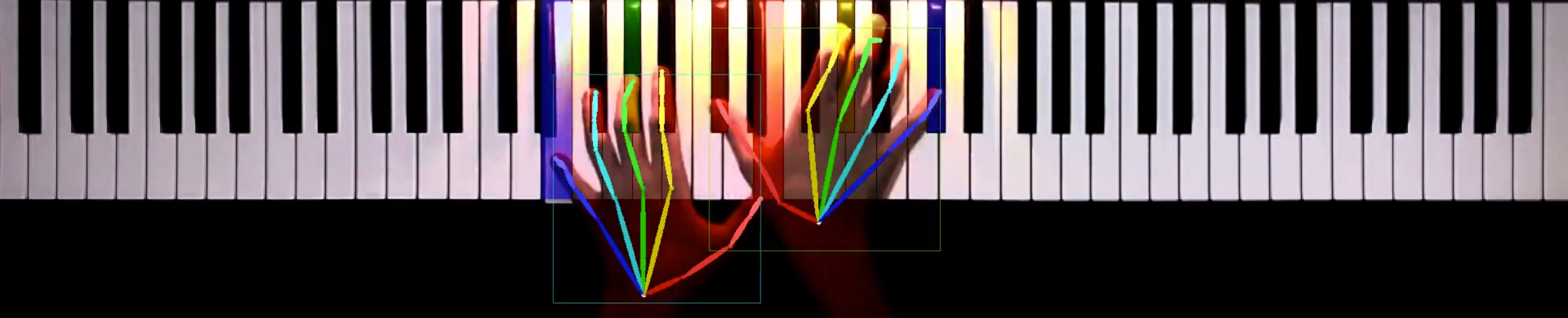
- A virtual piano keyboard is mapped to the video frame using geometric calibration to align key positions with the video image.
- A custom hand detection model is trained on a newly annotated hand dataset and fine-tuned using a GAN-based approach for out-of-domain adaptation.
- Finger pose estimation is performed per hand using a pose estimation model, with confidence scores for each finger's position.
- MIDI files are synchronized with video frames to identify which notes are played at each time step.
- For each played note, a probability distribution over the five fingers (1–5) is predicted based on finger positions and timing.
- A sequence tagging model using BiLSTM and MLP is trained on the APFD dataset to predict fingering sequences, with transfer learning evaluated on the PIG benchmark.
Experimental results
Research questions
- RQ1Can a deep learning pipeline accurately extract piano fingering from videos when fingers are occluded and key presses are subtle?
- RQ2How effective is a GAN-based domain adaptation method for improving pose estimation on out-of-domain video data in the context of piano fingering?
- RQ3Does an automatically generated, large-scale piano fingering dataset (APFD) improve the performance of downstream fingering prediction models compared to smaller, manually curated datasets?
- RQ4To what extent does pre-training on APFD and fine-tuning on a gold-standard dataset (PIG) improve state-of-the-art performance in piano fingering prediction?
Key findings
- The system achieves a 97% F1 score on a manually annotated test set of 6,894 notes, demonstrating high accuracy in fingering extraction.
- The Automatic Piano Fingering Dataset (APFD) contains 90 unique piano pieces with 155,107 notes, making it the largest publicly available piano fingering dataset to date.
- Fine-tuning a model pre-trained on APFD leads to a 2.7-point improvement in match rate (66.8%) over the previous SOTA on the PIG benchmark.
- Training on APFD alone yields 73.2% accuracy, while fine-tuning on PIG after pre-training on APFD achieves 73.6% accuracy, indicating the dataset's high quality and utility.
- The GAN-based domain adaptation method significantly improves pose estimation performance on out-of-domain video data, addressing generalization issues of existing models.
- Transfer learning from APFD to PIG outperforms training solely on PIG, confirming that the automatically generated dataset is both accurate and valuable for improving model generalization.
Read this paper
Open the full text in the Nubint reader and ask about any passage as you read.
Read this paper on NubintThis review was generated by AI from the original paper. Please check the paper before citing it.