
[Paper Review] ATFNet: Adaptive Time-Frequency Ensembled Network for Long-term Time Series Forecasting
ATFNet is a novel adaptive time-frequency ensembled network for long-term time series forecasting that dynamically combines time-domain and frequency-domain representations using a Dominant Harmonic Series Energy Weighting mechanism. It introduces Extended DFT to resolve frequency misalignment and Complex-valued Spectrum Attention to model frequency combinations, achieving state-of-the-art performance across 8 real-world datasets.
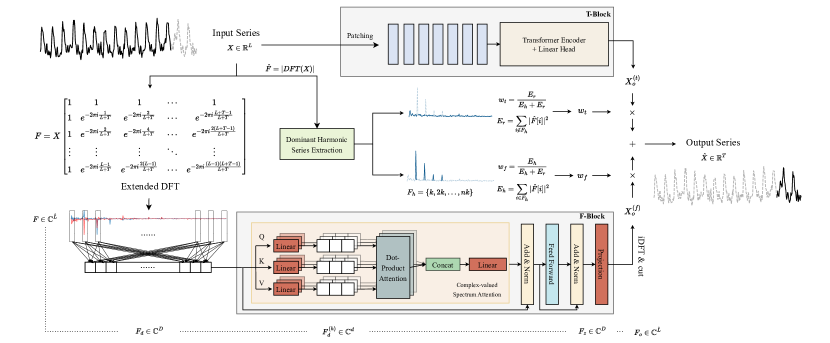
The intricate nature of time series data analysis benefits greatly from the distinct advantages offered by time and frequency domain representations. While the time domain is superior in representing local dependencies, particularly in non-periodic series, the frequency domain excels in capturing global dependencies, making it ideal for series with evident periodic patterns. To capitalize on both of these strengths, we propose ATFNet, an innovative framework that combines a time domain module and a frequency domain module to concurrently capture local and global dependencies in time series data. Specifically, we introduce Dominant Harmonic Series Energy Weighting, a novel mechanism for dynamically adjusting the weights between the two modules based on the periodicity of the input time series. In the frequency domain module, we enhance the traditional Discrete Fourier Transform (DFT) with our Extended DFT, designed to address the challenge of discrete frequency misalignment. Additionally, our Complex-valued Spectrum Attention mechanism offers a novel approach to discern the intricate relationships between different frequency combinations. Extensive experiments across multiple real-world datasets demonstrate that our ATFNet framework outperforms current state-of-the-art methods in long-term time series forecasting.
Motivation & Objective
- Address the challenge of effectively combining time-domain and frequency-domain representations in long-term time series forecasting.
- Overcome frequency misalignment in Discrete Fourier Transform (DFT) that degrades prediction accuracy in direct spectrum forecasting.
- Model complex relationships between frequency components, especially harmonic series, to better capture global dependencies.
- Develop a dynamic fusion mechanism that adapts to the periodicity of input time series, improving generalization across diverse temporal patterns.
- Achieve state-of-the-art performance on long-horizon forecasting benchmarks by leveraging complementary strengths of time and frequency domains.
Proposed method
- Proposes a dual-branch architecture with a time-domain module and a frequency-domain module to capture local and global dependencies respectively.
- Introduces Dominant Harmonic Series Energy Weighting to dynamically assign attention weights between the two modules based on input periodicity.
- Develops Extended DFT to align discrete frequency bins of input and target spectra, reducing misalignment errors in frequency representation.
- Designs Complex-valued Spectrum Attention (CSA) to model interactions among frequency components, especially harmonic groups, in the complex spectrum space.
- Employs a lightweight linear head to directly predict the full spectrum in the frequency domain, enabling end-to-end learning.
- Uses MSE and MAE as loss functions for training, with model outputs reconstructed via inverse DFT for evaluation in the time domain.

Experimental results
Research questions
- RQ1How can time-domain and frequency-domain representations be effectively fused to improve long-term time series forecasting?
- RQ2What mechanism enables adaptive weighting between time and frequency modules based on the periodicity of input series?
- RQ3How can frequency misalignment in DFT-based spectrum prediction be mitigated to improve accuracy?
- RQ4What is the role of harmonic series and frequency combinations in enhancing forecasting performance?
- RQ5Can direct spectrum prediction with attention in the frequency domain outperform conventional time-domain forecasting models?
Key findings
- ATFNet achieves state-of-the-art performance on 8 real-world long-term forecasting datasets, outperforming existing SOTA methods in both MSE and MAE metrics.
- On the ETTm1 dataset, ATFNet achieves an average MSE of 0.088 and MAE of 0.217, surpassing all baselines including F-Block and T-Block.
- The ablation study confirms that the full ATFNet model (MSE: 0.088, MAE: 0.217 on ETTm1) outperforms variants without the Dominant Harmonic Series Energy Weighting or CSA.
- Extended DFT reduces frequency misalignment, improving spectrum reconstruction accuracy, especially for signals with strong periodic components.
- Complex-valued Spectrum Attention significantly enhances performance by modeling inter-frequency relationships, as shown in ablation studies.
- The proposed Dominant Harmonic Series Energy Weighting effectively measures periodicity and enables dynamic module fusion, improving robustness across diverse time series patterns.
Read this paper
Open the full text in the Nubint reader and ask about any passage as you read.
Read this paper on NubintThis review was generated by AI from the original paper. Please check the paper before citing it.