
[Paper Review] Attack-Resilient Image Watermarking Using Stable Diffusion
ZoDiac is a zero-shot image watermarking framework that embeds invisible watermarks into the latent space of pre-trained stable diffusion models, enabling robust detection even under advanced stable-diffusion-based attacks. It achieves over 98% watermark detection rate and under 6.4% false positive rate across MS-COCO, DiffusionDB, and WikiArt datasets, outperforming existing methods in robustness and quality preservation.
Watermarking images is critical for tracking image provenance and proving ownership. With the advent of generative models, such as stable diffusion, that can create fake but realistic images, watermarking has become particularly important to make human-created images reliably identifiable. Unfortunately, the very same stable diffusion technology can remove watermarks injected using existing methods. To address this problem, we present ZoDiac, which uses a pre-trained stable diffusion model to inject a watermark into the trainable latent space, resulting in watermarks that can be reliably detected in the latent vector even when attacked. We evaluate ZoDiac on three benchmarks, MS-COCO, DiffusionDB, and WikiArt, and find that ZoDiac is robust against state-of-the-art watermark attacks, with a watermark detection rate above 98% and a false positive rate below 6.4%, outperforming state-of-the-art watermarking methods. We hypothesize that the reciprocating denoising process in diffusion models may inherently enhance the robustness of the watermark when faced with strong attacks and validate the hypothesis. Our research demonstrates that stable diffusion is a promising approach to robust watermarking, able to withstand even stable-diffusion--based attack methods. ZoDiac is open-sourced and available at https://github.com/zhanglijun95/ZoDiac.
Motivation & Objective
- To address the growing threat of stable diffusion-based watermark removal attacks that compromise existing watermarking methods.
- To develop a watermarking framework that is robust against both single and composite attacks, including generative AI-based regeneration attacks.
- To enable watermarking of existing images without retraining, leveraging pre-trained diffusion models for zero-shot applicability.
- To maintain high perceptual image quality while ensuring strong watermark invisibility and detectability.
- To overcome limitations of prior methods that fail under combined or geometric attacks, such as rotation.
Proposed method
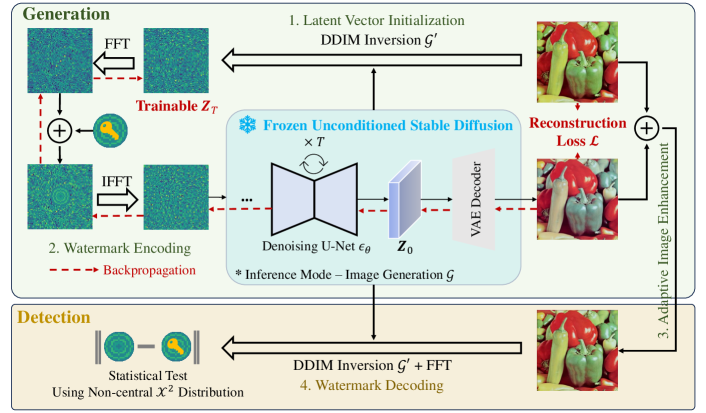
- ZoDiac injects watermarks into the trainable latent space of a pre-trained stable diffusion model, exploiting the model's ability to map multiple latent vectors to the same image.
- It identifies a watermarked latent vector that maps to the original image through optimization, ensuring the watermark is embedded in the model's latent representation.
- The framework uses diffusion inversion to reconstruct the latent vector from the watermarked image and applies a statistical test to detect the embedded watermark pattern.
- Adaptive blending between the original and watermarked images ensures perceptual quality with PSNR >30 dB and SSIM >0.9.
- For robustness to rotation, ZoDiac incorporates a rotation-invariant detection mechanism that maintains detection above 99%.
- The method avoids training a dedicated watermarking model, relying instead on the pre-trained diffusion model’s latent space for zero-shot watermarking.
Experimental results
Research questions
- RQ1Can watermarking in the latent space of a pre-trained stable diffusion model enhance robustness against generative AI-based watermark removal attacks?
- RQ2How does ZoDiac perform under composite attacks combining multiple distortion techniques?
- RQ3What is the trade-off between watermark detection rate, false positive rate, and image quality in a zero-shot watermarking framework?
- RQ4Can ZoDiac maintain high robustness against geometric transformations like rotation without retraining?
- RQ5How does ZoDiac compare to state-of-the-art watermarking methods in terms of invisibility and resilience to advanced attacks?
Key findings
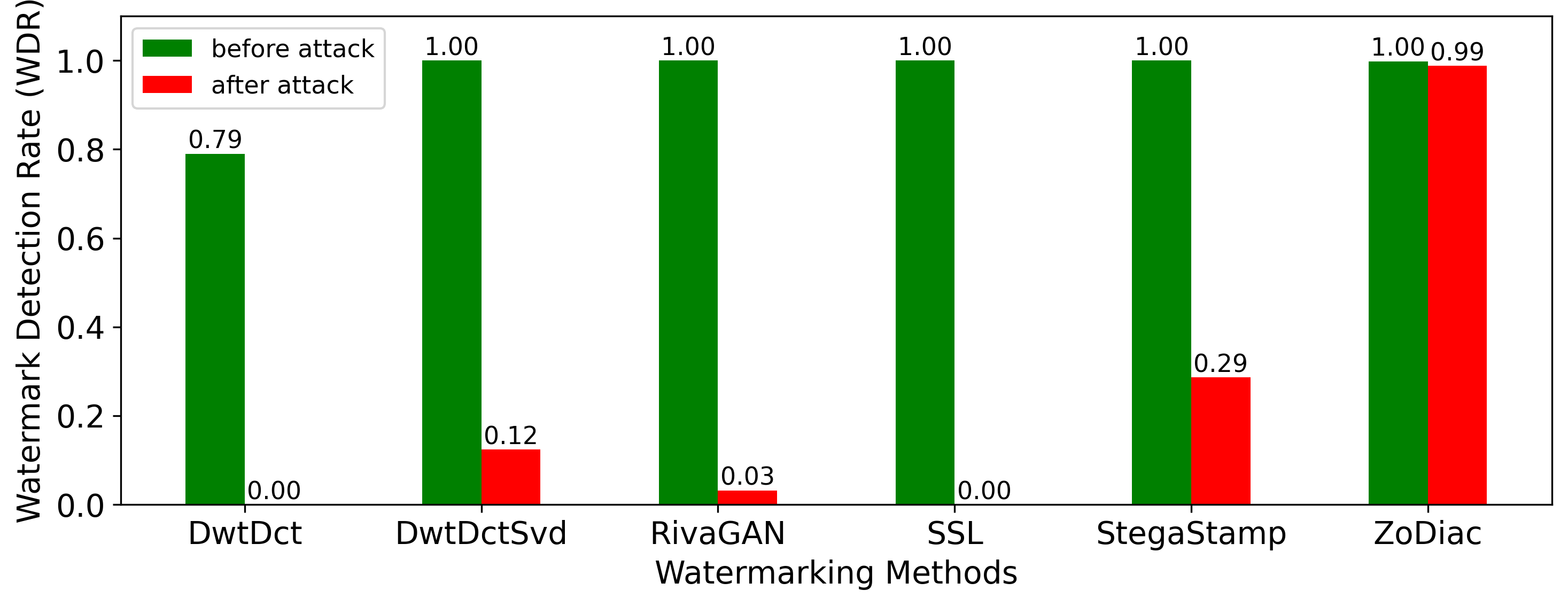
- ZoDiac achieves a watermark detection rate above 98% across MS-COCO, DiffusionDB, and WikiArt datasets under state-of-the-art stable-diffusion-based attacks.
- The false positive rate remains below 6.4%, with only 0.4% for standard detection and 3.4% when including rotation robustness.
- In composite attack scenarios (excluding rotation), ZoDiac maintains a detection rate above 50%, while all existing methods fail with 0% detection.
- ZoDiac preserves high image quality, achieving PSNR >30 dB and SSIM >0.9, indicating strong perceptual invisibility.
- The framework demonstrates robustness to rotation with a detection rate above 99%, significantly outperforming existing methods that fail under such attacks.
- ZoDiac is the first watermarking method to achieve robustness against the most recent stable-diffusion-based regeneration attacks, marking a significant advancement in zero-shot watermarking.
Read this paper
Open the full text in the Nubint reader and ask about any passage as you read.
Read this paper on NubintThis review was generated by AI from the original paper. Please check the paper before citing it.