
[Paper Review] AttentiveNAS: Improving Neural Architecture Search via Attentive Sampling
AttentiveNAS improves neural architecture search by introducing attentive sampling strategies—BestUp and WorstUp—that prioritize training on networks likely to enhance the accuracy-FLOPs Pareto front, achieving state-of-the-art ImageNet top-1 accuracy of 80.7% with only 491 MFLOPs, outperforming models like MobileNetV3 and FBNetV3.
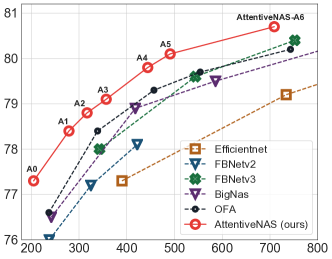
Neural architecture search (NAS) has shown great promise in designing state-of-the-art (SOTA) models that are both accurate and efficient. Recently, two-stage NAS, e.g. BigNAS, decouples the model training and searching process and achieves remarkable search efficiency and accuracy. Two-stage NAS requires sampling from the search space during training, which directly impacts the accuracy of the final searched models. While uniform sampling has been widely used for its simplicity, it is agnostic of the model performance Pareto front, which is the main focus in the search process, and thus, misses opportunities to further improve the model accuracy. In this work, we propose AttentiveNAS that focuses on improving the sampling strategy to achieve better performance Pareto. We also propose algorithms to efficiently and effectively identify the networks on the Pareto during training. Without extra re-training or post-processing, we can simultaneously obtain a large number of networks across a wide range of FLOPs. Our discovered model family, AttentiveNAS models, achieves top-1 accuracy from 77.3% to 80.7% on ImageNet, and outperforms SOTA models, including BigNAS and Once-for-All networks. We also achieve ImageNet accuracy of 80.1% with only 491 MFLOPs. Our training code and pretrained models are available at https://github.com/facebookresearch/AttentiveNAS.
Motivation & Objective
- Address the inefficiency of uniform sampling in two-stage NAS, which treats all candidate networks equally despite varying potential for Pareto improvement.
- Improve the performance Pareto front by strategically sampling networks that are either on the current best or worst Pareto front during training.
- Develop efficient, low-overhead methods to identify and prioritize networks on the best or worst Pareto front using training loss and accuracy predictors.
- Achieve superior accuracy-FLOPs trade-offs without retraining or post-processing, enabling a diverse family of high-performing models.
Proposed method
- Propose two attentive sampling strategies: BestUp, which focuses on improving the current best Pareto front, and WorstUp, which targets the worst-performing models to enhance parameter updates.
- Use training loss and a pre-trained accuracy predictor as proxies to efficiently identify networks on the best or worst Pareto front during training.
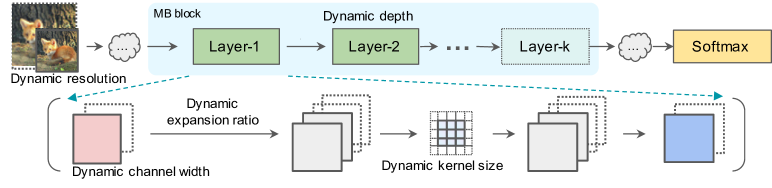
- Integrate attentive sampling into the weight-sharing training phase of two-stage NAS, maintaining computational efficiency while improving model quality.
- Apply evolutionary search on the final weight-shared model to discover high-performing architectures across diverse FLOPs regimes.
- Leverage a single, unified training process to generate a family of models spanning from 203 MFLOPs to 709 MFLOPs, each optimized for its target FLOPs budget.
- Evaluate performance using the original ImageNet validation set after training, ensuring fair comparison with prior methods.
Experimental results
Research questions
- RQ1Can attentive sampling strategies that focus on the best or worst Pareto front improve the final accuracy of searched models compared to uniform sampling?
- RQ2Does improving the performance of the worst Pareto models during training lead to better overall Pareto front performance?
- RQ3How do different proxy signals—training loss versus predicted accuracy—compare in guiding effective attentive sampling?
- RQ4Can attentive sampling achieve state-of-the-art accuracy-FLOPs trade-offs without additional retraining or post-processing?
- RQ5What is the optimal balance between exploration and exploitation in NAS sampling strategies?
Key findings
- WorstUp-1M (acc) outperforms Uniform by 0.3% top-1 accuracy on the 200±10 MFLOPs regime, demonstrating that improving worst-performing models boosts the entire Pareto front.
- WorstUp-50 (acc) and WorstUp-1M (acc) significantly improve the lower bounds of the Pareto front, with higher minimum and first-quartile accuracy than Uniform and BestUp strategies.
- BestUp-3 (loss) achieves the best overall performance, outperforming both Uniform and other BestUp variants by balancing exploration and exploitation effectively.
- AttentiveNAS-A5 achieves 80.1% top-1 accuracy on ImageNet with only 491 MFLOPs, surpassing MobileNetV3 and FBNetV3 under similar FLOPs constraints.
- AttentiveNAS-A6 achieves 80.7% top-1 accuracy at 709 MFLOPs, setting a new SOTA for models in the 700+ MFLOPs range.
- The method achieves state-of-the-art accuracy across all FLOPs regimes, outperforming established baselines including BigNAS, OFA, EfficientNet, and FBNetV3.
Read this paper
Open the full text in the Nubint reader and ask about any passage as you read.
Read this paper on NubintThis review was generated by AI from the original paper. Please check the paper before citing it.