
[Paper Review] Audio-Visual Efficient Conformer for Robust Speech Recognition
This paper proposes Audio-Visual Efficient Conformer (AVEC), a multimodal speech recognition model that enhances noise robustness by fusing audio and visual (lip movement) inputs using a lightweight Efficient Conformer back-end. By integrating intermediate CTC losses via Inter CTC residual modules and replacing grouped attention with a more efficient patch attention mechanism, AVEC achieves state-of-the-art WER of 2.3% on LRS2 and 1.8% on LRS3, reaching lower error rates with 4× fewer training steps than audio-only baselines.
End-to-end Automatic Speech Recognition (ASR) systems based on neural networks have seen large improvements in recent years. The availability of large scale hand-labeled datasets and sufficient computing resources made it possible to train powerful deep neural networks, reaching very low Word Error Rate (WER) on academic benchmarks. However, despite impressive performance on clean audio samples, a drop of performance is often observed on noisy speech. In this work, we propose to improve the noise robustness of the recently proposed Efficient Conformer Connectionist Temporal Classification (CTC)-based architecture by processing both audio and visual modalities. We improve previous lip reading methods using an Efficient Conformer back-end on top of a ResNet-18 visual front-end and by adding intermediate CTC losses between blocks. We condition intermediate block features on early predictions using Inter CTC residual modules to relax the conditional independence assumption of CTC-based models. We also replace the Efficient Conformer grouped attention by a more efficient and simpler attention mechanism that we call patch attention. We experiment with publicly available Lip Reading Sentences 2 (LRS2) and Lip Reading Sentences 3 (LRS3) datasets. Our experiments show that using audio and visual modalities allows to better recognize speech in the presence of environmental noise and significantly accelerate training, reaching lower WER with 4 times less training steps. Our Audio-Visual Efficient Conformer (AVEC) model achieves state-of-the-art performance, reaching WER of 2.3% and 1.8% on LRS2 and LRS3 test sets. Code and pretrained models are available at https://github.com/burchim/AVEC.
Motivation & Objective
- To improve the noise robustness of end-to-end automatic speech recognition (ASR) systems, which degrade significantly under environmental noise.
- To address the limitation of CTC-based models relying on conditional independence by introducing intermediate CTC supervision to relax this assumption.
- To accelerate training and improve performance by fusing audio and visual modalities using a lightweight, efficient architecture.
- To reduce computational complexity in attention mechanisms without sacrificing recognition accuracy, particularly in multimodal settings.
Proposed method
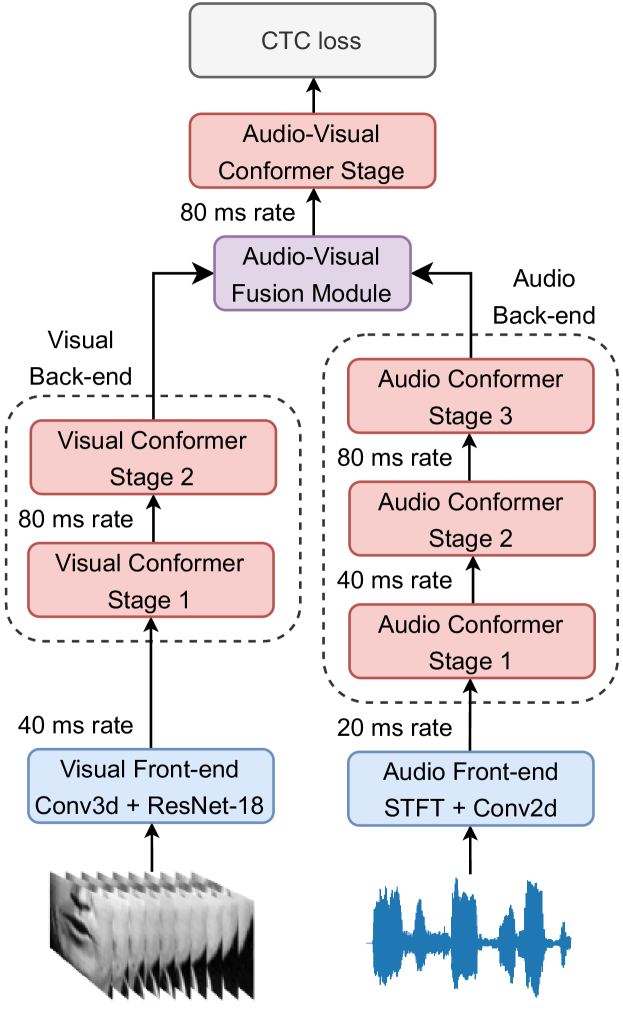
- Adopting a ResNet-18 visual front-end to extract spatiotemporal features from lip movements, which are then fused with raw audio waveforms.
- Employing an Efficient Conformer back-end with grouped attention replaced by a simpler, more efficient patch attention mechanism to reduce FLOPs.
- Introducing intermediate CTC losses between encoder blocks using Inter CTC residual modules to condition block-level features on early predictions and relax the conditional independence assumption of CTC.
- Applying early fusion of audio and visual features before the encoder, enabling joint modeling of both modalities from the start of the network.
- Training the end-to-end model using Connectionist Temporal Classification (CTC) loss with multimodal inputs to optimize transduction from raw audio and video to text.
- Augmenting training data with various noise types (e.g., babble, white, street noise) to improve robustness, especially in low SNR conditions.
Experimental results
Research questions
- RQ1Can multimodal fusion of audio and visual inputs significantly improve the noise robustness of end-to-end ASR systems?
- RQ2Does introducing intermediate CTC supervision between encoder blocks enhance recognition performance and reduce the gap between autoregressive and non-autoregressive models?
- RQ3Can a simplified attention mechanism like patch attention match the performance of grouped attention while reducing computational complexity?
- RQ4To what extent does training with noisy data improve generalization and robustness in low-SNR environments?
- RQ5Can visual modality features effectively guide audio recognition when audio is corrupted, especially in challenging noise conditions?
Key findings
- The Audio-Visual Efficient Conformer (AVEC) achieves a state-of-the-art Word Error Rate (WER) of 2.3% on the LRS2 test set and 1.8% on the LRS3 test set, outperforming previous methods.
- AVEC reduces WER by up to 16.3 percentage points compared to prior work on LRS2 under -5 dB babble noise, achieving 9.7% WER versus 16.3% for Ma et al. [29].
- With 4× fewer training steps, AVEC reaches lower WER than its audio-only counterpart, demonstrating significant training acceleration.
- The model achieves 2.0% WER on LRS3 under 20 dB SNR with babble noise, and 2.0% under white noise, showing strong robustness across noise types.
- The use of intermediate CTC supervision via Inter CTC residual modules helps prevent visual modality underuse and improves alignment between predictions and features.
- Patch attention achieves comparable performance to grouped attention while reducing computational complexity, making the model more efficient for real-time applications.

Read this paper
Open the full text in the Nubint reader and ask about any passage as you read.
Read this paper on NubintThis review was generated by AI from the original paper. Please check the paper before citing it.