
[Paper Review] Augmented Large Language Models with Parametric Knowledge Guiding
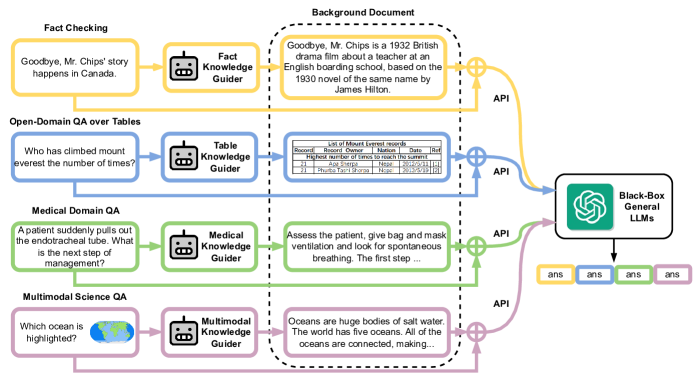
This paper proposes Parametric Knowledge Guiding (PKG), a framework that enhances black-box large language models (LLMs) with domain-specific knowledge by integrating a trainable, open-source 'white-box' language model to generate relevant background knowledge. The method improves LLM performance on knowledge-intensive tasks—achieving up to +11.9% gain on tabular QA—without modifying the original LLM’s parameters, ensuring privacy and enabling offline fine-tuning with domain data.
Large Language Models (LLMs) have significantly advanced natural language processing (NLP) with their impressive language understanding and generation capabilities. However, their performance may be suboptimal for domain-specific tasks that require specialized knowledge due to limited exposure to the related data. Additionally, the lack of transparency of most state-of-the-art (SOTA) LLMs, which can only be accessed via APIs, impedes further fine-tuning with domain custom data. Moreover, providing private data to the LLMs' owner leads to data privacy problems. To address these challenges, we propose the novel Parametric Knowledge Guiding (PKG) framework, which equips LLMs with a knowledge-guiding module to access relevant knowledge without altering the LLMs' parameters. Our PKG is based on open-source "white-box" language models, allowing offline memory of any knowledge that LLMs require. We demonstrate that our PKG framework can enhance the performance of "black-box" LLMs on a range of domain knowledge-intensive tasks that require factual (+7.9%), tabular (+11.9%), medical (+3.0%), and multimodal (+8.1%) knowledge.
Motivation & Objective
- Address the limitations of black-box LLMs in domain-specific tasks due to insufficient specialized knowledge and lack of transparency.
- Overcome data privacy concerns in fine-tuning by enabling offline, parameter-free integration of domain-specific knowledge.
- Provide a solution that enhances LLM performance without altering the original model weights, preserving model integrity and security.
- Enable effective knowledge infusion for LLMs using a parametric, fine-tunable knowledge generation module instead of retrieval-based methods.
- Demonstrate the framework’s effectiveness across diverse knowledge-intensive tasks, including factual, tabular, medical, and multimodal reasoning.
Proposed method
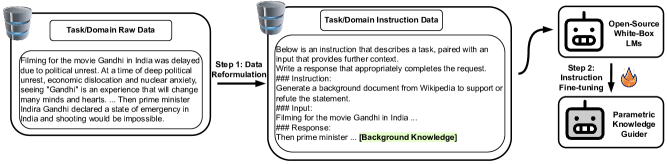
- Introduce a parametric knowledge-guiding module based on an open-source, fine-tunable LLM (e.g., LLaMA-7B) as a 'white-box' knowledge source.
- Fine-tune the PKG module via instruction tuning to align it with specific domain tasks and knowledge types.
- For each input, the PKG module generates a contextually relevant background knowledge sequence.
- Inject the generated knowledge as extra context into the input prompt of the target black-box LLM via background-augmented prompting.
- Decouple knowledge access from the original LLM, allowing offline, secure, and customizable knowledge injection.
- Use a modular design where the PKG module is trained independently and then used to guide inference in any external LLM.
Experimental results
Research questions
- RQ1Can a parametric knowledge generation module improve the performance of black-box LLMs on domain-specific tasks without modifying their weights?
- RQ2How effective is the PKG framework in enhancing LLMs on factual, tabular, medical, and multimodal knowledge-intensive tasks?
- RQ3Does the use of a fine-tuned, open-source 'white-box' model for knowledge generation outperform retrieval-based methods in complex knowledge integration?
- RQ4To what extent does the PKG framework preserve data privacy during fine-tuning compared to traditional API-based fine-tuning?
- RQ5Can the PKG framework generalize across diverse knowledge types and downstream tasks with minimal architectural changes?
Key findings
- The PKG framework improves performance on factual knowledge tasks (FM2) by +7.9% compared to baseline LLMs.
- On tabular knowledge tasks (NQ-Table), the framework achieves a +11.9% improvement, demonstrating strong performance on structured knowledge.
- For medical QA (MedMC-QA), the framework yields a +3.0% performance gain, indicating effectiveness in specialized domains.
- In multimodal reasoning (ScienceQA), the PKG framework improves accuracy by +8.1%, showing robustness across modalities.
- The framework enables secure, offline fine-tuning by decoupling knowledge access from the original LLM, mitigating data privacy risks.
- The method outperforms retrieval-based baselines by leveraging deeper, integrated knowledge generation rather than shallow document retrieval.
Read this paper
Open the full text in the Nubint reader and ask about any passage as you read.
Read this paper on NubintThis review was generated by AI from the original paper. Please check the paper before citing it.