
[Paper Review] Augmenting LLMs with Knowledge: A survey on hallucination prevention
A survey of knowledge-augmented language models that retrieve and fuse external knowledge to reduce hallucinations, covering retrieval, fusion, and search-based augmentation approaches.
Large pre-trained language models have demonstrated their proficiency in storing factual knowledge within their parameters and achieving remarkable results when fine-tuned for downstream natural language processing tasks. Nonetheless, their capacity to access and manipulate knowledge with precision remains constrained, resulting in performance disparities on knowledge-intensive tasks when compared to task-specific architectures. Additionally, the challenges of providing provenance for model decisions and maintaining up-to-date world knowledge persist as open research frontiers. To address these limitations, the integration of pre-trained models with differentiable access mechanisms to explicit non-parametric memory emerges as a promising solution. This survey delves into the realm of language models (LMs) augmented with the ability to tap into external knowledge sources, including external knowledge bases and search engines. While adhering to the standard objective of predicting missing tokens, these augmented LMs leverage diverse, possibly non-parametric external modules to augment their contextual processing capabilities, departing from the conventional language modeling paradigm. Through an exploration of current advancements in augmenting large language models with knowledge, this work concludes that this emerging research direction holds the potential to address prevalent issues in traditional LMs, such as hallucinations, un-grounded responses, and scalability challenges.
Motivation & Objective
- Motivate the need for external knowledge integration to address hallucinations and knowledge limits in LLMs.
- Survey and categorize external-knowledge augmentation techniques for LLMs, including unstructured and structured sources.
- Explain core architectures that enable retrieval, memory augmentation, and fusion of retrieved content with generation.
- Highlight challenges such as updating memory, efficiency, and safety in knowledge-augmented LLMs.
Proposed method
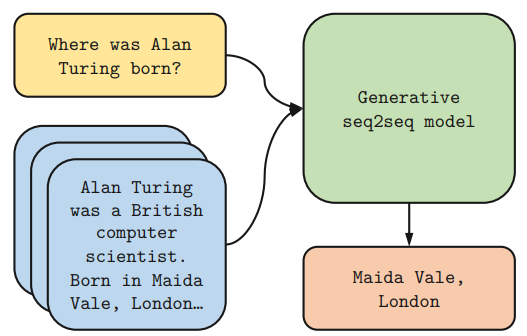
- Describe and compare retrieval-augmented generation (RAG) and fusion-in-decoder (FiD) architectures.
- Explain REALM-style joint retriever-generator pre-training and its training dynamics.
- Detail Atlas, RETRO, GRAFT-Net, and PullNet as examples of structured knowledge integration and multi-hop QA.
- Discuss search-engine augmented generation and SeeKeR as approaches leveraging live web information.
- Summarize graph-based and triplestore approaches (GCN/Relational GCN) for structured knowledge graphs.
Experimental results
Research questions
- RQ1What are the main architectural paradigms for augmenting LLMs with external knowledge?
- RQ2How do retrieval and fusion mechanisms influence the factuality and grounding of generated content?
- RQ3What are the trade-offs between parametric knowledge storage and non-parametric external memory in LLMs?
- RQ4How do structured knowledge graphs, triplestores, and text corpora contribute to multi-hop reasoning and QA?
- RQ5What are open challenges in updating, scalability, safety, and provenance for knowledge-augmented LLMs?
Key findings
- Identifies a spectrum of knowledge augmentation strategies from unstructured text to structured graphs.
- Shows that retrieval-augmented models can reduce reliance on parametric memory and improve grounding.
- Highlights methods that jointly train retriever and generator to improve retrieval quality and end-task performance.
- Discusses the benefits and limitations of different fusion strategies (RAG-style, FiD, FiD-like concatenation) for incorporating retrieved content.
- Notes the importance of scalability, real-time updates, and safety when using external knowledge sources such as search engines.

Read this paper
Open the full text in the Nubint reader and ask about any passage as you read.
Read this paper on NubintThis review was generated by AI from the original paper. Please check the paper before citing it.