
[Paper Review] Augmenting Reinforcement Learning with Transformer-based Scene Representation Learning for Decision-making of Autonomous Driving
This paper proposes Scene-Rep Transformer, a novel framework that enhances reinforcement learning (RL) for autonomous driving by integrating a multi-stage Transformer for interactive and intention-aware scene representation and a sequential latent Transformer (SLT) with self-supervised learning to distill future predictive information into the current latent state. The method significantly improves sample efficiency and decision-making performance in complex urban driving scenarios, achieving higher success rates, improved safety, and more diverse driving behaviors compared to baseline RL methods.
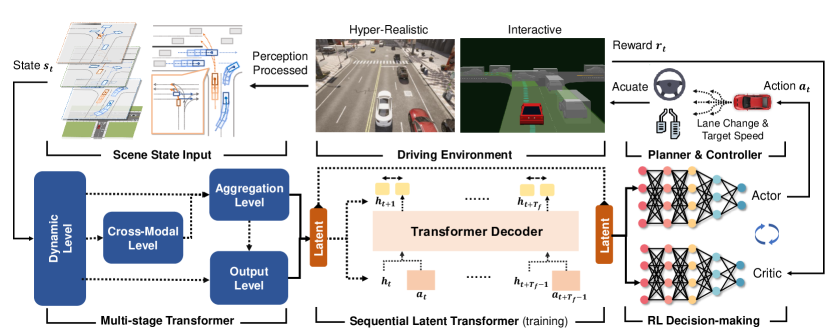
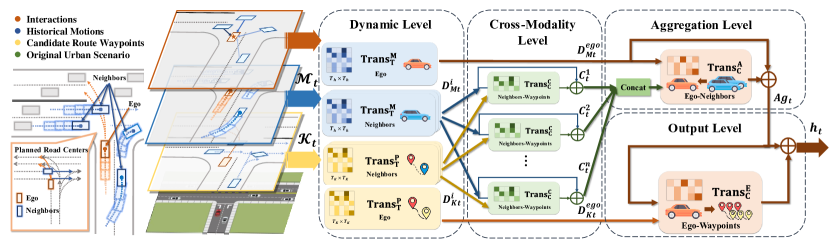
Decision-making for urban autonomous driving is challenging due to the stochastic nature of interactive traffic participants and the complexity of road structures. Although reinforcement learning (RL)-based decision-making scheme is promising to handle urban driving scenarios, it suffers from low sample efficiency and poor adaptability. In this paper, we propose Scene-Rep Transformer to improve the RL decision-making capabilities with better scene representation encoding and sequential predictive latent distillation. Specifically, a multi-stage Transformer (MST) encoder is constructed to model not only the interaction awareness between the ego vehicle and its neighbors but also intention awareness between the agents and their candidate routes. A sequential latent Transformer (SLT) with self-supervised learning objectives is employed to distill the future predictive information into the latent scene representation, in order to reduce the exploration space and speed up training. The final decision-making module based on soft actor-critic (SAC) takes as input the refined latent scene representation from the Scene-Rep Transformer and outputs driving actions. The framework is validated in five challenging simulated urban scenarios with dense traffic, and its performance is manifested quantitatively by the substantial improvements in data efficiency and performance in terms of success rate, safety, and efficiency. The qualitative results reveal that our framework is able to extract the intentions of neighbor agents to help make decisions and deliver more diversified driving behaviors.
Motivation & Objective
- To address low sample efficiency and poor adaptability in RL-based decision-making for urban autonomous driving.
- To improve scene representation learning by modeling interactions between ego vehicles, neighbors, and candidate routes.
- To inject predictive future dynamics into the current latent state to reduce exploration space and accelerate training.
- To enable more interpretable and diverse driving behaviors through intention-aware representation.
- To validate the framework in challenging simulated urban scenarios with dense traffic.
Proposed method
- A multi-stage Transformer (MST) encodes heterogeneous scene elements—such as agent trajectories and candidate route waypoints—into a unified latent representation, capturing both agent interactions and route intention.
- The sequential latent Transformer (SLT) uses self-supervised learning to distill features from sequences of future latent-action pairs into the current latent vector, embedding predictive knowledge.
- The SLT is trained only during the RL training phase to guide policy learning without affecting inference.
- A soft actor-critic (SAC) agent uses the refined latent representation as input to generate high-quality driving decisions.
- The entire framework is trained end-to-end to maximize cumulative reward and task success rate.
- Future horizon hyperparameter $T_G$ in SLT is tuned to balance predictive accuracy and training stability across different task lengths.
Experimental results
Research questions
- RQ1Can a Transformer-based scene representation model effectively encode heterogeneous driving elements, including agent interactions and route intentions?
- RQ2Does distilling sequential predictive information into the current latent state reduce exploration space and improve training efficiency in RL-based decision-making?
- RQ3How does the proposed framework compare to baseline RL methods in terms of success rate, safety, and behavioral diversity in complex urban driving tasks?
- RQ4What is the optimal future horizon $T_G$ for predictive distillation in long-term driving scenarios?
- RQ5Can the model learn interpretable driving behaviors such as lane changes, aggressive turns, and merging maneuvers?
Key findings
- The Scene-Rep Transformer achieves substantial improvements in data efficiency, reducing the number of training samples required to reach high performance compared to PPO and DrQ baselines.
- In five simulated urban scenarios—unprotected left turn, double merging, roundabout, and others—the method achieves higher success rates, with qualitative results showing more diverse and safer driving maneuvers.
- The ego vehicle learns both conservative and aggressive behaviors, such as lane-changing during left turns and multiple lane changes during merging, indicating robust policy generalization.
- The SLT with $T_G = 10$ achieves peak performance on longer tasks like Roundabout-C, demonstrating that longer predictive horizons improve learning in complex scenarios.
- Attention visualization confirms that the model adaptively focuses on intention-relevant cues, such as candidate waypoints and interaction dynamics, improving interpretability.
- Ablation studies show that both the multi-stage Transformer and SLT contribute significantly to performance, with the SLT reducing exploration space and accelerating convergence.
Read this paper
Open the full text in the Nubint reader and ask about any passage as you read.
Read this paper on NubintThis review was generated by AI from the original paper. Please check the paper before citing it.