
[Paper Review] Auto-Encoding Score Distribution Regression for Action Quality Assessment
This paper proposes a plug-and-play uncertainty-aware regression module, Distribution Auto-Encoder (DAE), for Action Quality Assessment (AQA) by modeling action scores as learned probability distributions using variational inference. By encoding video features into a distribution and sampling via reparameterization, DAE improves prediction accuracy and uncertainty estimation, achieving state-of-the-art performance on AQA-7, MTL-AQA, and JIGSAWS with only a minor inference time overhead.
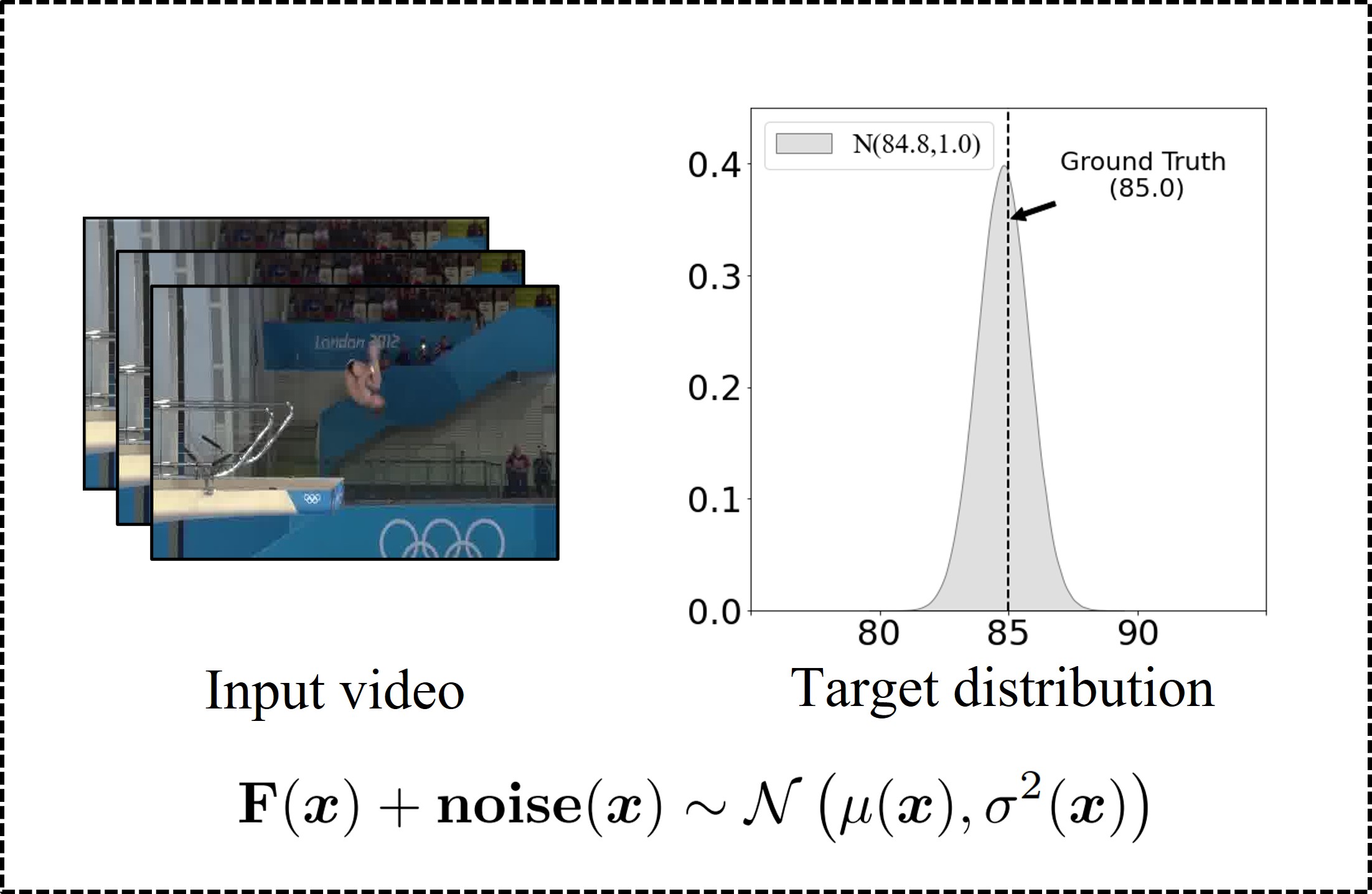
The action quality assessment (AQA) of videos is a challenging vision task since the relation between videos and action scores is difficult to model. Thus, AQA has been widely studied in the literature. Traditionally, AQA is treated as a regression problem to learn the underlying mappings between videos and action scores. But previous methods ignored data uncertainty in AQA dataset. To address aleatoric uncertainty, we further develop a plug-and-play module Distribution Auto-Encoder (DAE). Specifically, it encodes videos into distributions and uses the reparameterization trick in variational auto-encoders (VAE) to sample scores, which establishes a more accurate mapping between videos and scores. Meanwhile, a likelihood loss is used to learn the uncertainty parameters. We plug our DAE approach into MUSDL and CoRe. Experimental results on public datasets demonstrate that our method achieves state-of-the-art on AQA-7, MTL-AQA, and JIGSAWS datasets. Our code is available at https://github.com/InfoX-SEU/DAE-AQA.
Motivation & Objective
- To address the limitation of traditional AQA methods that ignore aleatoric uncertainty in human-annotated scores.
- To model the inherent variability in human judgment by learning a distribution over action scores instead of a single scalar value.
- To develop a generalizable, plug-and-play module that enhances existing regression-based AQA frameworks without architectural overhaul.
- To improve prediction robustness and explainability by quantifying uncertainty through learned variance in the score distribution.
Proposed method
- DAE uses a variational auto-encoder-inspired architecture to map video features into a parameterized probability distribution (e.g., Gaussian) over action scores.
- The encoder outputs mean and variance of the score distribution, and the reparameterization trick enables differentiable sampling for end-to-end training.
- A novel likelihood-based loss function is introduced, combining reconstruction and supervision terms to jointly optimize distribution parameters and prediction accuracy.
- The method is integrated into existing AQA models—MUSDL, CoRe, and MLP-based baselines—via a plug-and-play design.
- The model is trained using a weighted combination of a supervision loss and a reconstruction loss, enabling adaptive uncertainty estimation.
- DAE is evaluated on three public datasets: AQA-7, MTL-AQA, and JIGSAWS, with ablation studies on loss components and inference efficiency.
Experimental results
Research questions
- RQ1Can modeling action scores as probability distributions improve regression performance in AQA compared to point estimates?
- RQ2How effectively can a learnable distribution capture the inherent aleatoric uncertainty in human-annotated video scores?
- RQ3Does the proposed DAE module generalize across different AQA architectures and datasets?
- RQ4What is the impact of the proposed likelihood loss function on uncertainty estimation and model stability?
- RQ5How does the inference time of DAE compare to baseline regression models?
Key findings
- DAE achieves state-of-the-art performance on AQA-7, MTL-AQA, and JIGSAWS, with a 6.1% relative improvement over the baseline on MTL-AQA.
- The proposed likelihood loss outperforms standard MSE loss, improving Spearman’s rank correlation by 0.0037 on MTL-AQA and 0.04 on JIGSAWS.
- The model learns adaptive variance: high-quality actions show low variance (stable scores), while low-quality actions show higher variance (disagreement among judges).
- DAE-MT and DAE-CoRe achieve 7% and 9.7% inference time increases, respectively, demonstrating minimal computational overhead.
- Case studies confirm that DAE captures real-world uncertainty patterns, with distributions reflecting the reliability of human judgments.
- Ablation studies show that the combined loss function yields better performance and more stable variance estimation than single-loss alternatives.

Read this paper
Open the full text in the Nubint reader and ask about any passage as you read.
Read this paper on NubintThis review was generated by AI from the original paper. Please check the paper before citing it.