
[Paper Review] Auto-GPT for Online Decision Making: Benchmarks and Additional Opinions
The paper benchmarks Auto-GPT styled agents across real-world online decision tasks (WebShop and ALFWorld) and introduces an Additional Opinions algorithm that injects external expert model suggestions to improve performance, especially with GPT-4.
Auto-GPT is an autonomous agent that leverages recent advancements in adapting Large Language Models (LLMs) for decision-making tasks. While there has been a growing interest in Auto-GPT stypled agents, questions remain regarding the effectiveness and flexibility of Auto-GPT in solving real-world decision-making tasks. Its limited capability for real-world engagement and the absence of benchmarks contribute to these uncertainties. In this paper, we present a comprehensive benchmark study of Auto-GPT styled agents in decision-making tasks that simulate real-world scenarios. Our aim is to gain deeper insights into this problem and understand the adaptability of GPT-based agents. We compare the performance of popular LLMs such as GPT-4, GPT-3.5, Claude, and Vicuna in Auto-GPT styled decision-making tasks. Furthermore, we introduce the Additional Opinions algorithm, an easy and effective method that incorporates supervised/imitation-based learners into the Auto-GPT scheme. This approach enables lightweight supervised learning without requiring fine-tuning of the foundational LLMs. We demonstrate through careful baseline comparisons and ablation studies that the Additional Opinions algorithm significantly enhances performance in online decision-making benchmarks, including WebShop and ALFWorld.
Motivation & Objective
- Investigate how Auto-GPT styled agents perform on real-world online decision tasks.
- Compare multiple LLMs (GPT-4, GPT-3.5, Claude, Vicuna) in Auto-GPT configurations.
- Propose and evaluate the Additional Opinions algorithm that uses external expert models as opinion providers.
- Demonstrate through ablation and baseline studies whether lightweight supervision can improve performance without fine-tuning.
Proposed method
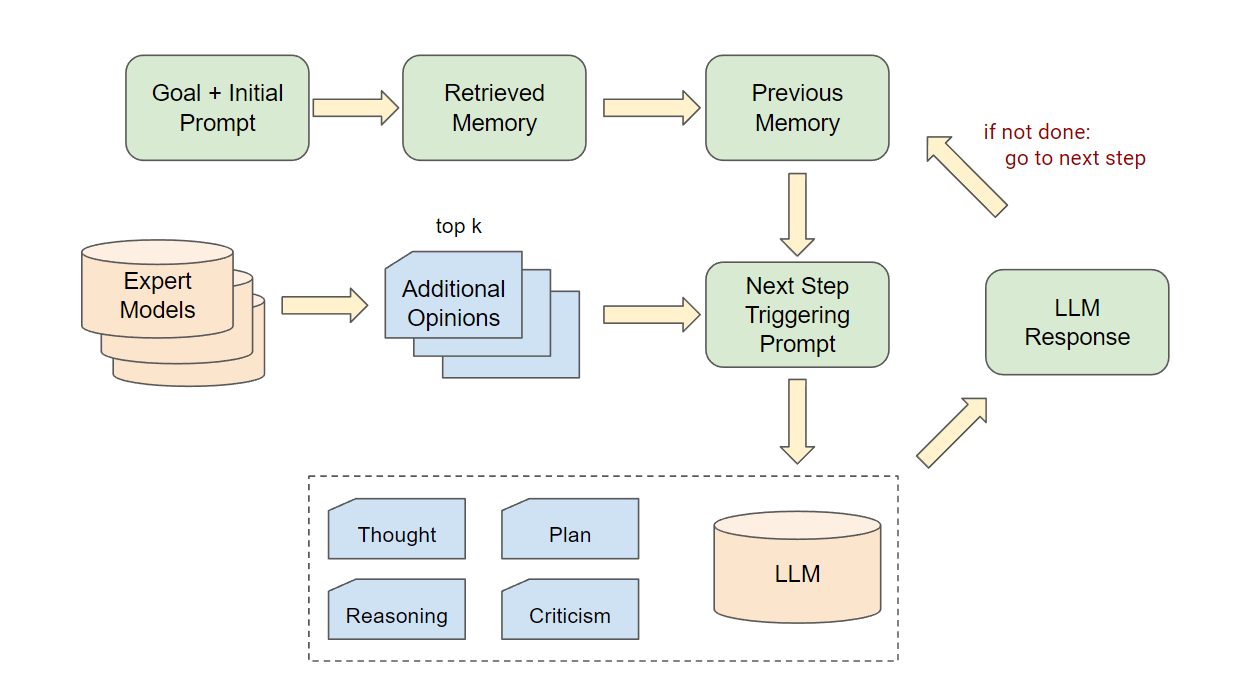
- Adapt Auto-GPT to two online decision tasks with minimal prompting improvements.
- Represent actions as tools and provide 1–3 few-shot tool demonstrations to leverage in-context learning.
- Introduce Additional Opinions by sampling top-k opinions from expert models and injecting them into the prompt context as references.
- Evaluate across WebShop and ALFWorld against imitation-learning baselines and various LLMs.
- Use low temperature to reduce randomness and conduct multiple runs for variance control in IL+Auto-GPT variants.
Experimental results
Research questions
- RQ1Can Auto-GPT styled agents be effectively adapted to online decision-making tasks resembling real-world environments?
- RQ2Which LLMs (GPT-4, GPT-3.5, Claude, Vicuna) perform best in Auto-GPT configurations on WebShop and ALFWorld?
- RQ3Does incorporating Additional Opinions from external expert models improve decision-making performance without fine-tuning the foundational LLMs?
- RQ4What is the relative impact of single versus multiple additional opinions on performance, and how does this vary by task and model?
Key findings
- GPT-4-based Auto-GPT variants achieve the highest performance among tested models on both tasks.
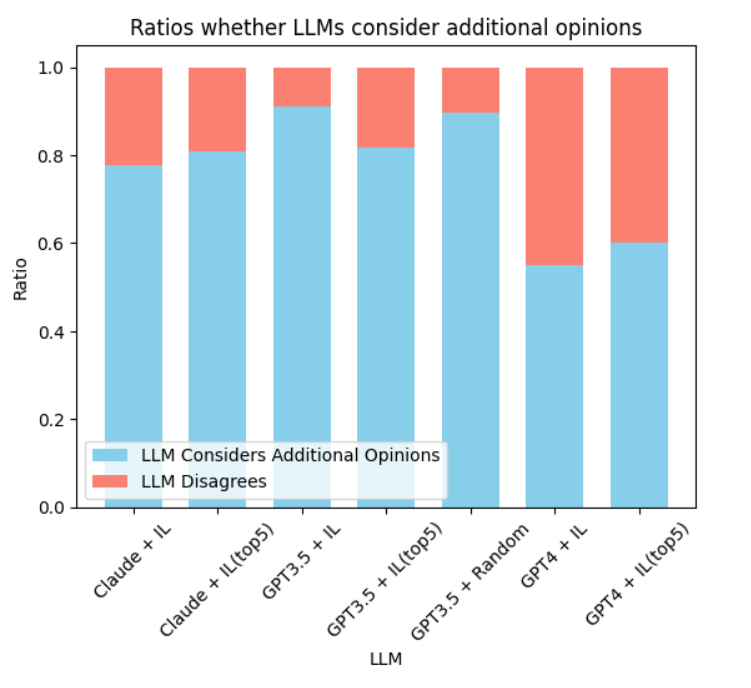
- Providing top-k Additional Opinions from expert models improves performance, with GPT-4 benefiting notably from multiple opinions.
- In WebShop, GPT-4 with Additional Opinions reaches higher success, precision, and rewards than many baselines.
- In ALFWorld, GPT-4 considerably outperforms imitation-learning baselines, and the presence of beam search in IL impacts results.
- Claude and GPT-3.5 generally underperform GPT-4 in Auto-GPT setups, though latency trade-offs exist.
- Vicuna-based Auto-GPT performs poorly or fails to generate formatted responses in these setups.
Read this paper
Open the full text in the Nubint reader and ask about any passage as you read.
Read this paper on NubintThis review was generated by AI from the original paper. Please check the paper before citing it.