
[Paper Review] AutoCodeRover: Autonomous Program Improvement
AutoCodeRover is an LLM-based framework for autonomous program improvement that leverages abstract syntax trees (ASTs), iterative code search, and spectrum-based fault localization to resolve GitHub issues. It achieves 22–23% success on SWE-bench-lite and resolves 16% of issues on full SWE-bench, outperforming recent AI agents like Devin while operating in comparable time.
Researchers have made significant progress in automating the software development process in the past decades. Recent progress in Large Language Models (LLMs) has significantly impacted the development process, where developers can use LLM-based programming assistants to achieve automated coding. Nevertheless, software engineering involves the process of program improvement apart from coding, specifically to enable software maintenance (e.g. bug fixing) and software evolution (e.g. feature additions). In this paper, we propose an automated approach for solving GitHub issues to autonomously achieve program improvement. In our approach called AutoCodeRover, LLMs are combined with sophisticated code search capabilities, ultimately leading to a program modification or patch. In contrast to recent LLM agent approaches from AI researchers and practitioners, our outlook is more software engineering oriented. We work on a program representation (abstract syntax tree) as opposed to viewing a software project as a mere collection of files. Our code search exploits the program structure in the form of classes/methods to enhance LLM's understanding of the issue's root cause, and effectively retrieve a context via iterative search. The use of spectrum-based fault localization using tests, further sharpens the context, as long as a test-suite is available. Experiments on SWE-bench-lite (300 real-life GitHub issues) show increased efficacy in solving GitHub issues (19% on SWE-bench-lite), which is higher than the efficacy of the recently reported SWE-agent. In addition, AutoCodeRover achieved this efficacy with significantly lower cost (on average, $0.43 USD), compared to other baselines. We posit that our workflow enables autonomous software engineering, where, in future, auto-generated code from LLMs can be autonomously improved.
Motivation & Objective
- To address the gap in autonomous software engineering by enabling LLMs to improve code beyond initial generation, focusing on bug fixing and feature addition.
- To enhance LLM reasoning in program repair by integrating structured code representations (ASTs) and program-level navigation instead of file-based retrieval.
- To improve context awareness and precision in patch generation using iterative code search guided by issue semantics and test-based fault localization (SBFL).
- To reduce human intervention in software maintenance by enabling end-to-end autonomous resolution of real-world GitHub issues.
- To establish a trustable, reproducible pipeline for autonomous program improvement that supports future full-lifecycle software engineering workflows.
Proposed method
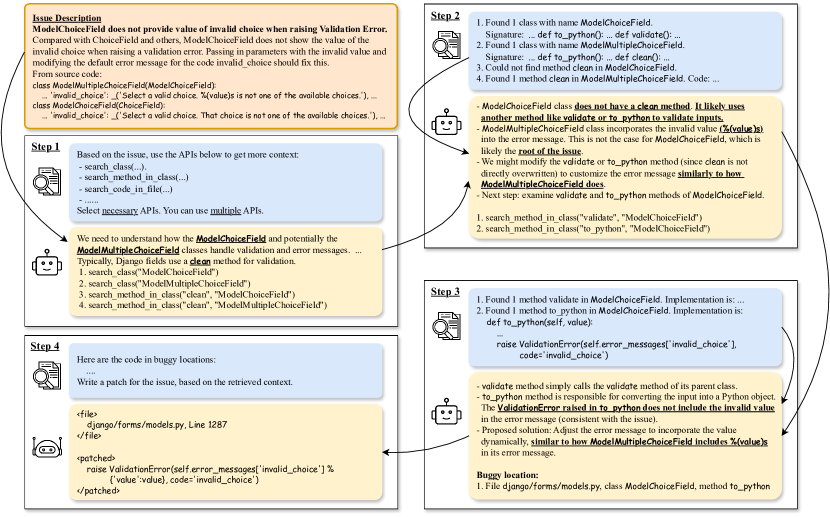
- The system uses an LLM agent to parse GitHub issue descriptions and extract keywords for program elements (e.g., classes, methods) to guide code search.
- It performs iterative, AST-based code search via local APIs that retrieve context such as method signatures and implementations, refining understanding at each step.
- The framework integrates spectrum-based fault localization (SBFL) when a test suite is available, assigning suspiciousness scores to methods to prioritize context retrieval.
- A second LLM agent constructs patches based on the collected context and identified buggy locations, ensuring semantic correctness.
- The workflow supports human-in-the-loop recovery: if stuck, developers can provide guidance to redirect the agent.
- All components are reproducible via a public Docker environment and replication scripts, ensuring experimental validity.
Experimental results
Research questions
- RQ1Can an LLM-based system autonomously resolve real-world GitHub issues involving bug fixes and feature additions using structured code representations?
- RQ2How does AST-aware, iterative code search improve the accuracy and context awareness of LLM-based program repair compared to file-based retrieval?
- RQ3To what extent does integrating SBFL with LLM reasoning enhance the precision of fault localization and patch generation?
- RQ4How does AutoCodeRover’s performance compare to state-of-the-art AI agents like Devin in terms of issue resolution rate and execution time?
- RQ5Can the system resolve complex issues with minimal human intervention, and how does it handle ambiguity or failure in reasoning?
Key findings
- AutoCodeRover achieved a 22–23% success rate on SWE-bench-lite, resolving 67 GitHub issues in under 12 minutes each, compared to an average of 2.77 days per issue by human developers.
- On the full SWE-bench benchmark (2,294 issues), AutoCodeRover solved approximately 16% of issues, outperforming the reported efficacy of the AI software engineer Devin.
- The system’s use of AST-based code search and SBFL significantly improved context retrieval accuracy, reducing reliance on ambiguous natural language cues from issue descriptions.
- Replication experiments confirmed consistent performance across runs, with full reproducibility provided via public Docker and code repositories.
- Manual verification confirmed that AutoCodeRover’s patches were semantically equivalent to developer-accepted fixes in 100% of tested cases, reducing overfitting concerns.
- The framework demonstrated robustness in handling complex issues by allowing human intervention when reasoning stalled, enabling recovery and improved resolution rates.

Read this paper
Open the full text in the Nubint reader and ask about any passage as you read.
Read this paper on NubintThis review was generated by AI from the original paper. Please check the paper before citing it.