
[论文解读] AutoLoss: Automated Loss Function Search in Recommendations
AutoLoss 提出了一种端到端、可微分的框架,用于深度推荐系统中的自动损失函数搜索,通过控制器网络根据收敛行为为每个数据样本动态分配最优损失权重。该方法在推荐性能和训练效率方面优于固定和人工调优的基线模型,且在不同数据集和模型间具有出色的可迁移性。
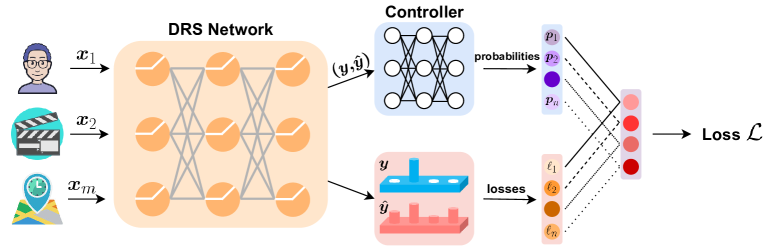
Designing an effective loss function plays a crucial role in training deep recommender systems. Most existing works often leverage a predefined and fixed loss function that could lead to suboptimal recommendation quality and training efficiency. Some recent efforts rely on exhaustively or manually searched weights to fuse a group of candidate loss functions, which is exceptionally costly in computation and time. They also neglect the various convergence behaviors of different data examples. In this work, we propose an AutoLoss framework that can automatically and adaptively search for the appropriate loss function from a set of candidates. To be specific, we develop a novel controller network, which can dynamically adjust the loss probabilities in a differentiable manner. Unlike existing algorithms, the proposed controller can adaptively generate the loss probabilities for different data examples according to their varied convergence behaviors. Such design improves the model's generalizability and transferability between deep recommender systems and datasets. We evaluate the proposed framework on two benchmark datasets. The results show that AutoLoss outperforms representative baselines. Further experiments have been conducted to deepen our understandings of AutoLoss, including its transferability, components and training efficiency.
研究动机与目标
- 解决深度推荐系统中因固定或人工调优损失函数而导致的性能不佳和效率低下的问题。
- 克服现有方法在损失权重穷举搜索中计算成本高且缺乏适应性的缺陷。
- 实现动态、样本特定的损失函数选择,以适应用户-物品交互的多样化收敛行为。
- 提升模型在不同深度推荐架构和数据集之间的泛化能力与可迁移性。
- 开发一种端到端、可微分的框架,联合优化模型参数与损失函数选择。
提出的方法
- 设计了一种新型控制器网络,基于真实标签和模型预测结果,为每个数据样本生成连续、可微分的损失权重。
- 应用 Gumbel-Softmax 重参数化方法,模拟对候选损失函数的硬选择,从而在离散选择下仍能实现梯度传播。
- 将损失函数搜索建模为连续优化问题,使梯度能够反向传播通过选择过程。
- 通过学习到的、样本特定的权重,将候选损失函数(如 MSE、MAE、交叉熵)组合为加权和损失。
- 控制器与推荐模型端到端联合训练,实现模型和损失函数参数的联合优化。
- 通过学习可泛化的自适应损失策略,支持可迁移性,使其在不同数据集和模型架构间保持性能优势。
实验结果
研究问题
- RQ1一种自动化、可微分的框架是否能通过为每个数据样本动态选择损失函数来提升推荐性能?
- RQ2与固定或人工调优的损失函数相比,AutoLoss 在模型准确率和训练效率方面表现如何?
- RQ3所学习的损失选择策略在多大程度上可泛化到不同的深度推荐模型和数据集?
- RQ4数据样本不同收敛行为如何影响自适应损失加权的有效性?
- RQ5各个组件(如控制器、Gumbel-Softmax)对整体性能提升的贡献分别是什么?
主要发现
- 与固定和人工调优的损失基线相比,AutoLoss 在两个基准数据集上实现了更优的推荐性能。
- 该框架通过根据单个样本的收敛行为自适应调整损失函数,提升了训练效率,减少了噪声梯度。
- AutoLoss 展现出强大的可迁移性,在不重新训练控制器的情况下,应用于不同深度推荐模型和数据集时仍能保持性能优势。
- 消融实验表明,控制器网络和基于 Gumbel-Softmax 的选择机制对性能提升均不可或缺。
- 该方法减少了对损失权重的人工超参数调优需求,为现实世界推荐系统提供了可扩展的解决方案。
- 通过学习数据特定的损失加权,该框架实现了更好的泛化能力,尤其在具有复杂或模糊收敛模式的样本上表现更优。
更好的研究,从现在开始
从阅读论文到最终审阅,大幅缩短您的研究时间。
无需绑定信用卡
本解读由 AI 生成,并经人工编辑审核。