
[Paper Review] AUTOLYCUS: Exploiting Explainable AI (XAI) for Model Extraction Attacks against Interpretable Models
AUTOLYCUS is a novel model extraction attack that leverages LIME explanations to significantly reduce query cost when stealing white-box machine learning models like decision trees and logistic regression. By using explanations to generate adaptive, boundary-aware queries, the attack achieves comparable surrogate model accuracy to state-of-the-art methods with up to 60× fewer queries.
Explainable Artificial Intelligence (XAI) aims to uncover the decision-making processes of AI models. However, the data used for such explanations can pose security and privacy risks. Existing literature identifies attacks on machine learning models, including membership inference, model inversion, and model extraction attacks. These attacks target either the model or the training data, depending on the settings and parties involved. XAI tools can increase the vulnerability of model extraction attacks, which is a concern when model owners prefer black-box access, thereby keeping model parameters and architecture private. To exploit this risk, we propose AUTOLYCUS, a novel retraining (learning) based model extraction attack framework against interpretable models under black-box settings. As XAI tools, we exploit Local Interpretable Model-Agnostic Explanations (LIME) and Shapley values (SHAP) to infer decision boundaries and create surrogate models that replicate the functionality of the target model. LIME and SHAP are mainly chosen for their realistic yet information-rich explanations, coupled with their extensive adoption, simplicity, and usability. We evaluate AUTOLYCUS on six machine learning datasets, measuring the accuracy and similarity of the surrogate model to the target model. The results show that AUTOLYCUS is highly effective, requiring significantly fewer queries compared to state-of-the-art attacks, while maintaining comparable accuracy and similarity. We validate its performance and transferability on multiple interpretable ML models, including decision trees, logistic regression, naive bayes, and k-nearest neighbor. Additionally, we show the resilience of AUTOLYCUS against proposed countermeasures.
Motivation & Objective
- To investigate whether explainable AI (XAI) tools like LIME can be exploited to facilitate model extraction attacks.
- To develop a query-efficient model extraction method that leverages LIME explanations to target white-box models in black-box settings.
- To evaluate the effectiveness of AUTOLYCUS in reconstructing surrogate models that are highly similar to target models with minimal query budgets.
- To assess the efficacy of existing countermeasures—such as noise injection in explanations or training data—against the proposed attack.
- To explore the broader implications of XAI tools increasing model extraction risks in commercial machine learning services.
Proposed method
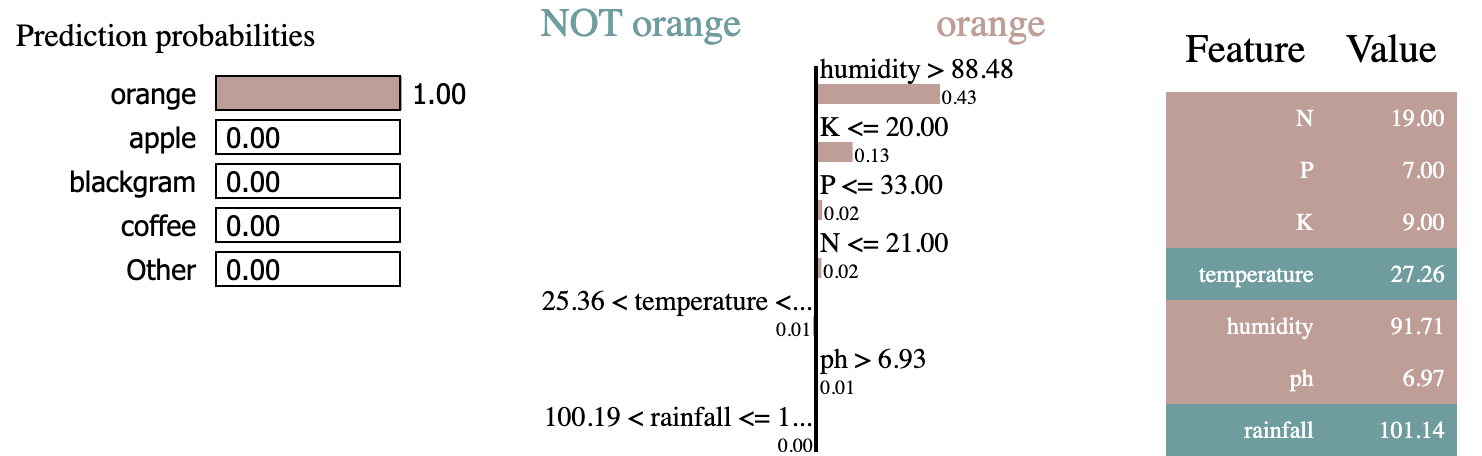
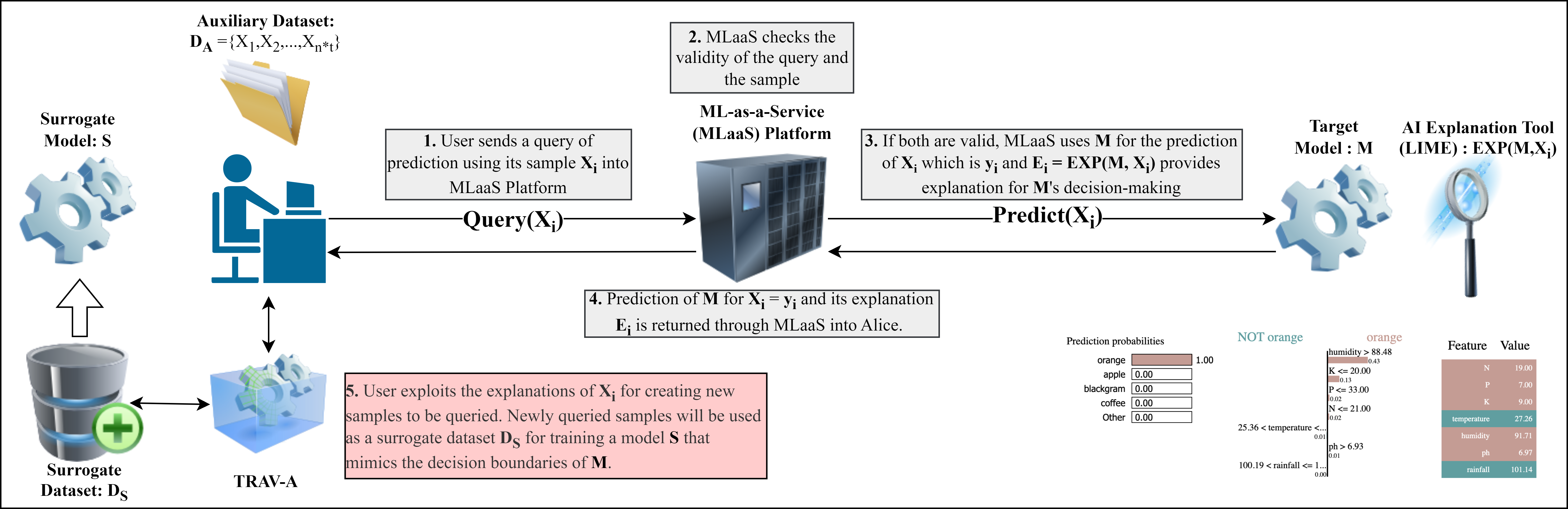
- AUTOLYCUS generates adaptive queries by analyzing LIME explanations from previous queries to target the decision boundaries of the model.
- It uses the local surrogate model generated by LIME to infer feature importance and directionality, enabling the creation of informative, boundary-proximate data samples.
- The attack iteratively queries the target model with these adaptive samples, retraining a surrogate model at each step to improve fidelity to the target.
- The method relies on LIME’s model-agnostic nature and interpretability to reconstruct decision boundaries without access to model parameters.
- It applies a line-search-like strategy to explore regions near the decision boundary, guided by LIME’s explanation output.
- The approach transforms LIME’s local explanations into actionable query generation heuristics, reducing reliance on random or blind queries.
Experimental results
Research questions
- RQ1Can LIME explanations be exploited to reduce the number of queries required for successful model extraction?
- RQ2How effective is AUTOLYCUS in reconstructing surrogate models that are both accurate and structurally similar to white-box models?
- RQ3To what extent do existing countermeasures, such as noise injection in explanations or training data, remain effective against XAI-powered model extraction attacks?
- RQ4How does the performance of AUTOLYCUS vary across different tabular datasets and model types, such as decision trees and logistic regression?
- RQ5What are the limitations of AUTOLYCUS in complex models or non-tabular data, such as images, where LIME explanations are less informative per feature?
Key findings
- AUTOLYCUS reduces the query budget by up to 60× compared to the state-of-the-art attack while achieving comparable surrogate model accuracy and similarity to the target model.
- The attack achieves high surrogate model accuracy on five benchmark datasets, demonstrating robustness across diverse tabular data distributions.
- The use of LIME explanations enables the generation of highly informative queries that efficiently probe decision boundaries, significantly outperforming blind query strategies.
- Countermeasures such as adding noise to LIME explanations or training data were empirically shown to be ineffective against AUTOLYCUS, indicating a critical gap in current defense mechanisms.
- The attack is less effective on image classification tasks due to the nature of LIME explanations, which treat groups of pixels as units rather than individual features, limiting per-feature interpretability.
- The method’s performance is constrained in complex models with many influential features, where some branches or decision paths may not be adequately captured due to limited auxiliary data and probabilistic reconstruction.
Read this paper
Open the full text in the Nubint reader and ask about any passage as you read.
Read this paper on NubintThis review was generated by AI from the original paper. Please check the paper before citing it.