
[Paper Review] Automated Cyber Defence: A Review
This paper defines Automated Cyber Defence (ACD), surveys literature on automated blue/red agents and ACO Gyms, and proposes a requirement analysis to guide real-world deployment and future research.
Within recent times, cybercriminals have curated a variety of organised and resolute cyber attacks within a range of cyber systems, leading to consequential ramifications to private and governmental institutions. Current security-based automation and orchestrations focus on automating fixed purpose and hard-coded solutions, which are easily surpassed by modern-day cyber attacks. Research within Automated Cyber Defence will allow the development and enabling intelligence response by autonomously defending networked systems through sequential decision-making agents. This article comprehensively elaborates the developments within Automated Cyber Defence through a requirement analysis divided into two sub-areas, namely, automated defence and attack agents and Autonomous Cyber Operation (ACO) Gyms. The requirement analysis allows the comparison of automated agents and highlights the importance of ACO Gyms for their continual development. The requirement analysis is also used to critique ACO Gyms with an overall aim to develop them for deploying automated agents within real-world networked systems. Relevant future challenges were addressed from the overall analysis to accelerate development within the area of Automated Cyber Defence.
Motivation & Objective
- Define Automated Cyber Defence (ACD) and distinguish it from related terms.
- Develop a requirement analysis for automated blue/red agents and ACO Gyms.
- Survey and critique existing ACD publications against the requirement framework.
- Identify gaps, challenges, and future research directions in ACD.
Proposed method
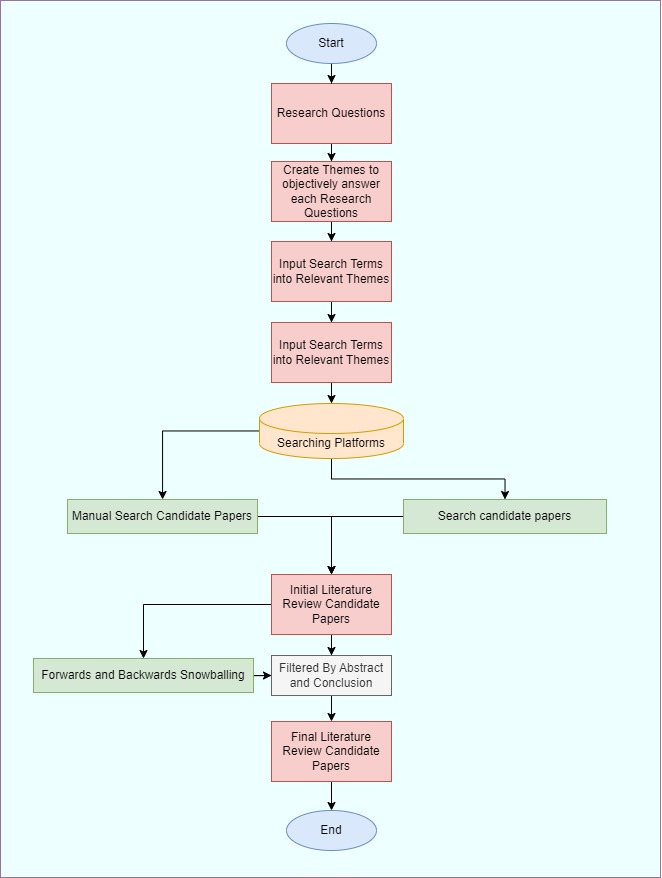
- Literature review following a Kitchenham-inspired methodology.
- Backward snowballing and manual search to identify ACD publications and implementations.
- Definition of ACD, automated blue/red agents, and ACO Gyms from existing sources.
- Development of a structured requirement analysis (G and A categories) for ACD components.
- Evaluation of existing works against the requirement analysis to identify gaps.
- Discussion of challenges, national strategies, and ethical considerations for deployment.
Experimental results
Research questions
- RQ1RQ1: What is Automated Cyber Defence (ACD) and how is it differentiated from related terms?
- RQ2RQ2: What algorithmic approaches are used within Automated Blue/Red Teaming and ACD?
- RQ3RQ3: What environments or terrains (ACO Gyms) are best suited for developing and testing ACD systems?
- RQ4RQ4: What are the key requirements and gaps hindering real-world deployment of ACD?
- RQ5RQ5: What challenges and future directions emerge from the literature review?
Key findings
- ACD is defined as automated decision-making for cyber defense focusing on blue/red agents and ACO Gyms.
- Most automated blue-teaming works use sequential decision-making within MDPPOMDP-like formulations, but real-world generalisation and explainability remain limited.
- A substantial portion of evaluated works rely on simulated networks; few achieve real-world generalisation (A.1.3) or long-horizon planning (A.2.3).
- DRL and related sequential approaches show promise for long-term actions and generalisation, while explainability and resilience against adversarial and algorithmic attacks remain under-addressed.
- Table 3 (AICA-based requirements) and Table 4 (blue-team publications) highlight gaps in generalisability, explainability, and adversarial training; few works meet all recommended requirements (e.g., A.4.1, A.6.x).
- National strategy documents increasingly emphasize AI-enabled automated defense and the need for open, extensible ACO Gym ecosystems.
Read this paper
Open the full text in the Nubint reader and ask about any passage as you read.
Read this paper on NubintThis review was generated by AI from the original paper. Please check the paper before citing it.